This post is about clear client emails, not tax advice. Which forms a client needs, and what they mean for the return, is your firm's professional call.
What should a missing tax document email say?
A missing-document email should answer five questions before the client has to ask them:
- What exactly is missing? The form's name and who issues it.
- Where do I find it? The account, the website or the menu.
- What do you already have? So the client doesn't resend it or argue that they sent everything.
- What happens once it arrives? Your firm's own turnaround, in steps.
- How do I send it? Your secure portal.
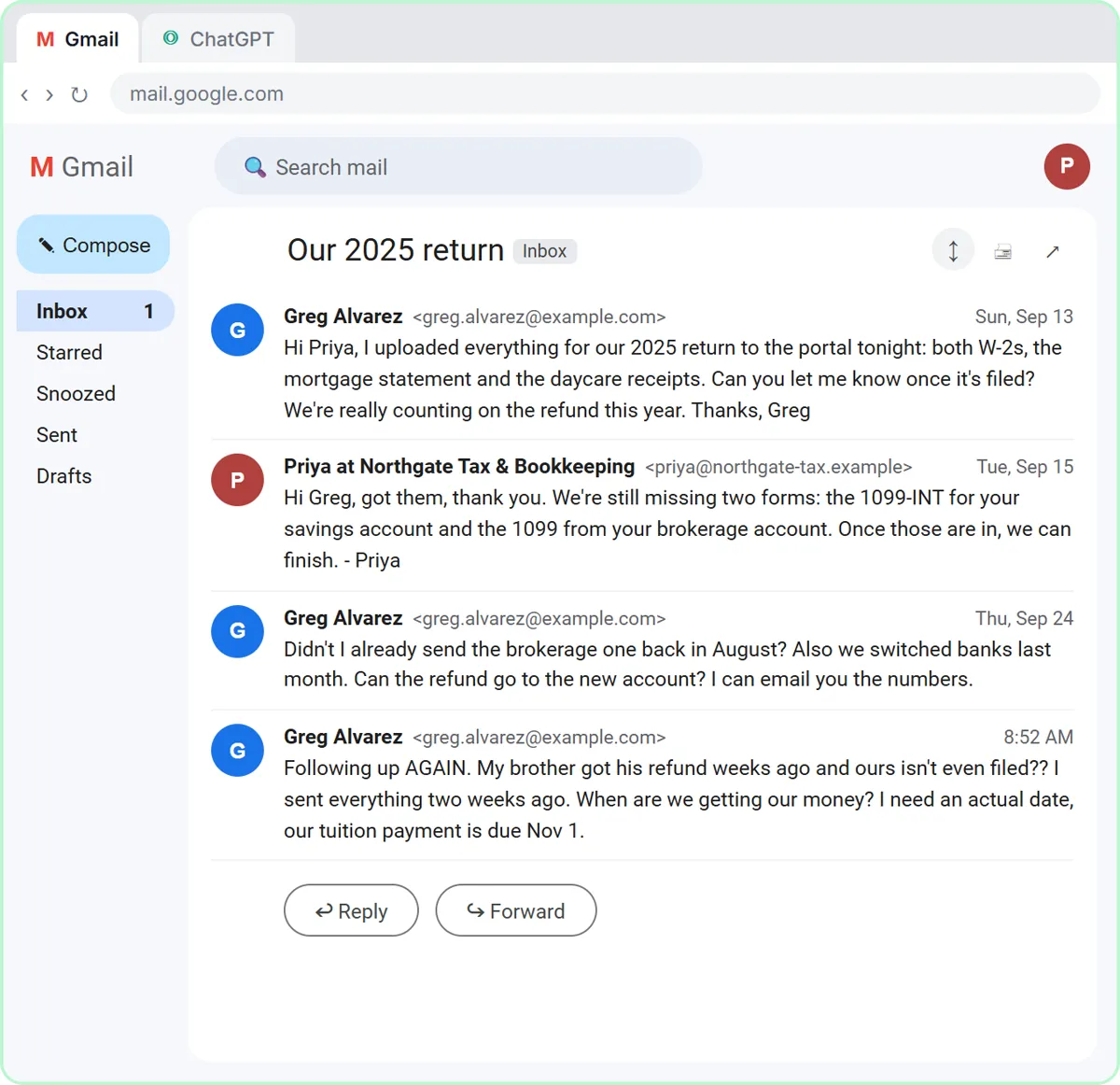
Most back-and-forth on missing documents comes from leaving one of those out. The client in the lesson thread asks "Didn't I already send the brokerage one back in August?" because nobody told him what he'd actually sent.
How do you name the right tax form?
Name the form, the account it comes from and where it lives, and say what it isn't if the client has already sent something that looks similar.
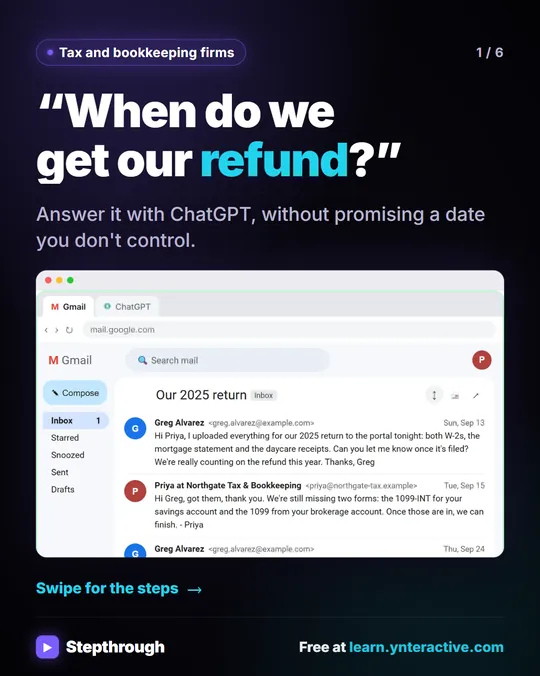
In the lesson, Northgate Tax & Bookkeeping, a made-up firm, is missing two forms for clients Greg and Lena:
- The 1099-INT for their savings account at Harborview Credit Union.
- The consolidated 1099 from their brokerage account.
The firm's facts add the detail that ends the confusion: what Greg sent in August was a quarterly brokerage statement, not the tax form, and the consolidated 1099 is under Tax Documents when he logs in to his brokerage account. The final reply says exactly that in two sentences.
That's the pattern to copy: "a statement isn't the tax form" plus "here's where the tax form is." Exact menu names vary by brokerage and bank, so only name a location you've confirmed or one the client has used before.
Why list the documents you already have?
Listing what you've received shows the client you've done your part and stops them from resending everything. It also makes the missing items stand out.
The lesson's facts list it plainly: both W-2s (Greg's and Lena's), the mortgage statement (Form 1098) and the daycare receipts, all received Sep 13. The final reply opens with that list, then the two missing forms as bullets. A client scanning on a phone sees "you have these, you need these" in a few seconds.
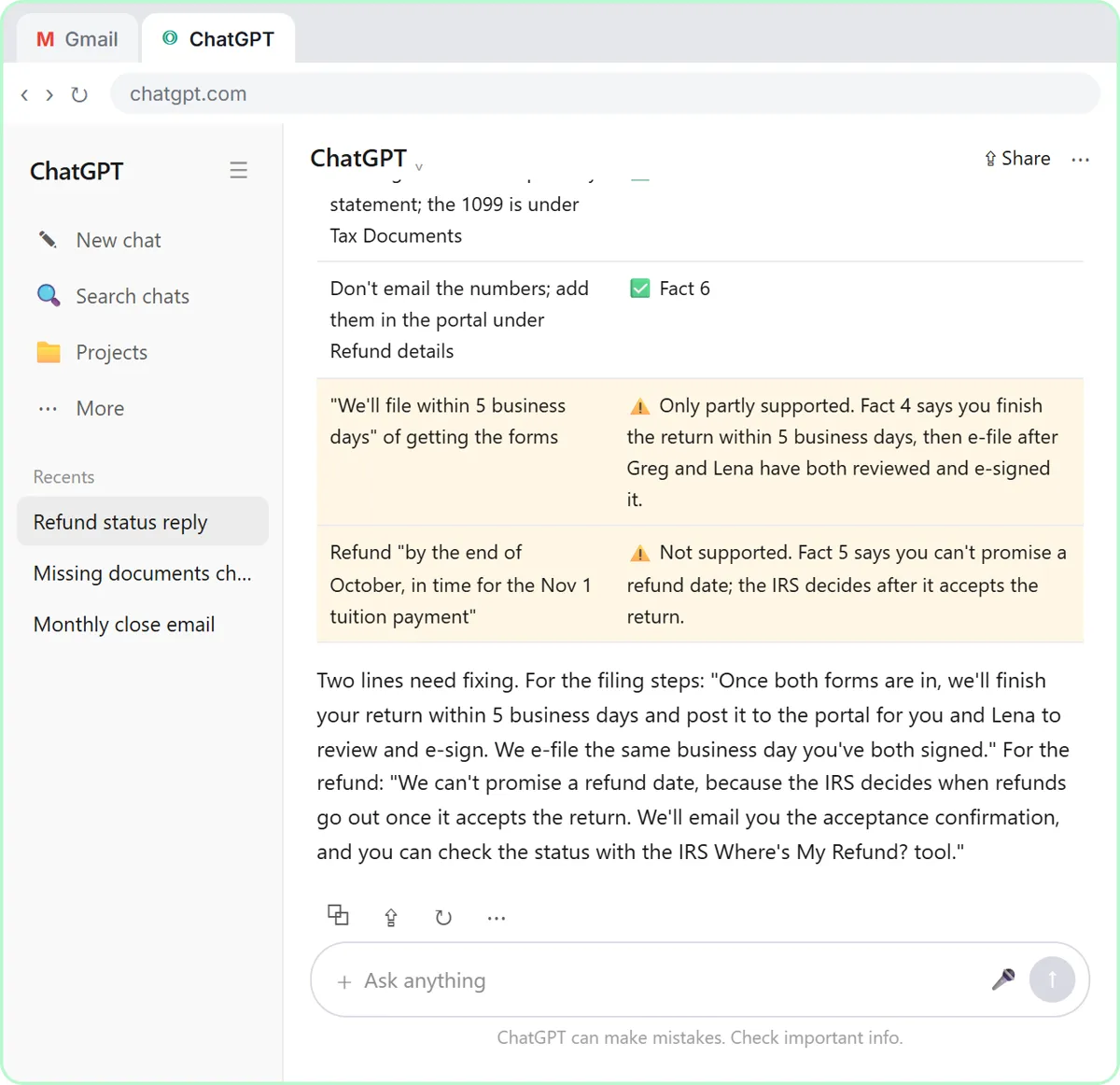
What timing can you promise in the email?
Promise only your firm's own steps, not the government's. In the lesson, the firm's policy reads:
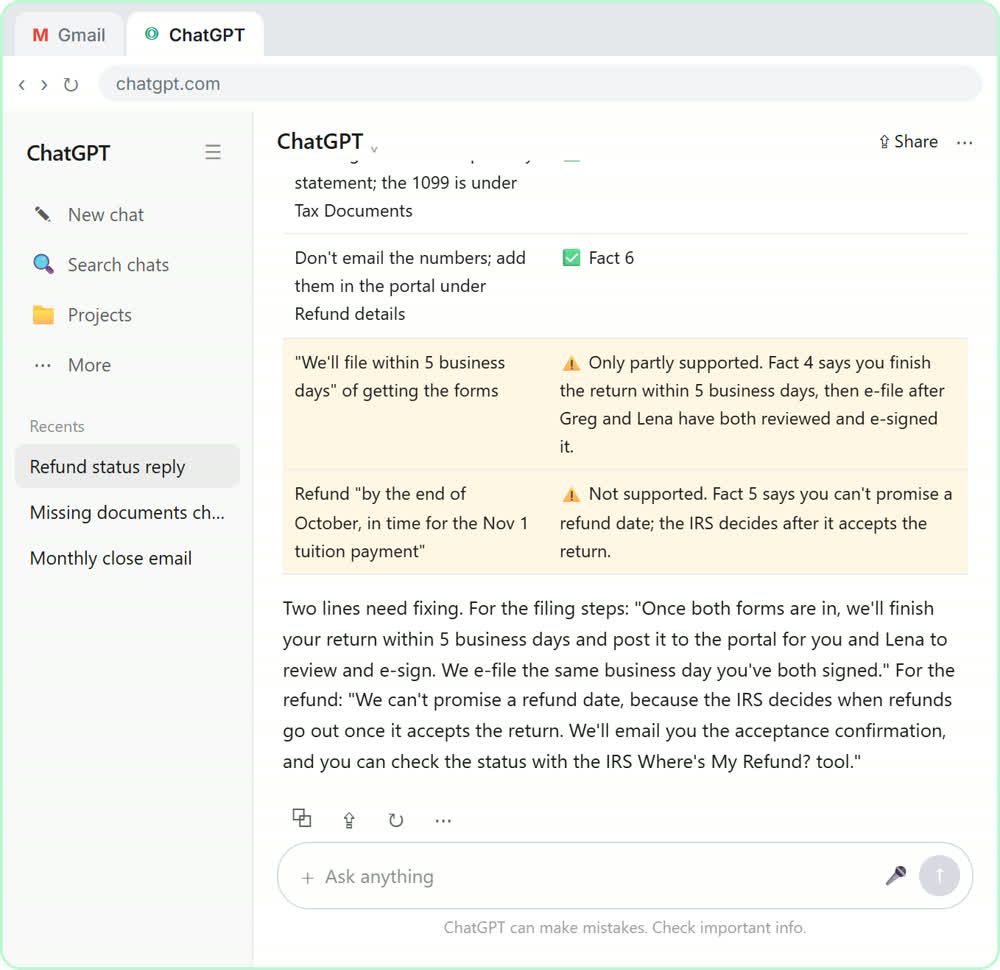
- Once the firm has every document, it finishes the return within 5 business days.
- It posts the return to the portal for both spouses to review and e-sign.
- It e-files the same business day both have signed.
The firm can't promise a refund date, because once the IRS accepts the return, the IRS decides when the refund is issued. The firm emails the acceptance confirmation and points clients to the IRS "Where's My Refund?" tool. ChatGPT for Accountants shows how the lesson's promise check catches a draft that promised a refund date anyway.
If your firm doesn't have a written turnaround, write one before tax season. It turns "when will it be done?" into a sentence you can paste every time.
How should clients send documents and bank details?
Through your secure client portal, never by email. Say so in the email itself, and say where in the portal.
Greg wants to email his new bank account numbers for the refund. The firm's rule: "never send account numbers by email. Add the routing and account numbers in the portal under Refund details." He'll see them on the return before he signs. The same goes for tax forms: point clients to the upload spot, not to a reply.
How can ChatGPT write a missing-document email?
Give ChatGPT a numbered facts list and clear instructions, the same way the lesson writes a reply. For a first request rather than a reply, a prompt like this works:
Write a short email to a client asking for missing tax documents.

Facts (only use what is here):
1. We have: [documents received, with dates].
2. Still missing: [form name] from [account or issuer]. It is usually found under [location you've confirmed].
3. [Anything they sent that isn't the tax form, and why.]
4. Our policy: once we have every document, we finish within [your turnaround] and post it to the portal to review and sign.
5. Upload documents in the portal under [section]. Never email account numbers.
6. Sign it: [name, firm].

Tone: calm, warm and professional. List received and missing items as bullets. Under 150 words. Don't promise a refund date or give tax advice.
Then check the draft against your facts before you send it, and read it yourself. Leave Social Security numbers, account numbers and anything else the email doesn't need out of the chat, use a business ChatGPT account that doesn't train on your data, and follow your firm's policy on client information.
Try it free, step by step
Answer Refund-Date Emails Without Overpromising using ChatGPT. A client wants a refund date while two tax forms are still missing. Give ChatGPT the thread and your firm's facts, catch the date it shouldn't promise, and send a calm, clear reply from Gmail. You do every step yourself in a practice copy of ChatGPT, it checks your work as you go, and “Do it for me” finishes any step you get stuck on. Free, and nothing touches your real accounts.
Start the free lessonWhich documents can you request before tax season starts?
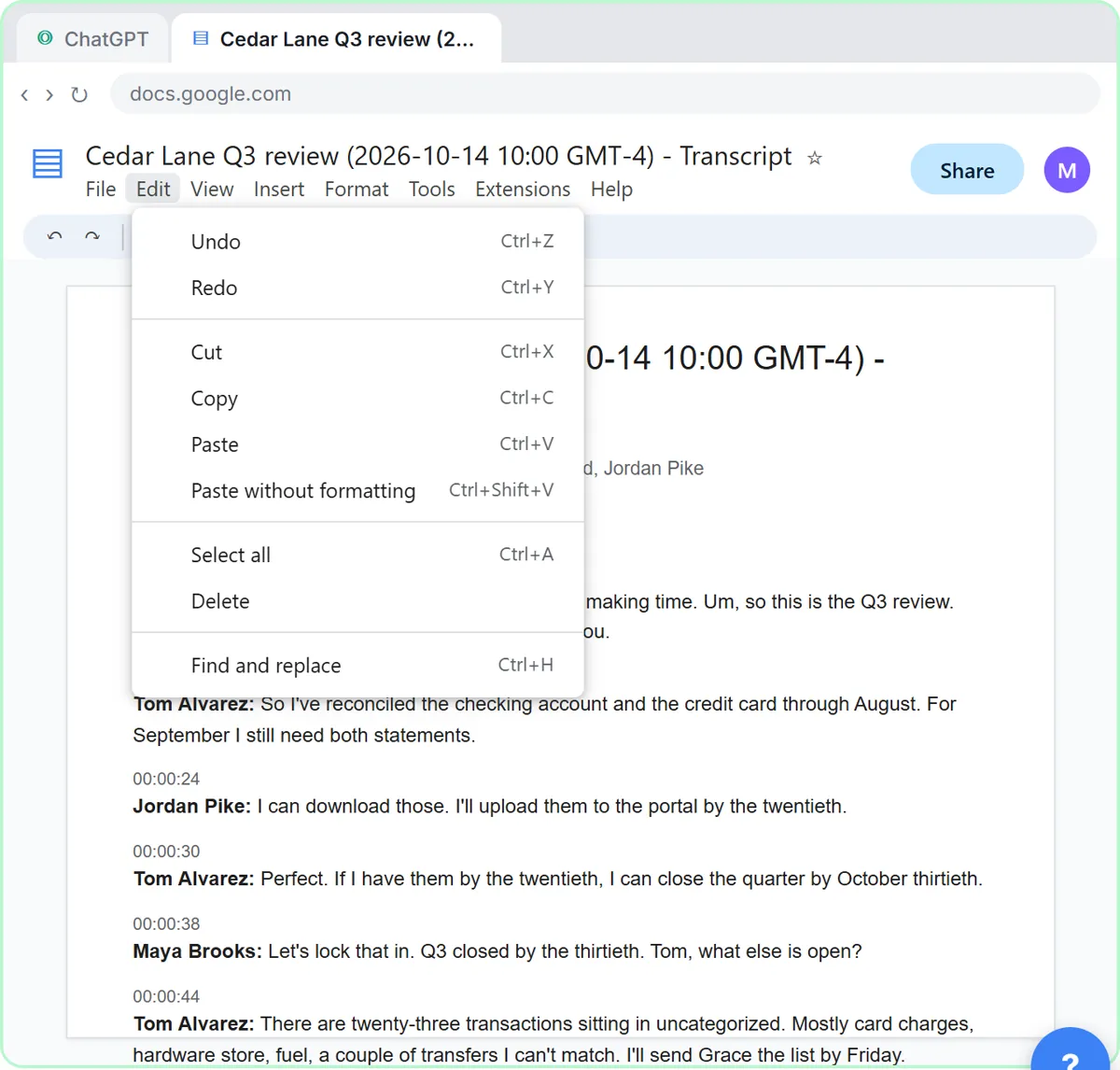
Anything you already know you'll need, especially forms from third parties. The Summarize a Client Meeting lesson shows a firm doing this during a Q3 review with a made-up landscaping client, Cedar Lane Landscaping:
- W-9s: three subcontractors still have no W-9 on file. The firm remembers chasing them for weeks last January, so the client agrees to collect all three by the end of October.
- Statements: September bank and credit card statements, uploaded to the portal by the 20th, so the quarter can close by October 30.
- Purchase paperwork: the purchase agreement and loan paperwork for a new truck.
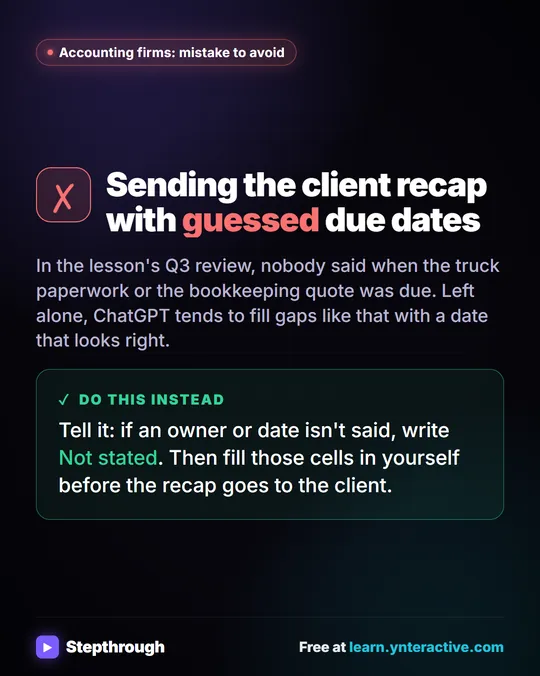
ChatGPT turns the meeting transcript into an action items table with an owner and a due date for each request, writing "Not stated" where nobody said a date. You fill in the gaps, then ask for a follow-up email to the client. That recap becomes your first document request, sent while everyone still remembers the meeting. The full routine is in Turn a Meeting Transcript into Action Items with ChatGPT.
What should a document request never include?
Leave out anything that creates a promise or a risk:
- No refund dates or estimates of what the client will get back.
- No tax advice in a reminder email.
- No requests to email account numbers, Social Security numbers or full forms.
- No guilt. A firm that missed an email says so once ("Your Sep 24 email slipped past us, and that's on us") and moves on.
Both lessons are free, run in a practice copy and work with any ChatGPT plan to start; business plans add more for firms. More lessons for firms are on the accounting and bookkeeping hub.
Key takeaways
- A missing tax document email should name the exact form, where to find it, what you already have, your timing and how to upload.
- When a client sends a statement instead of the tax form, say so and say where the tax form is, as the lesson does with the consolidated 1099.
- Promise only your firm's own turnaround, such as finishing within 5 business days of getting every document, never a refund date.
- Tell clients to upload documents and bank details through the secure portal, never by email.
- Request third-party forms like W-9s before tax season, and turn client meetings into a dated list of who sends what.
Frequently asked questions
- How do I ask a client for a missing 1099?
Name the specific 1099 and the account it comes from, say where it's usually found, list what you already have, and point to the portal for the upload.
- Can I tell clients when their refund will arrive?
No. Once the IRS accepts the return, the IRS decides when refunds are issued. Promise your firm's own steps and point clients to the IRS "Where's My Refund?" tool.
- Can ChatGPT write document request emails?
Yes, if you give it a numbered facts list and clear instructions. Check every claim against your facts and keep private numbers out of the chat.
- Is this tax advice?
No. This post is about writing clear client emails. Which documents a return needs is your firm's professional judgment.
- Are Northgate Tax & Bookkeeping and Cedar Lane Landscaping real?
No. Both firms and their clients are made-up examples used in the lessons.