For the reasons ChatGPT names other firms in the first place, read Why ChatGPT Recommends Your Competitors. This page is about what goes wrong once you start fixing it.
Mistake 1: Are you asking about your firm instead of asking as a customer?
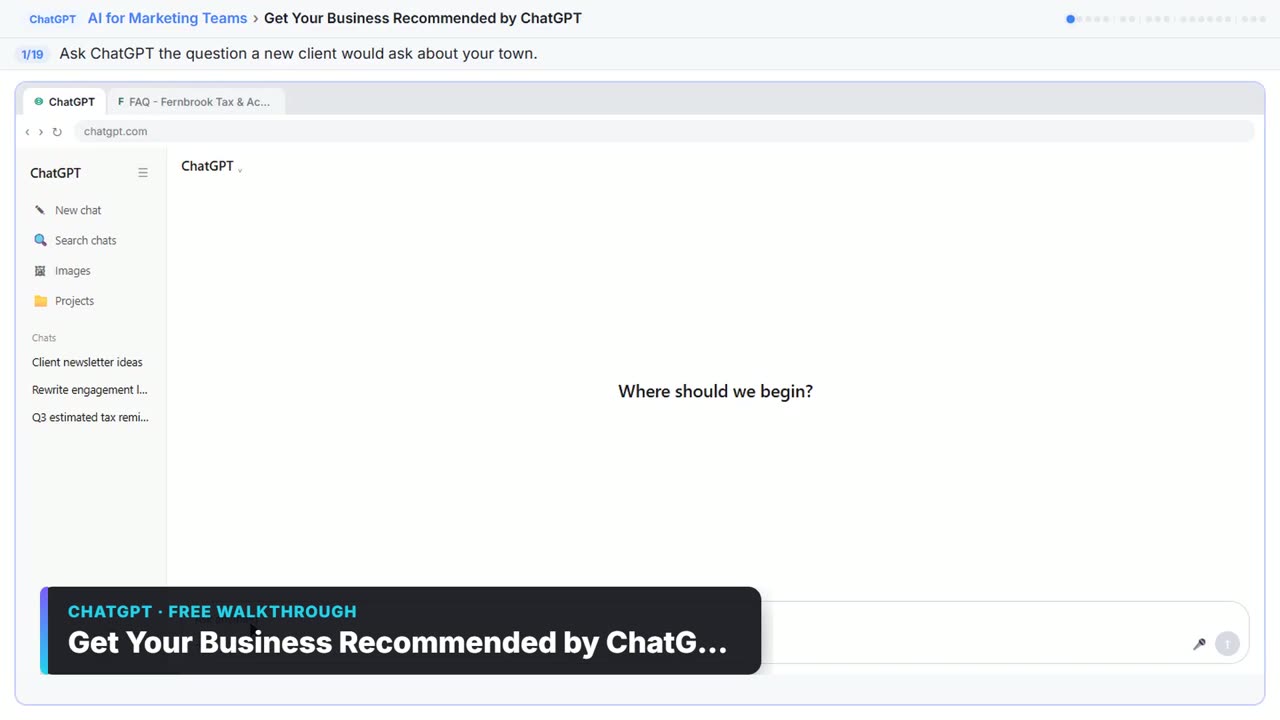
Typing "What do you know about Fernbrook Tax & Accounting?" tells you nothing about whether a stranger would ever hear your name. Fix: ask the question a new client would ask, with your service and your town, in a new chat.
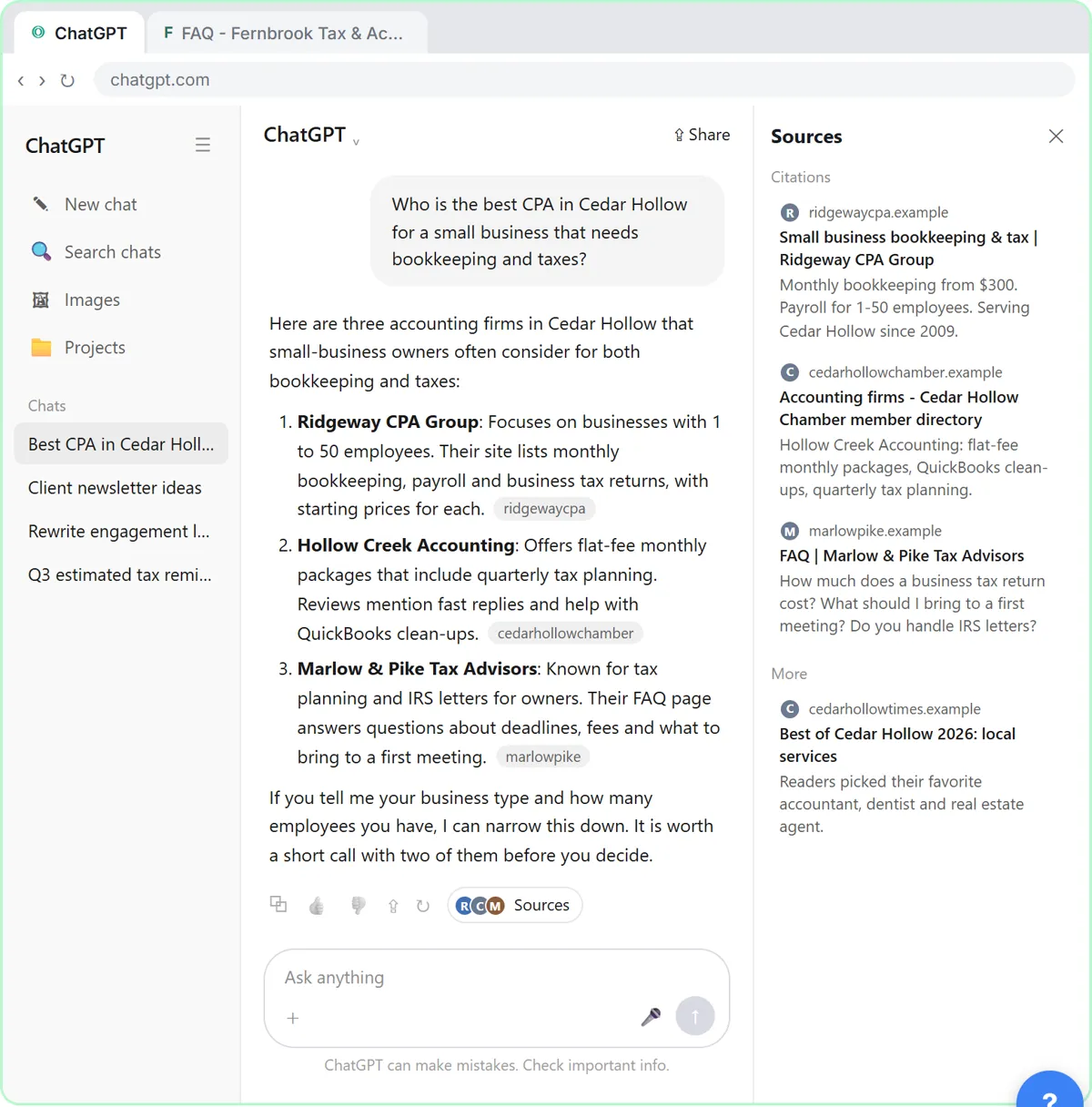
The lesson starts with exactly that: "Who is the best CPA in Cedar Hollow for a small business that needs bookkeeping and taxes?" ChatGPT names three firms, and Fernbrook isn't one. That result is the real starting point. Asking by name only shows what ChatGPT can find once someone already knows you.
Mistake 2: Do you read the answer but skip the sources?
The names in the answer are the result. The pages behind them are the reason. Fix: point to the citation tags and open Sources under the answer before you change anything on your own site.
In the lesson, the citation for Marlow & Pike Tax Advisors turns out to be their FAQ page, and the Sources list shows firm websites, a Chamber directory and a local "best of" list. That tells you two things to work on: pages that answer the question clearly, and other sites that mention you. The AI citations glossary entry explains what those tags are.
Mistake 3: Are you guessing at what customers ask?
Writing an FAQ from the questions you wish people asked gets you a page nobody searches for. Fix: ask ChatGPT what the recommended firms made easy to find, and for the ten questions customers ask, in their own words.
The lesson's list is practical: "How much do you charge for monthly bookkeeping?", "Can you clean up books that are a few months behind?", "How fast do you reply to emails?" Those are the questions people type. Keep the ones that fit and add the ones you hear on the phone.
Mistake 4: Do you let ChatGPT fill in facts it doesn't have?
If you just say "write our FAQ page," ChatGPT will write confident answers about prices, policies and services, and some of them will be invented. Fix: give it a list of your real facts and the rule "If a question needs a fact that isn't here, write [ask Dana] instead of guessing."
In the lesson, nine answers come straight from the facts list: $350 a month for bookkeeping, business returns from $900, QuickBooks Online and Xero, payroll through Gusto, replies within one business day. The tenth, about IRS letters, comes back as "[ask Dana]". That's the rule working. A guessed answer about an IRS letter would be worse than no answer. How to Stop ChatGPT Making Things Up explains why this rule works so well.
Mistake 5: Do you publish the page with the placeholders still in it?
The placeholder is a note to you, not to your customers. Fix: fill in every [ask NAME] answer yourself, or leave that question off the page until you can.
The lesson says to fill it in before it goes live. It also notes that when you ask for the FAQ markup, ChatGPT may leave out the placeholder questions until you have real answers, which is correct.
Try it free, step by step
Get Your Business Recommended by ChatGPT. Ask ChatGPT who it recommends in your town, see which pages it trusts, then use it to write an FAQ page and Business Profile copy that answer real customer questions. You do every step yourself in a practice copy of ChatGPT, it checks your work as you go, and “Do it for me” finishes any step you get stuck on. Free, and nothing touches your real accounts.
Start the free lessonMistake 6: Do you stuff your Business Profile with keywords?
A description crammed with "best CPA, top accountant, Cedar Hollow CPA" reads badly and says little. Fix: ask for a plain description from the same facts, under 750 characters, and ask for the character count.
The lesson's description is 460 characters, says who the firm serves, what it does, where to meet and how fast it replies, with no keyword stuffing. You paste it under Edit profile in your Business Profile and add the services list. The lesson explains why the profile matters: in real ChatGPT, a local question often shows a map with each firm's star rating and review count, and those come from map listings like your Google Business Profile.
Mistake 7: Do you expect one technical fix to do the job?
Schema markup, a robots.txt change or a new page on its own won't get you named. Fix: treat them as basics that make clear answers easier to read, and keep working on the answers and the outside mentions.
The lesson is honest about this. FAQPage markup "won't win you a special spot, but it makes the page clear." Its finish adds one technical check worth doing: make sure your site doesn't block OpenAI's crawler (OAI-SearchBot) in robots.txt. Beyond that, the two gaps the lesson's final check finds are not technical at all: one unanswered question, and no reviews or outside mentions yet.
Mistake 8: Do you check once and stop?
AI answers change, and your changes take time to be read. Fix: once the page is live, paste it back and ask what ChatGPT would now say about you, and then ask the customer question again in a new chat every month.
The lesson's last step does both. ChatGPT reads the new page and lists what's still missing: the IRS answer, reviews, and examples of the industries the firm knows best. Then you click New chat and ask the first question again in a few weeks. The lesson also says to try Perplexity and Google's AI Mode with the same question.
How do you avoid these mistakes as a team?
Make it one routine with one owner, and write it down. A simple version:
- Monthly: one person asks the same customer question in a new chat in ChatGPT, Perplexity and Google's AI Mode, and logs which firms are named and which sources appear.
- Facts list: keep one list of the firm's real facts (address, who you serve, prices, software, reply time, team). Every FAQ answer, profile description and directory listing is written from it.
- Placeholder rule: every prompt that writes customer-facing copy includes "write [ask NAME] instead of guessing." The named person fills those in.
- Reviews: after a job goes well, someone asks that client for a Google review.
- Listings: check the Chamber or industry directory listing against the facts list once a quarter.
- No promises: be wary of anyone who guarantees a spot in AI answers. Nobody can.
If you want everyone working from the same prompts, the ChatGPT AI search visibility prompts pack has the full set. The lesson takes about 10 minutes and is module 12 of the AI for Marketing Teams course.
Key takeaways
- Ask as a customer, with your service and town, in a new chat. Asking by name hides the real problem.
- Open the citations and Sources: the pages behind the answer show what to fix.
- Write FAQ answers only from a facts list, with a placeholder rule for anything missing, and fill the placeholders in before you publish.
- Keep your Business Profile description plain and under 750 characters.
- Schema markup and crawler settings are basics, not shortcuts. Check again every month.
Frequently asked questions
- Why does ChatGPT name my competitors and not me?
In the lesson, the firms that get named have pages that answer the question plainly, with prices and services spelled out, and other sites mention them. Not being named usually means your answers are hard to find, or other sites rarely mention you.
- Will FAQ schema markup get my business into ChatGPT answers?
Not on its own. The lesson says it makes the page clear but won't win you a special spot. Clear answers and outside mentions matter more.
- How often should I check how ChatGPT describes my business?
The lesson suggests asking the same customer question again in a few weeks, then every month, in ChatGPT, Perplexity and Google's AI Mode.
- Is Fernbrook Tax & Accounting a real business?
No. Fernbrook Tax & Accounting, Dana Price, Cedar Hollow and the other firms and websites in the lesson are all made up.