Updated . Built step by step in a real Runable account on 17 November 2026. Every screen in the practice is a real Runable screen, and every output is what Runable produced in that run. How we check this lesson
A deck with one invented number loses the room. In this free lesson Maya Chen (made up) needs a pitch deck by Friday to raise $40,000 for Harbor & Pine from local angels. You brief Runable's Slides tool with only her real numbers and a rule to write [NEEDS NUMBER] instead of guessing, answer its three questions, approve a 2-slide preview, and fill every gap it lists. It builds 10 slides with speaker notes, then warns that wholesale nets $0.50 a candle, and you fix slide 7 so the deck says it first. 42 credits in all.
At a glance
| Question | Answer |
|---|---|
| What you build | A business case for founders raising a small round: brief Runable's Slides tool with only your real numbers, answer its questions, approve a 2-slide preview, fill the gaps it lists, and fix the one number an investor will question. Real Runable screens, 17 November 2026. |
| Tools | Runable |
| Time | About 12 minutes, 23 steps in 6 parts |
| Level | Beginner, no coding needed |
| Cost | Free |
| Ways to learn it | Practice it step by step |
The 6 parts, in short
- A raise with no deck: Count what a deck costs, Brief an agent with your real numbers.
- Brief the Slides tool: Open Slides, Pick the investor template, Type your brief over the sample, Send it.
- Answer its questions: Let it read the brief, Pick a look that fits the brand, Skip what you do not have, Name the team.
- Fill the gaps it found: Look at the preview, not a full deck, Fill every gap it listed, Send and let it build.
- Read the warning, fix the slide: Open the deck, Read what it warns you about, Find the number an investor will question, Fix slide 7 only, and 3 more steps.
- What it saved, and what is next: Read what it cost, See what you have now, Up next.
Start here first: Know How Many Sales Pay the Bills Before You Order Stock using Runable (module 1 of Runable for Startups)
The business case: a deck by Friday, without a designer
A designer quotes about $1,500 and two weeks for a pitch deck; a template takes a weekend and invites typed-in numbers that do not match the spreadsheet. Maya has 90 days of real traction and a short deadline. These are example numbers; use your own.
What you do in the lesson
You pick Slides, Pitch Deck and the investor template, and type a brief with the raise, the market range, prices, profit per candle, the first 90 days and the use of funds, plus the ten slides you want. Runable asked three questions first: it noticed the dark-blue template did not fit a candle brand, asked for brand assets, and asked who else is on the team.
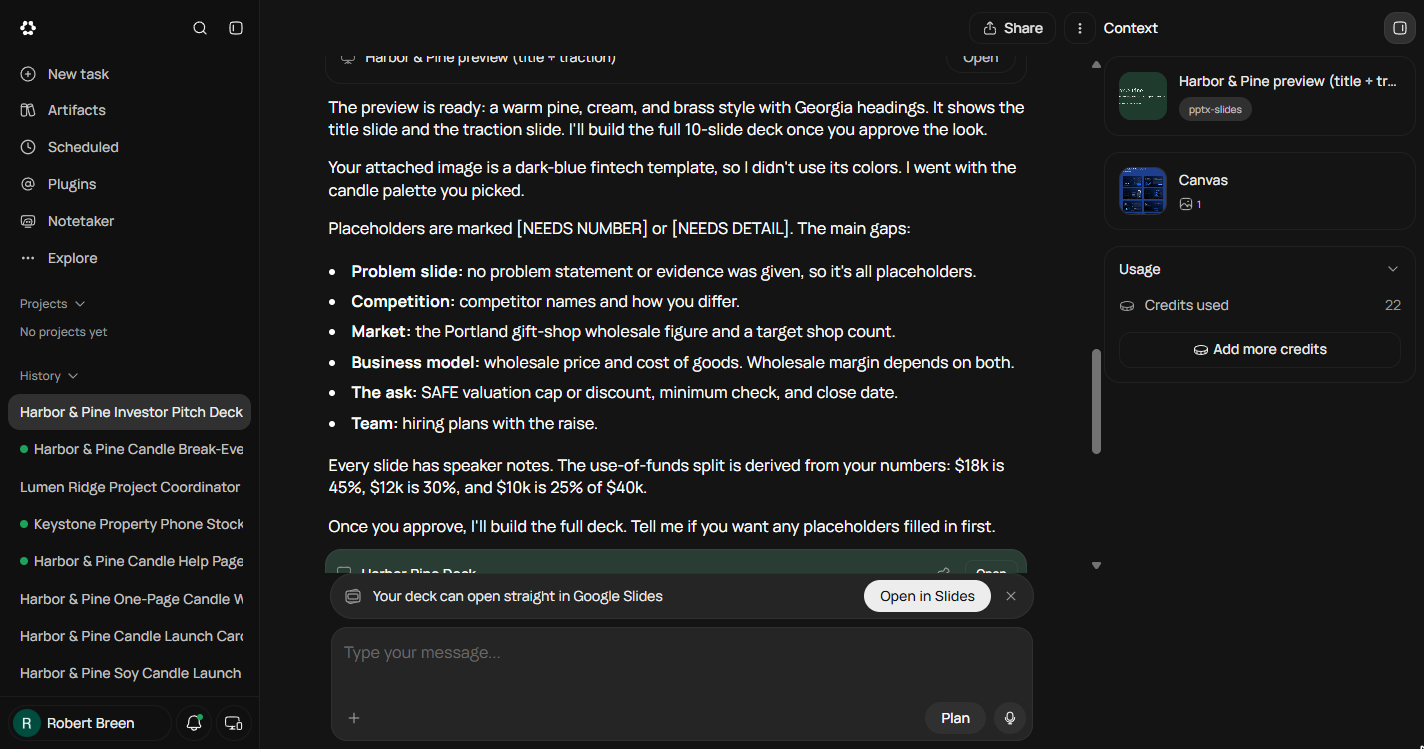
It then built only the title and traction slides and listed what it could not fill: the problem, competition, the local market, wholesale price and cost, and the SAFE terms. You answer each one and leave the local market size as [NEEDS NUMBER]. The full deck took about three minutes. Its reply warned that $16 wholesale against a $15.50 cost nets $0.50 a candle and that $15.04 profit implies a $16.36 cost. You check that both costs are right (online fees explain the gap) and change slide 7 to present wholesale as a 2-shop test until cost comes down.
What it does not do
It does not know your numbers or your investors. It cannot tell whether a valuation cap is fair, and this lesson is not investment advice. Read the speaker notes aloud and have someone you trust check the ask before you send it.
Links
- Runable: the AI agent this course teaches. Its Free plan showed 1,500 credits a day when we tested it in October 2026.
- Runable pricing: current plans, credits and limits. Check them before you rely on the Free plan.
Try it yourself, free
Reading the steps is a start. Doing them is how it sticks. The interactive module walks you through every click in a practice copy of Runable, checks each step, and never touches your real accounts.
Start “Build an Investor Pitch Deck From Your Real Numbers using Runable”Step by step: Build an Investor Pitch Deck From Your Real Numbers using Runable
All 23 steps of the interactive module, in order. In the module you watch each one, then do it yourself in a practice copy that checks your work.
1. A raise with no deck
- Count what a deck costs. Harbor & Pine (made up) wants $40,000 from local angels to start selling wholesale. Two investors asked for a deck by Friday. A designer quotes about $1,500 and two weeks. Click the deck row.
Forty thousand dollars to raise, a deck due Friday, and a designer who needs two weeks.
- Brief an agent with your real numbers. Runable's Slides tool builds the deck from a brief. The rule that matters: give it only your real numbers and tell it to write [NEEDS NUMBER] instead of inventing one. Click the Runable card.
Give it only your real numbers, and tell it not to invent any.
2. Brief the Slides tool
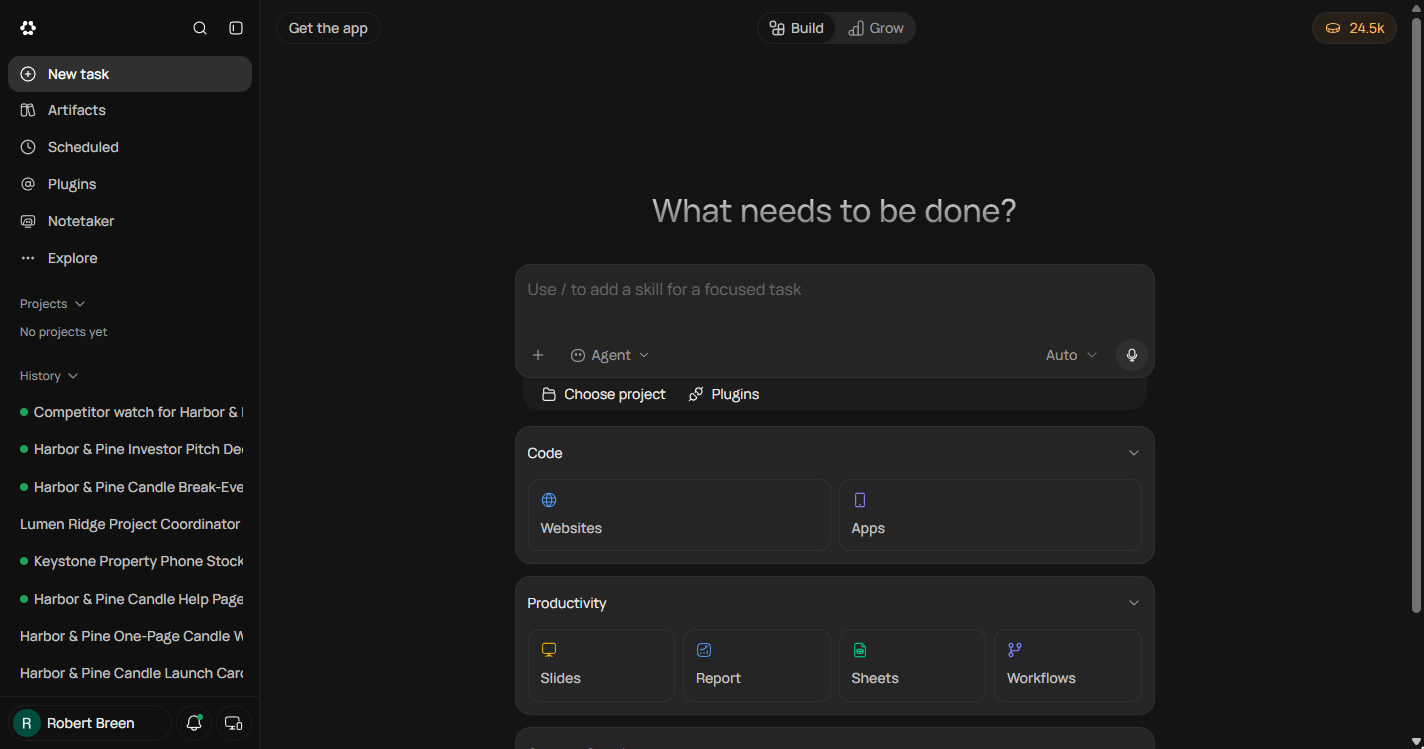
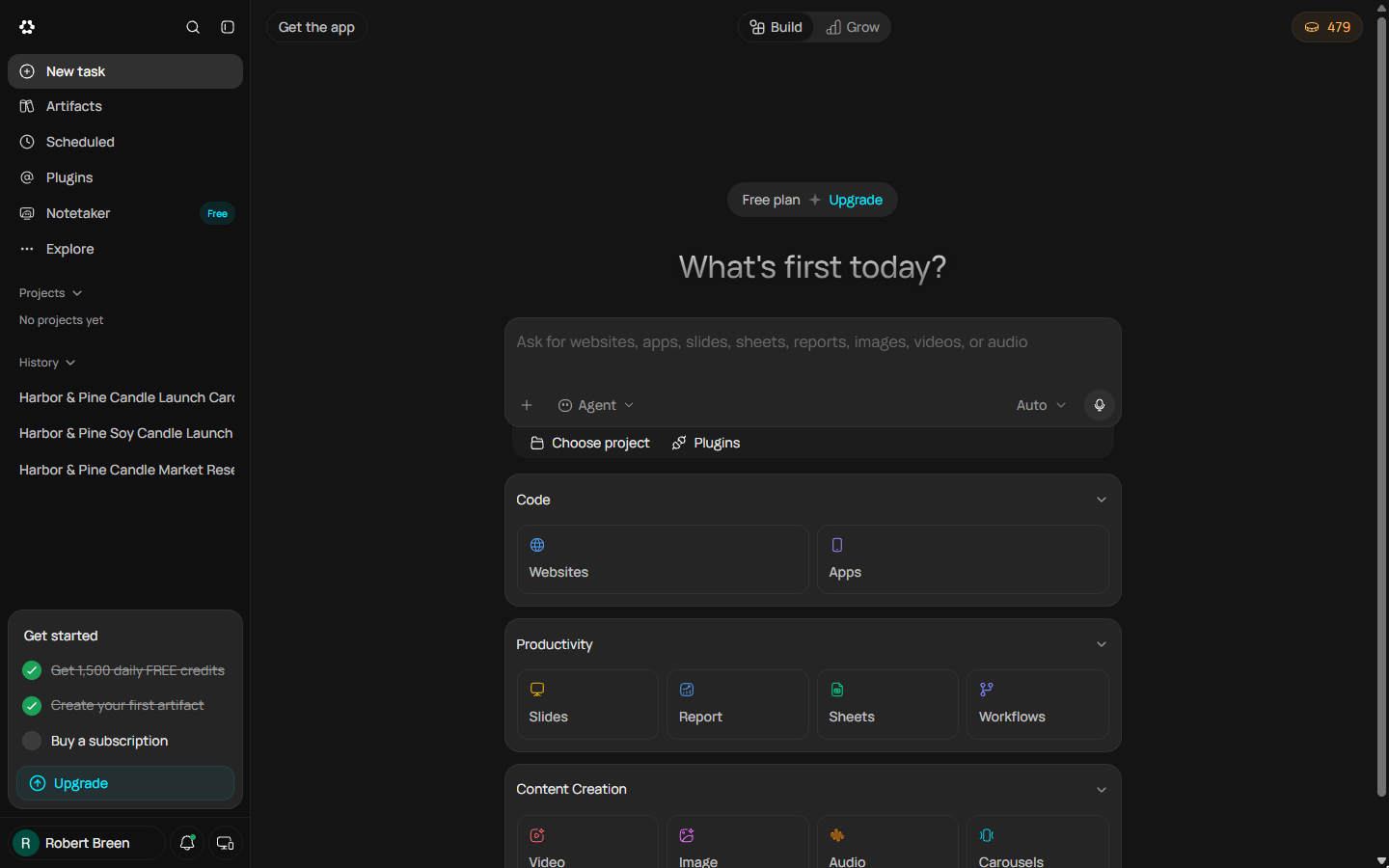
- Open Slides. On the home screen, under Productivity, click Slides.
Under Productivity, click Slides.
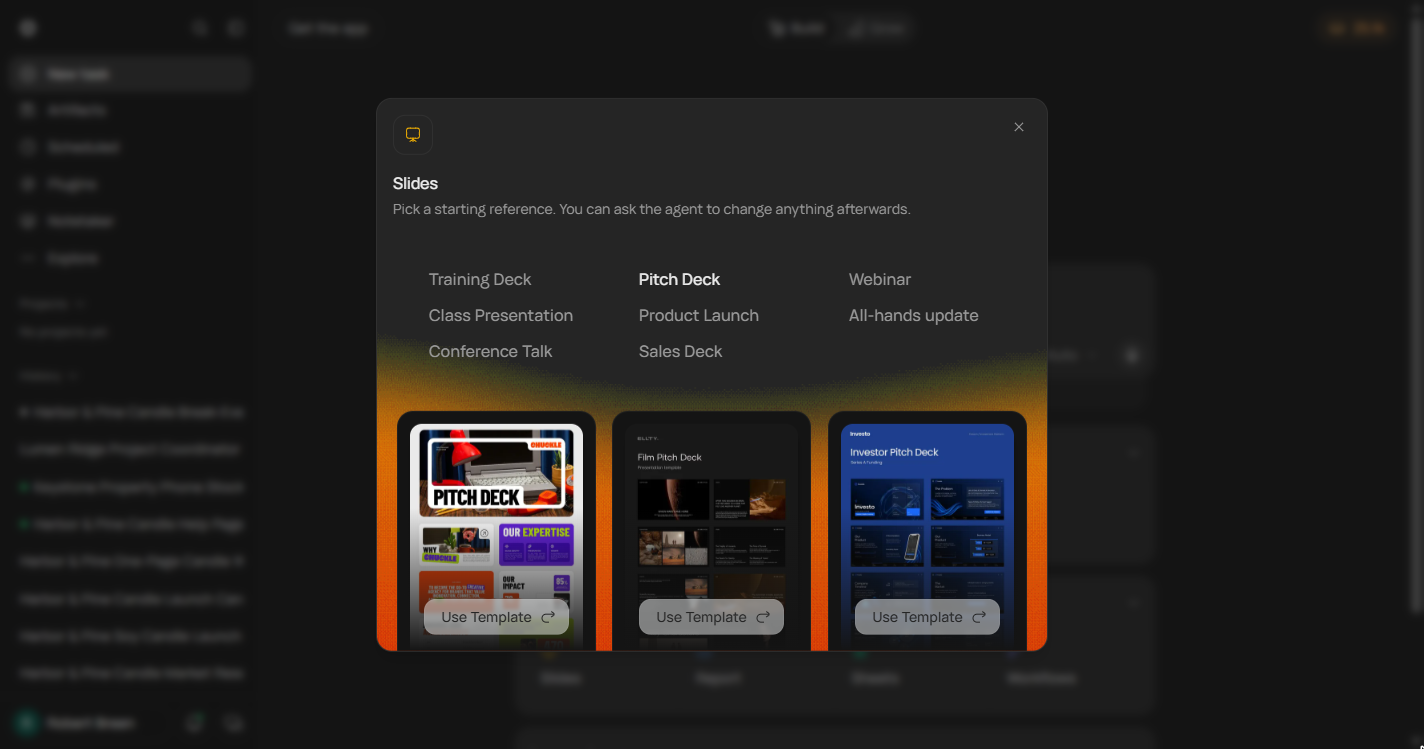
- Pick the investor template. Click Pitch Deck in the list. Three previews appear. The third, Investor Pitch Deck, has the investor slide order. Click its Use Template.
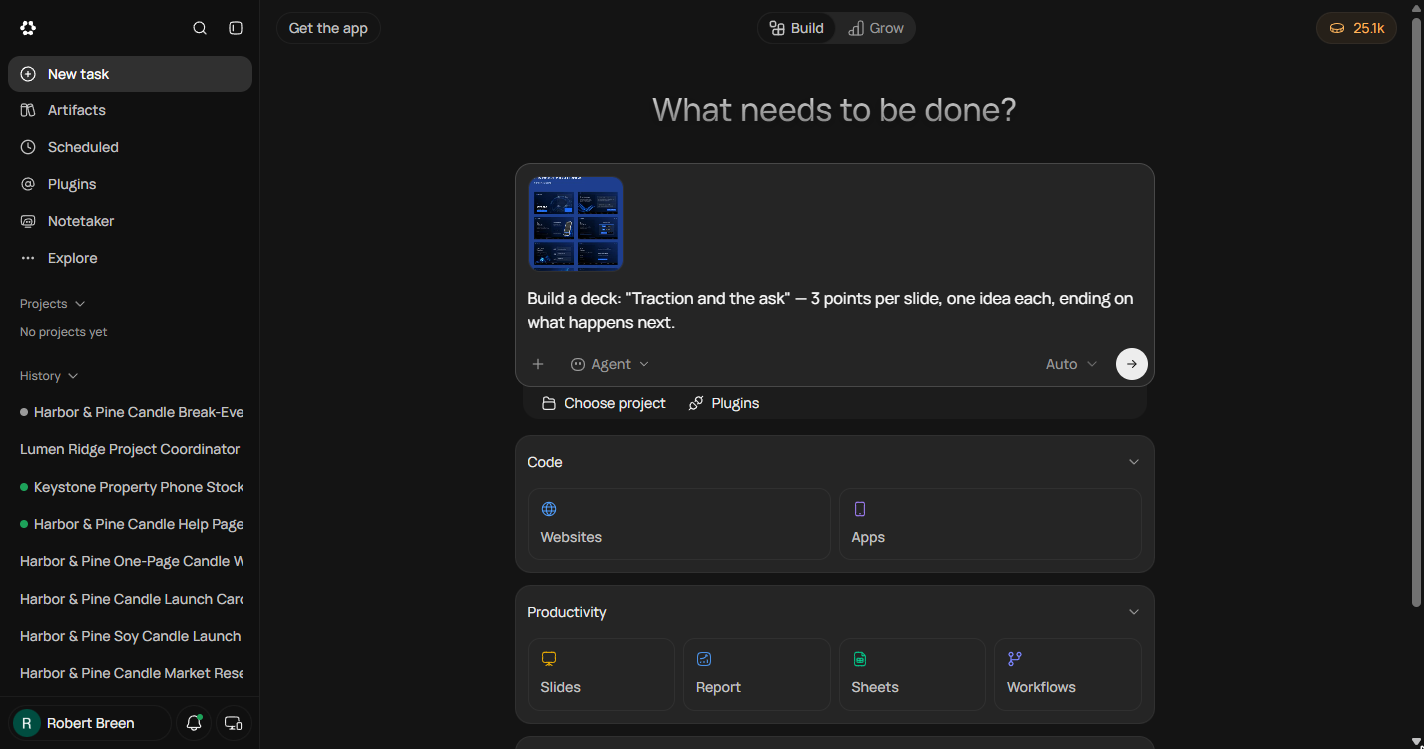
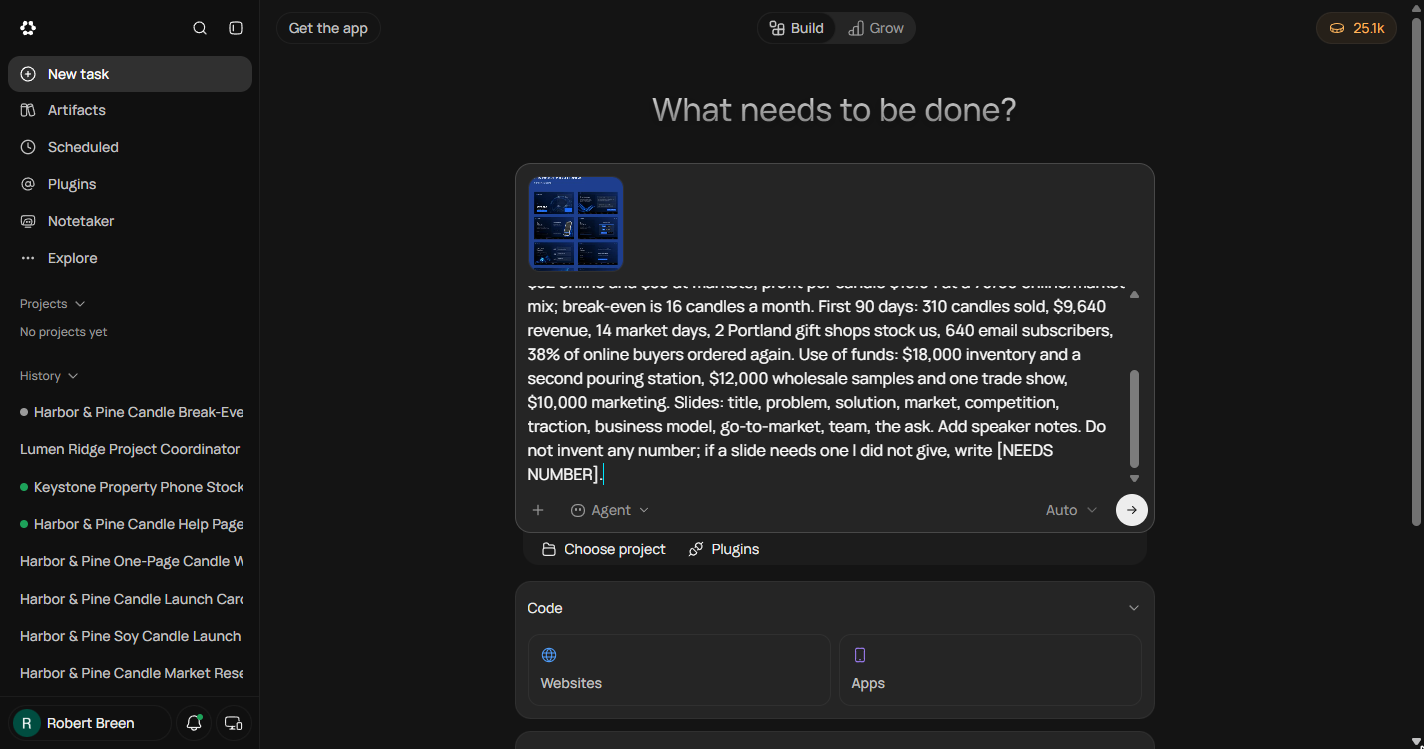
- Type your brief over the sample. Select the sample text and type your brief: the raise, only your facts (market, prices, profit per candle, the first 90 days, use of funds), the ten slides, speaker notes, and do not invent any number.
Only your facts. The ten slides. And, do not invent any number.
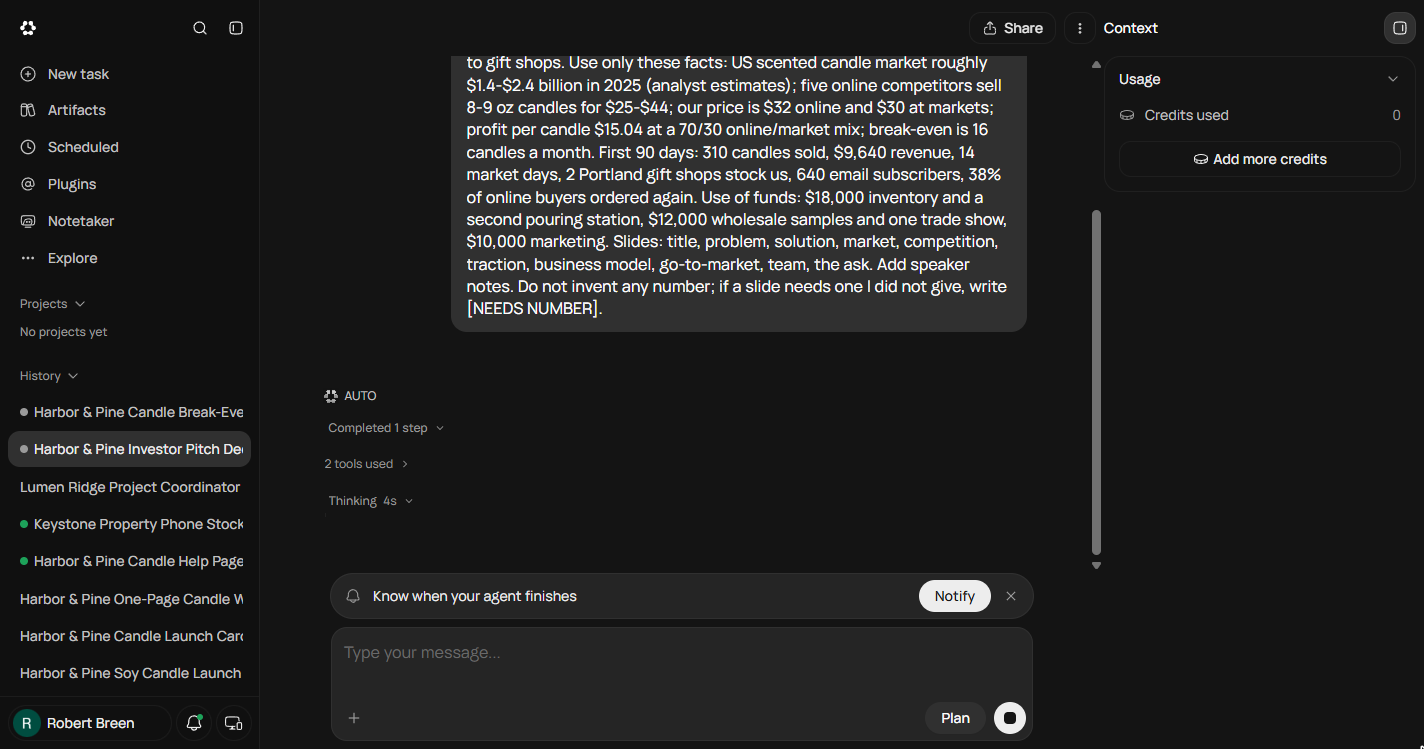
Build a 10-slide investor pitch deck for Harbor & Pine, a small-batch soy candle brand in Portland, Oregon (founder Maya Chen). We are raising $40,000 from local angel investors on a SAFE to start selling wholesale to gift shops. Use only these facts: US scented candle market roughly $1.4-$2.4 billion in 2025 (analyst estimates); five online competitors sell 8-9 oz candles for $25-$44; our price is $32 online and $30 at markets; profit per candle $15.04 at a 70/30 online/market mix; break-even is 16 candles a month. First 90 days: 310 candles sold, $9,640 revenue, 14 market days, 2 Portland gift shops stock us, 640 email subscribers, 38% of online buyers ordered again. Use of funds: $18,000 inventory and a second pouring station, $12,000 wholesale samples and one trade show, $10,000 marketing. Slides: title, problem, solution, market, competition, traction, business model, go-to-market, team, the ask. Add speaker notes. Do not invent any number; if a slide needs one I did not give, write [NEEDS NUMBER].
- Send it. Click the arrow to send.
3. Answer its questions
- Let it read the brief. Runable reads the brief and the template image before it builds. Click the Thinking line.
It reads the brief first.
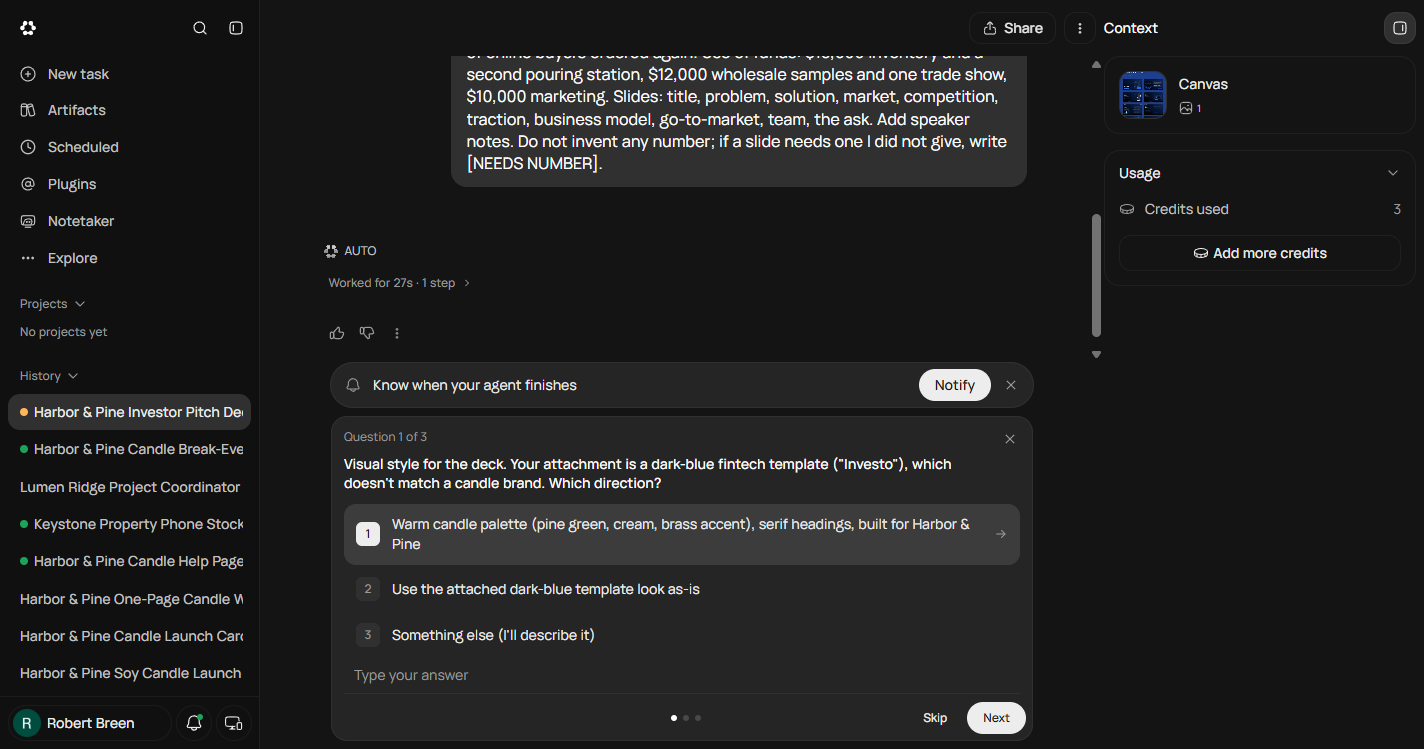
- Pick a look that fits the brand. Question 1 of 3: the template is a dark-blue fintech look that does not match a candle brand. Pick Warm candle palette (it is selected here), then click Next.
It noticed the template doesn't fit a candle brand. Pick the warm palette, then Next.
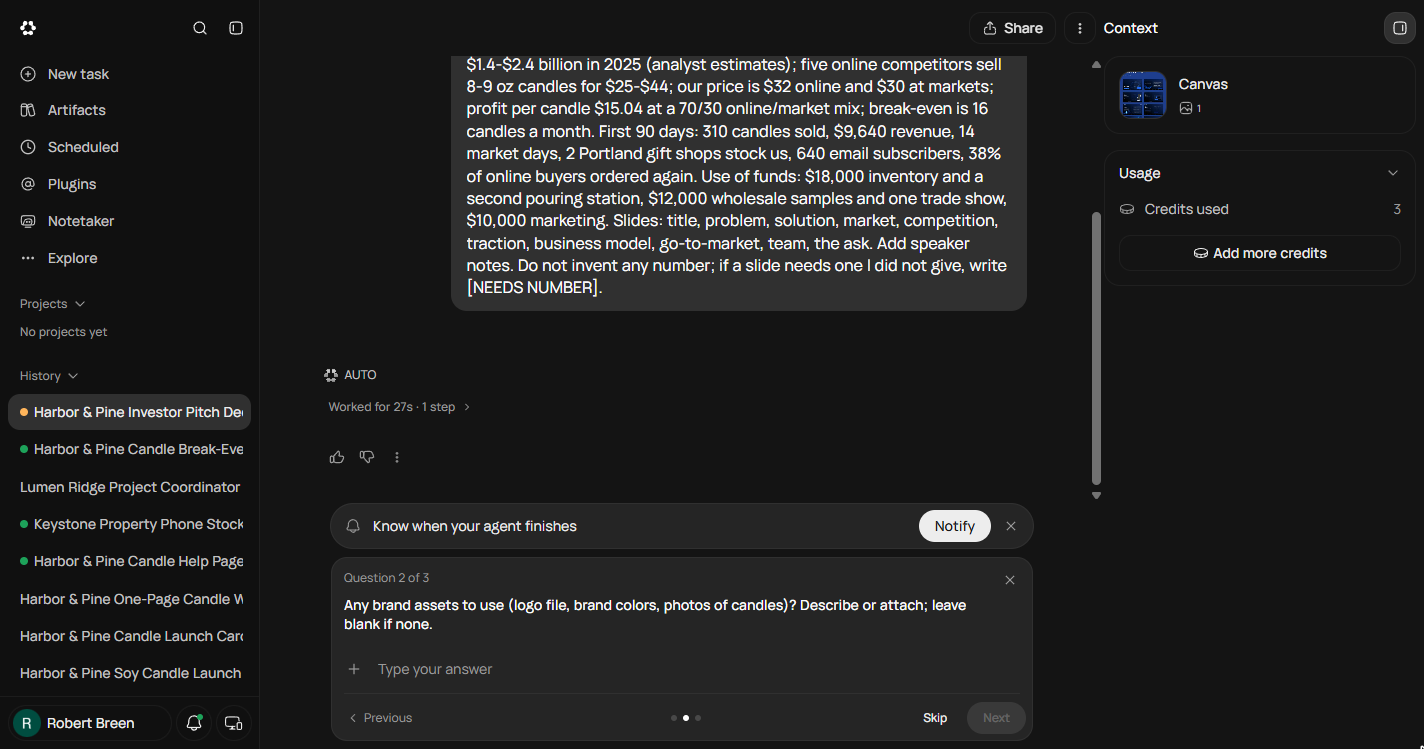
- Skip what you do not have. Question 2 asks for a logo, brand colors or photos. You have none yet. Click Skip.
No logo yet.
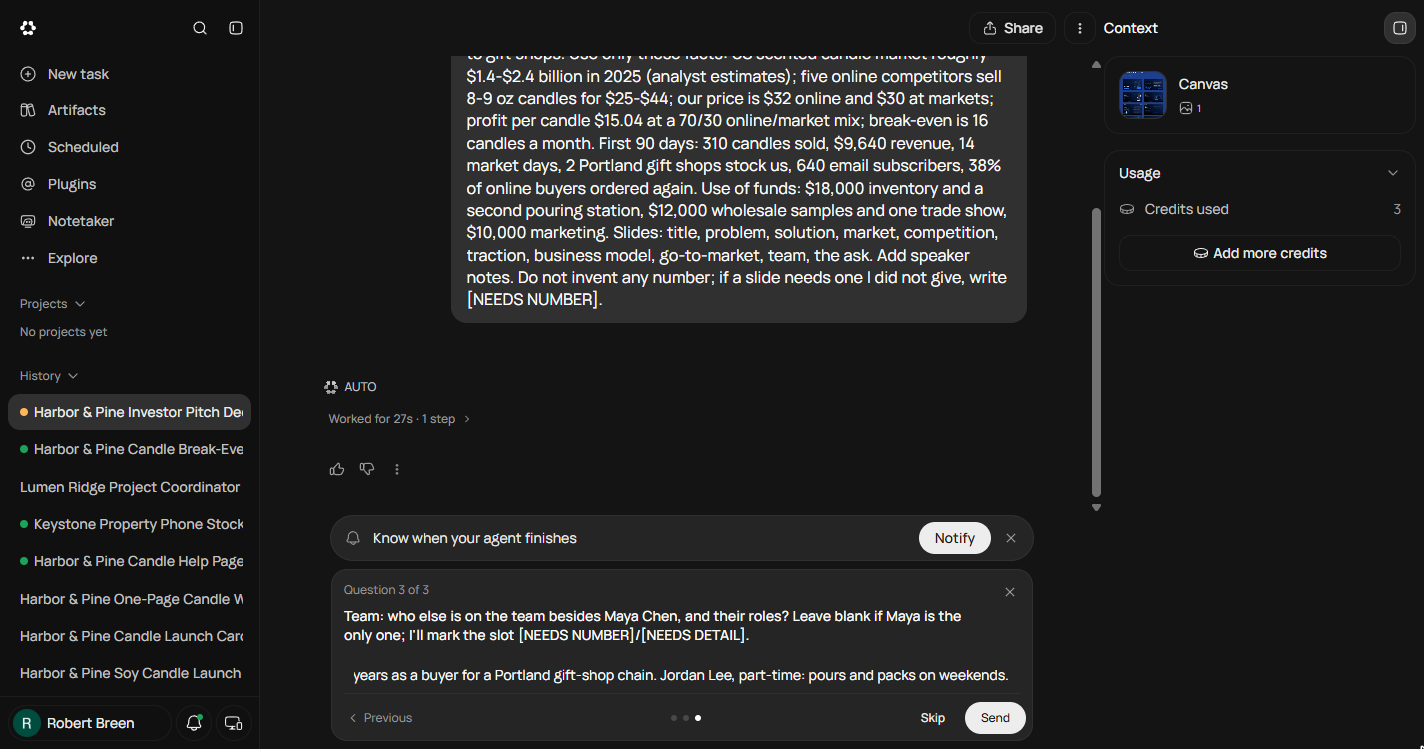
- Name the team. Question 3: who else is on the team. We typed: "Maya Chen, founder: makes every candle, 6 years as a buyer for a Portland gift-shop chain. Jordan Lee, part-time: pours and packs on weekends." Click Send.
Name the team. Maya, and a part-time helper.
4. Fill the gaps it found
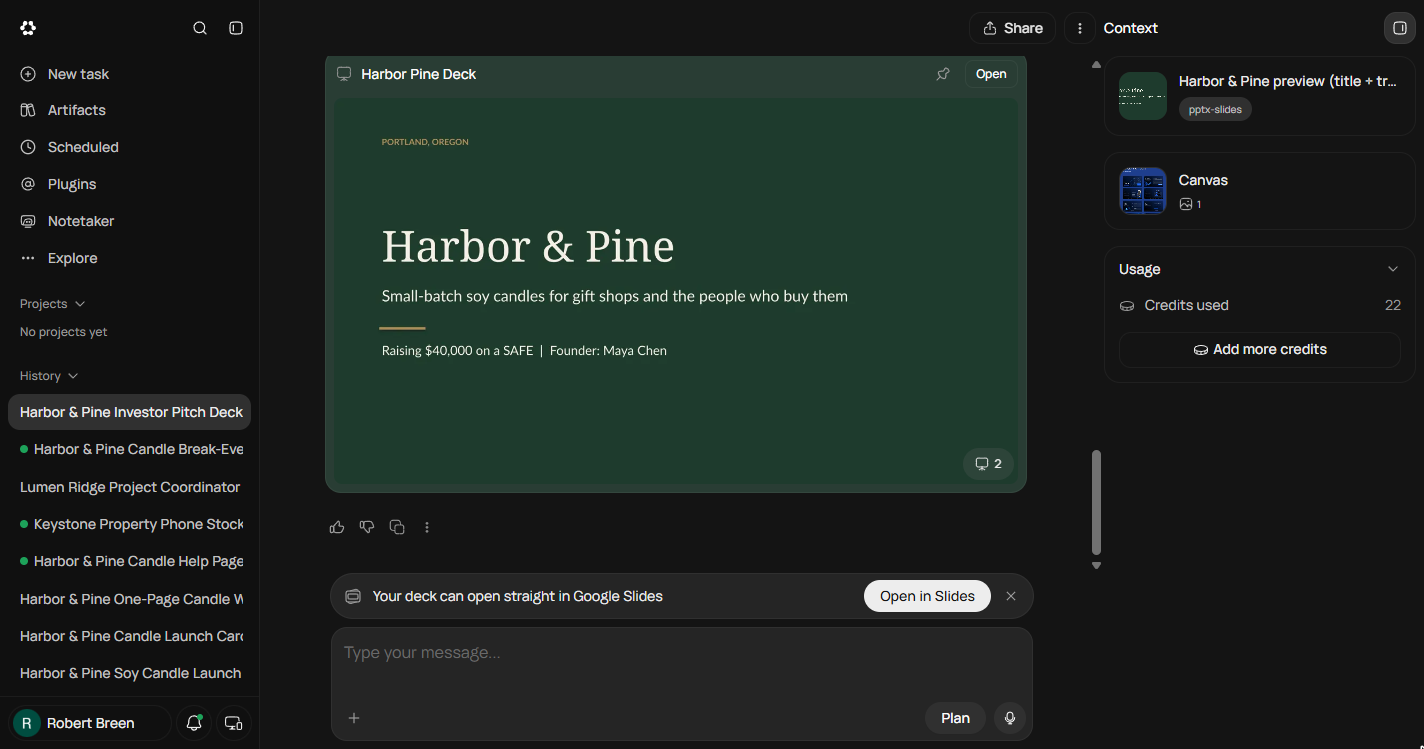
- Look at the preview, not a full deck. Runable built 2 slides first, title and traction, so you approve the look before it spends credits on ten. Click the 2 badge.
It built two slides first, so you approve the look before it builds ten.
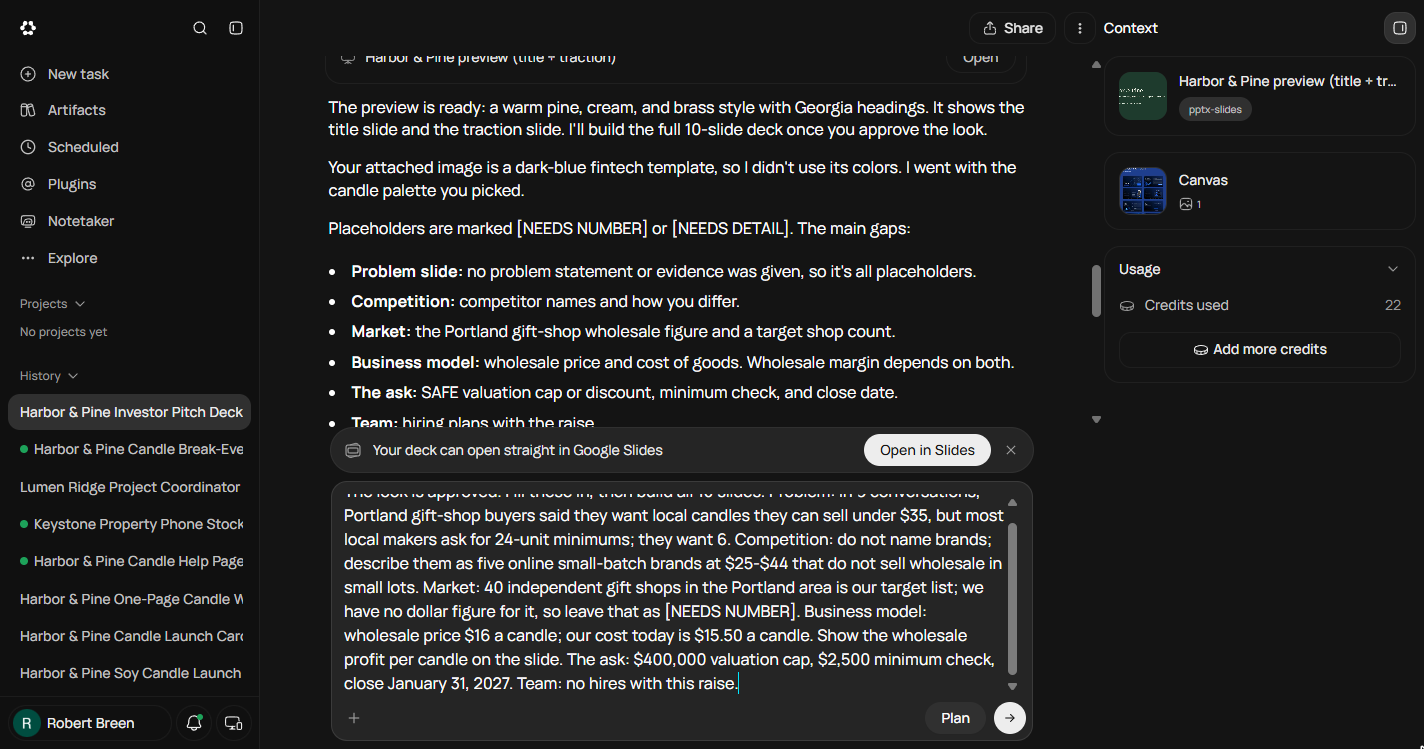
- Fill every gap it listed. It lists what it could not fill: the problem, competition, the local market, wholesale price and cost, and the SAFE terms. Approve the look and answer each one. Where you have no number, say so: it stays [NEEDS NUMBER].
It lists every gap. Answer each one. Where you have no number, say so.
The look is approved. Fill these in, then build all 10 slides. Problem: in 9 conversations, Portland gift-shop buyers said they want local candles they can sell under $35, but most local makers ask for 24-unit minimums; they want 6. Competition: do not name brands; describe them as five online small-batch brands at $25-$44 that do not sell wholesale in small lots. Market: 40 independent gift shops in the Portland area is our target list; we have no dollar figure for it, so leave that as [NEEDS NUMBER]. Business model: wholesale price $16 a candle; our cost today is $15.50 a candle. Show the wholesale profit per candle on the slide. The ask: $400,000 valuation cap, $2,500 minimum check, close January 31, 2027. Team: no hires with this raise.
- Send and let it build. Click the arrow to send.
5. Read the warning, fix the slide
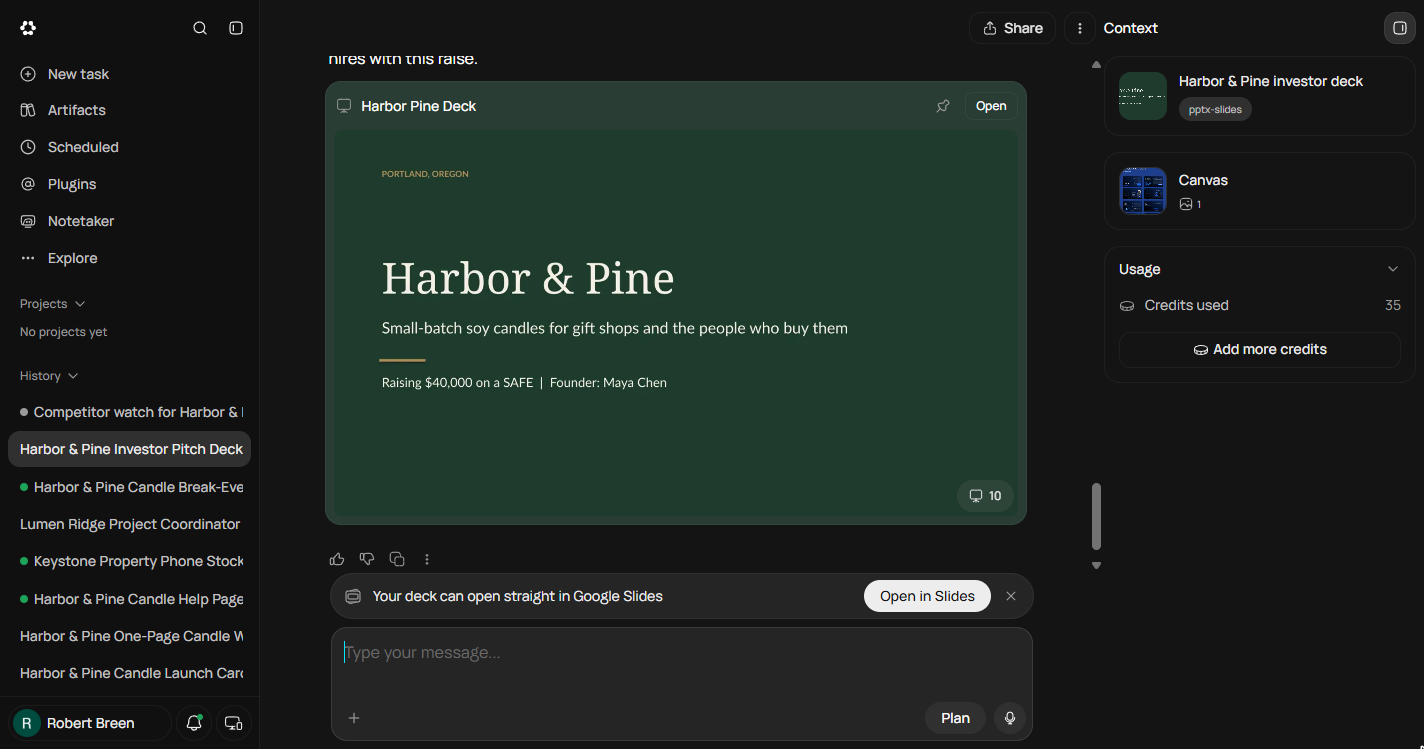
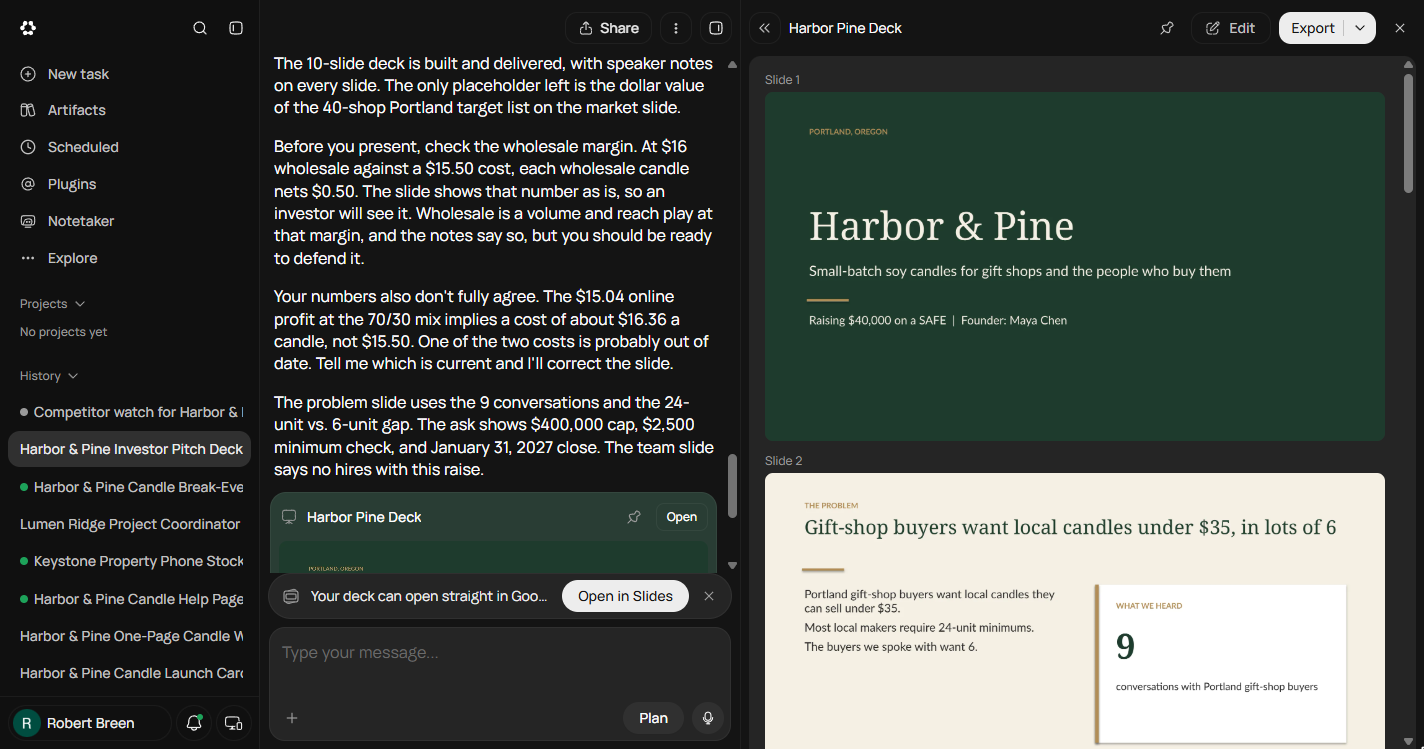
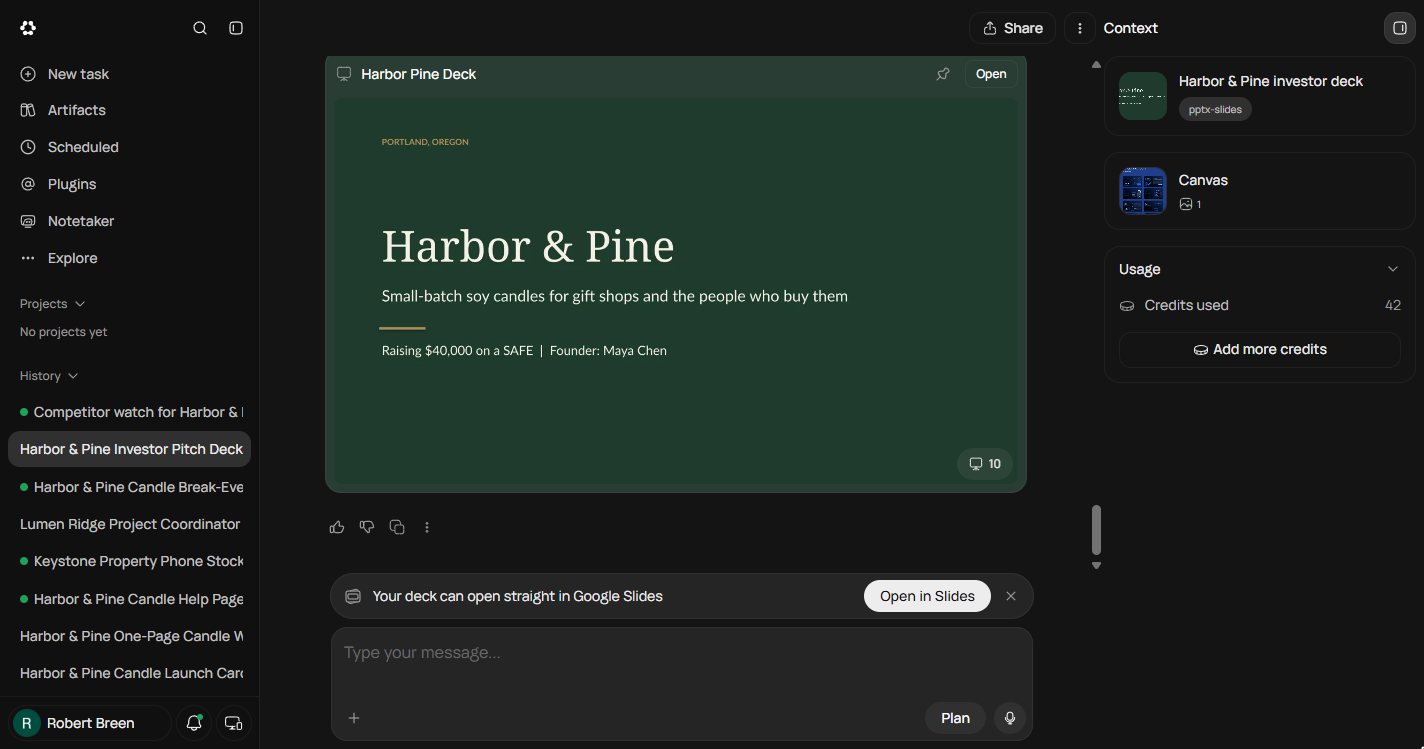
- Open the deck. 3m 11s later the full deck is in: 10 slides with speaker notes. Click Open.
Three minutes, and the full deck is in.
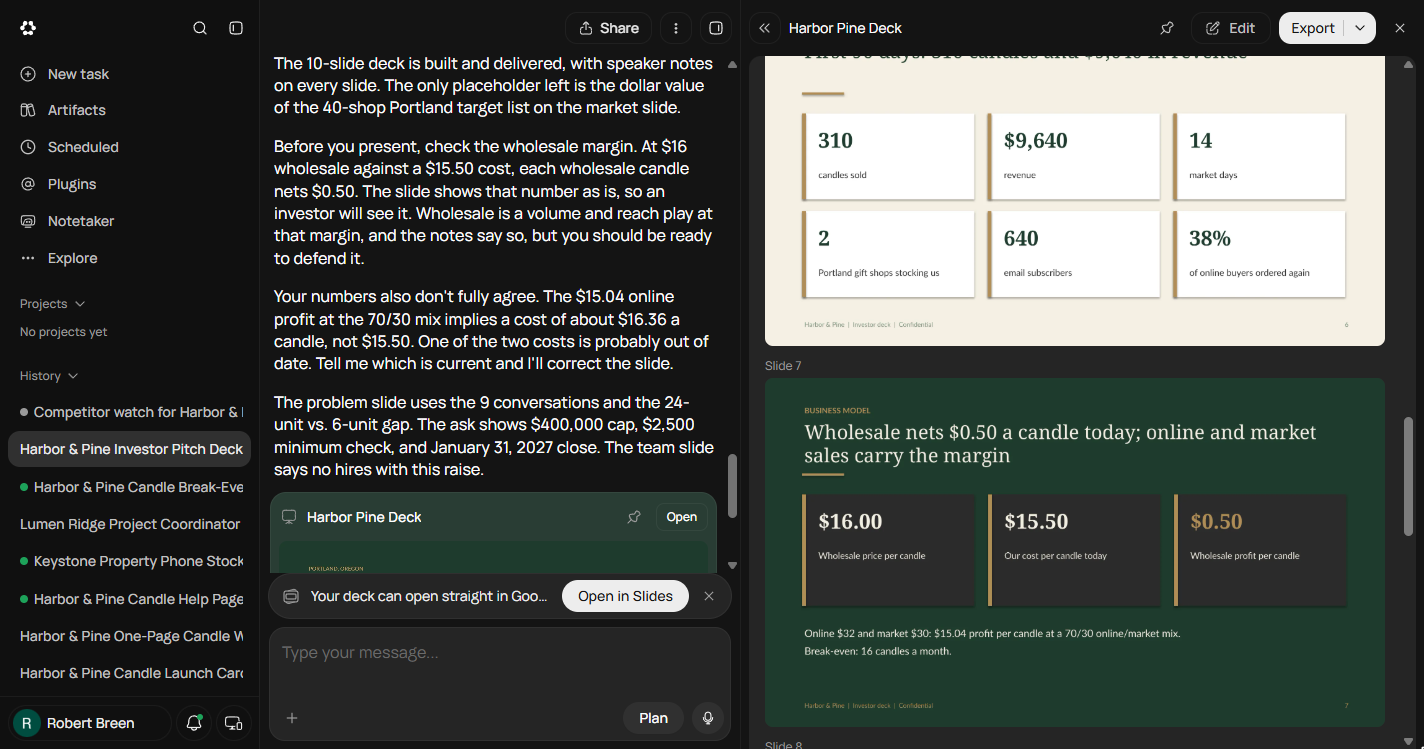
- Read what it warns you about. Before the slides, read its reply. At $16 wholesale against a $15.50 cost, each wholesale candle nets $0.50, and it put that on the slide so you are ready for the question. It also says $15.04 profit implies a $16.36 cost, not $15.50. Click the warning.
Read the warning. Fifty cents a wholesale candle. And a cost that doesn't match.
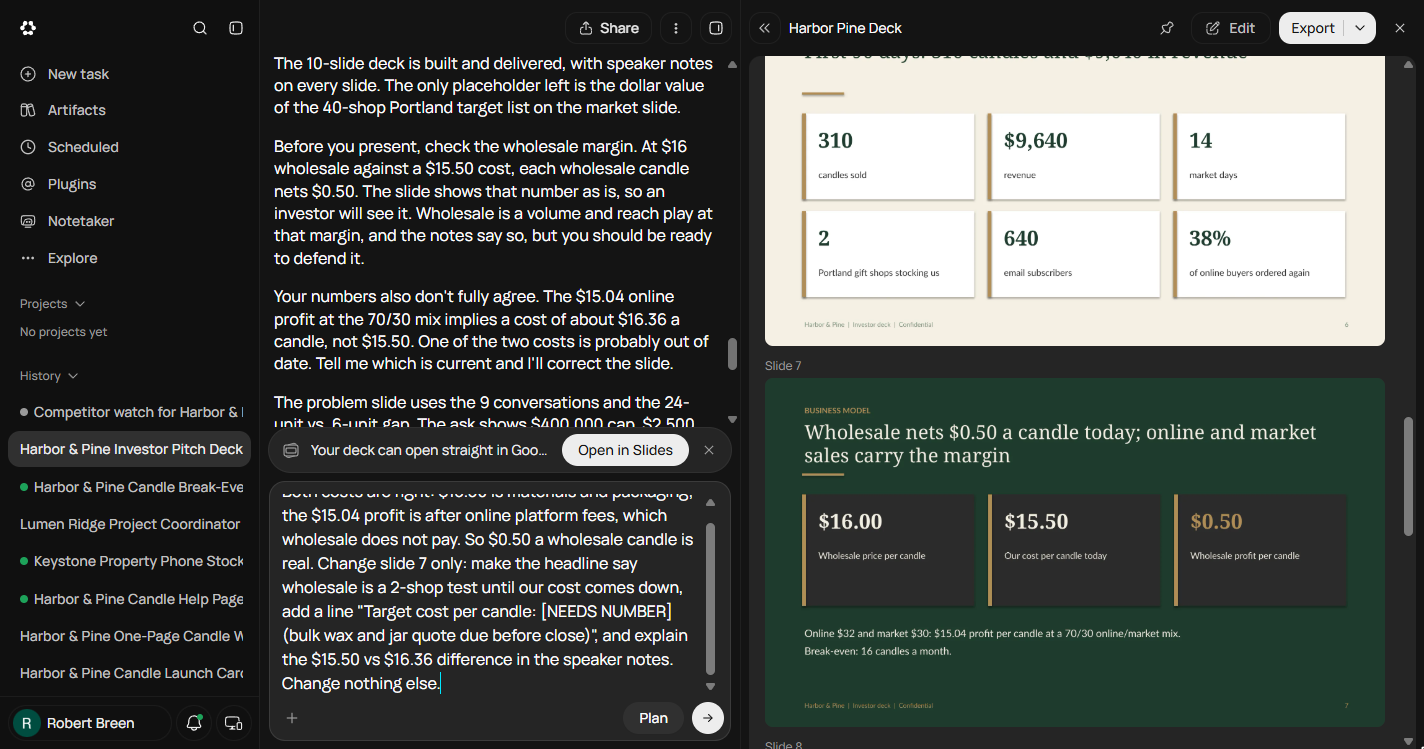
- Find the number an investor will question. Scroll to slide 7, Business model: $16.00, $15.50, $0.50. Both costs are right: $15.50 is materials and packaging; $15.04 is after online fees, which wholesale does not pay. The real problem is the plan. Click $0.50.
Both costs are right. Fees explain the gap. The real problem is fifty cents.
- Fix slide 7 only. Explain the two costs, then ask for one change: make wholesale a 2-shop test until cost comes down, add a target cost line marked [NEEDS NUMBER], and put the explanation in the speaker notes. End with change nothing else.
Explain the costs. Make wholesale a two-shop test. Change nothing else.
Both costs are right: $15.50 is materials and packaging; the $15.04 profit is after online platform fees, which wholesale does not pay. So $0.50 a wholesale candle is real. Change slide 7 only: make the headline say wholesale is a 2-shop test until our cost comes down, add a line "Target cost per candle: [NEEDS NUMBER] (bulk wax and jar quote due before close)", and explain the $15.50 vs $16.36 difference in the speaker notes. Change nothing else.
- Send the fix. Click the arrow to send.
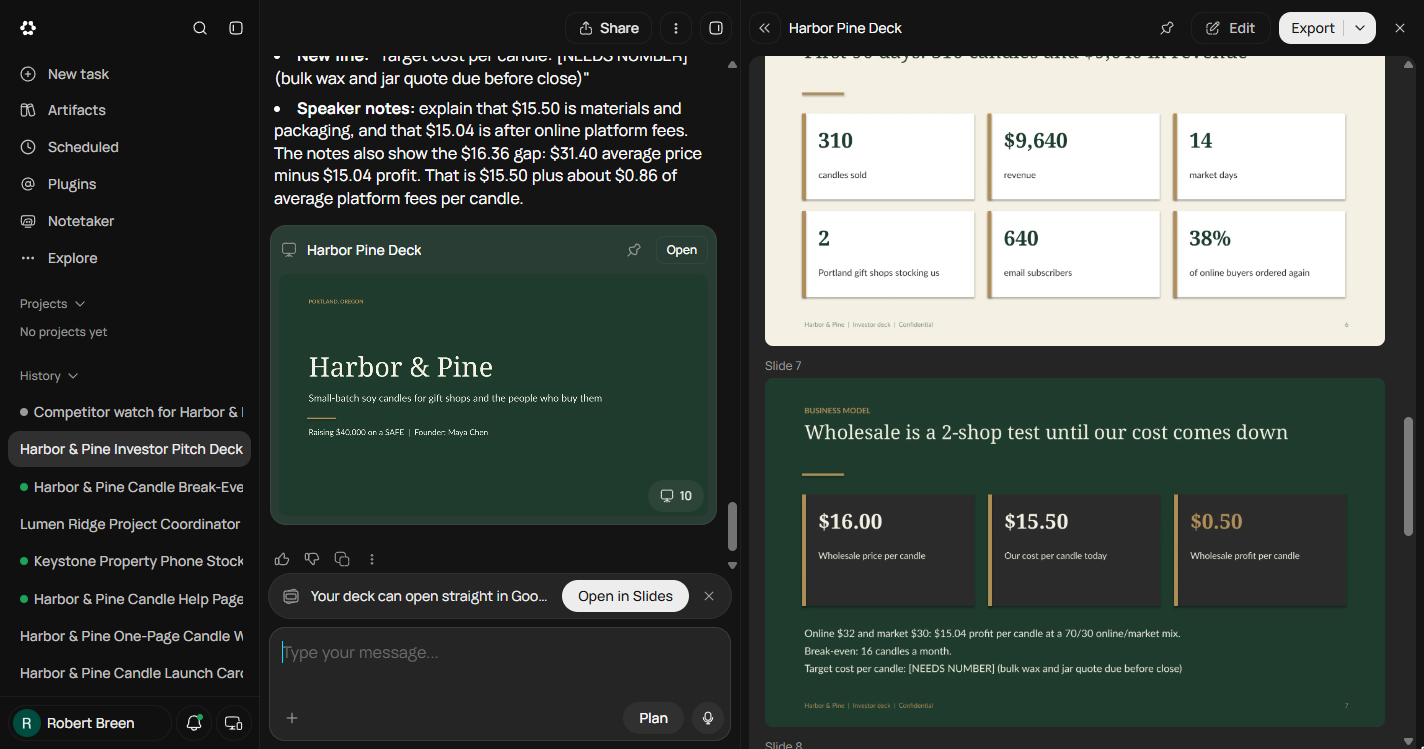
- Check slide 7. Slide 7 now reads Wholesale is a 2-shop test until our cost comes down, with the target-cost line. The notes explain the $0.86 of fees behind $16.36. Click the headline.
Slide seven now says wholesale is a two-shop test.
- Close the deck. Click the X at the top right.
6. What it saved, and what is next
- Read what it cost. Credits used: 42 for the preview, the full deck and the fix. Click the row.
Forty-two credits for the whole deck.
- See what you have now. A 10-slide deck with speaker notes, every number from your own facts, one honest [NEEDS NUMBER], and the weakest number answered before an investor asks. Click What you have now.
Ten slides, every number yours, and the weak one answered first.
- Up next. Next in the course: keep an eye on competitors every week with a scheduled task. Click Up next.
Next, a weekly competitor watch.
Screenshots
Frequently asked questions
- Can Runable make a pitch deck?
- Yes. Runable's Slides tool has Pitch Deck templates. In our run it asked three questions, built a 2-slide preview, listed the gaps, and then built 10 slides with speaker notes. The preview, the full deck and one fix used 42 credits.
- How do I stop AI from inventing numbers in a deck?
- List only your real numbers in the brief and give it a placeholder rule, such as writing [NEEDS NUMBER] when a slide needs a number you did not give. Then search the deck for the placeholder before you send it.
- Can I edit the deck in PowerPoint or Google Slides?
- Runable offers Open in Google Slides and an Export menu. We did not export in this lesson; check the export before you send.
More Runable tutorials
A business case for a small agency: price what a slow proposal costs, then use Runable, an AI agent, to turn a messy client email into a finished six-slide proposal…
Free · Live ~16 min Beginner
 Size Up Your Market and 5 Competitors Before You Spend a Dollar using Runable
A business case for new founders: before you buy stock, have Runable, an AI agent, research the market size, five competitors and their prices, and two gaps, with a…
Free · Live ~12 min Beginner
 Turn Your Research into a One-Page Business Plan using Runable
A business case for new founders: turn your research into a one-page launch plan with Runable's Report tool and Business Plan template, read the fact and assumption…
Free · Live ~10 min Beginner
 Make an Instagram Launch Carousel for Your Products using Runable
A business case for new founders: make a 5-slide Instagram launch carousel with Runable's Carousels tool, approve the cover before it renders the rest, check every…
Free · Live ~10 min Beginner
 Brief a One-Page Website and Approve the Plan using Runable (and Budget Your Credits)
A business case for new founders: brief Runable's Websites tool for a one-page site, answer its two clarifying questions, approve the plan, run out of free credits…
Free · Live ~16 min Beginner
 Turn Customer Questions into a Help Page and DM Replies using Runable (and Check What It Changed)
A business case for small shops: turn the questions customers keep asking into a help page and paste-ready DM replies with Runable, make it list what your facts don't…
Free · Live ~10 min Beginner
Terms in this lesson
Plain-English definitions, each with an example from a free lesson.