What is ticket deflection?
Quick answer
Ticket deflection is when a customer's question gets answered by self-service, such as an FAQ page or an AI chat agent, so nobody on your team has to open a ticket or write a reply. The deflection rate is the share of questions handled that way.
Last updated
Take the free module →Module 33 of the free AI Apps Worth Knowing course, about 14 minutes. No account needed.
Updated · By Robert Breen
Why it matters for a small business
Every repeat question costs staff time, and the cost is easy to miss because each one only takes a few minutes. Forty emails a week asking about hours, prices and refunds add up to hours a week of skilled people typing answers that already exist in the FAQ. Deflection is the plain business measure of how much of that work a self-service tool takes off the team.
It is also a number that can lie. A customer who gives up and closes the chat counts as deflected, yet their problem is not solved, and they may call later in a worse mood. So pair the deflection rate with a quality check: read a sample of the chats, look at feedback, and count how many people came back with the same question.
Working out a deflection rate (example numbers)
| Item | Figure | How you get it |
|---|---|---|
| Questions a week | 40 | Count the repeat emails before the agent goes live |
| Answered by the agent | 30 | Chats closed with no ticket and no follow-up email |
| Handed to a person | 10 | Tickets created or chats a person joined |
| Deflection rate | 75% | 30 divided by 40 |
| Time saved a week | 2 hours | 30 questions at 4 minutes each |
In a real lesson: Chatbase: Answer Customer FAQs with an AI Agent
The Chatbase FAQ agent lesson opens with the deflection case without using the word. Dana Ruiz at Juniper Lane Bookkeeping (made up) gets about 40 emails a week with the same questions. At 4 minutes each and $45 an hour, that is about $520 a month, before counting the customers who wait overnight.
You train the agent on a 22-question FAQ file, tell it in Guardrails to answer only from that, and test real questions in the Playground. Anything it cannot answer goes to a person, through a fallback answer or the Escalations action that creates a support ticket. The lesson's habit is 15 minutes a week in Activity, reading the Chat logs and fixing weak answers with Revise answer. Those logs are where you would count what was answered and what was handed off.
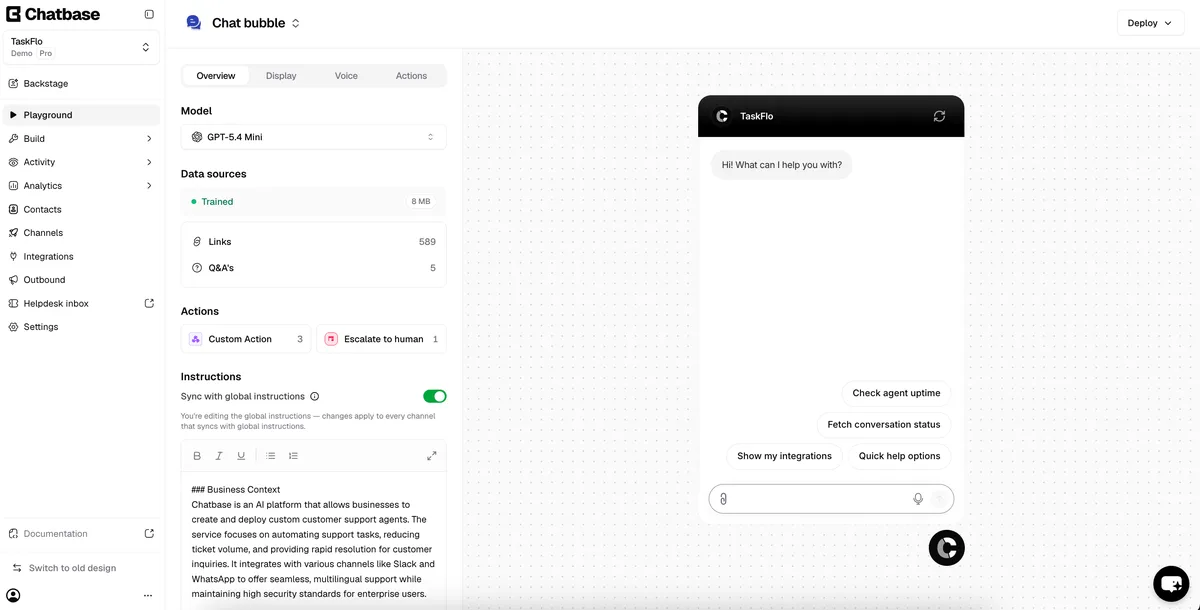
Try this lesson free or read the step-by-step guide.
Common confusions
Ticket deflection vs ticket resolution
A resolved ticket was opened and then solved by a person. A deflected question never became a ticket. Deflection only counts as a win if the customer really got their answer.
Ticket deflection vs a knowledge base
A knowledge base is the set of articles or facts an agent answers from. Deflection is the result you measure once customers start using it.
Tips
- Count the repeat questions for two weeks before you launch, so you have a baseline.
- Read a sample of "deflected" chats each week to check the answers were right.
- Add every new question you find in the logs to the FAQ.
Related terms
More Business terms
Where you use it: free lessons
- Chatbase: Answer Customer FAQs with an AI Agent (Chatbase, 14 min)
- tawk.to: Answer Website Questions After Hours (tawk.to, 14 min)
AI tools that use it
Frequently asked questions
- What is a good ticket deflection rate?
- There is no single target. Start by measuring your own baseline, then aim to raise it while the answers stay correct and customers stop sending the same question twice.
- How do I measure deflection?
- Compare how many questions came in with how many needed a person. Chat logs, ticket counts and follow-up emails give you both sides.
- Does deflection mean customers never reach a person?
- No. Good deflection answers the routine questions and hands everything else to a person quickly, with the details already collected.