What is data minimization?
Quick answer
Data minimization is the habit of giving an AI tool only the information the task actually needs, and nothing more. If the job is to tidy an email, the client's name, account number and balance usually are not needed, so they are replaced with placeholders before anything is pasted.
Last updated
Take the free module →Module 3 of the free AI Governance for Small Business course, about 7 minutes. No account needed.
Updated · By Robert Breen
Why it matters for a small business
Most AI mistakes at work are not hacks. Someone pastes a whole payroll file because it was easier than picking three columns. Once data is in a chat, it can sit in history, in saved memory or in a shared link. The cheapest control is the one that happens before the paste: the less you send, the less there is to clean up, explain to a client or report later.
Minimizing works best with a rule people can follow. In the free data cheat sheet lesson, a four-level scheme (Public, Internal, Confidential, Restricted) gives one AI rule per level: Confidential data goes into an approved tool only after names and numbers are swapped for placeholders, and Restricted data such as a Social Security number never goes in at all. It pairs with data classification and redaction.
What to send, by data level
| Level | Example | What to send to AI |
|---|---|---|
| Public | Website text, a brochure | As is |
| Internal | A staff memo | As is, in an approved tool with training turned off |
| Confidential | A client's payroll total | Placeholders such as [CLIENT] and [AMOUNT] instead of real names and numbers |
| Restricted | A Social Security number | Nothing. Remove it by hand first |
The four levels and rules are the ones taught in the free data cheat sheet lesson. Your own policy comes first.
In a real lesson: Know What Never Goes into AI: a Four-Level Data Cheat Sheet using ChatGPT
In the free Know What Never Goes into AI lesson, Harbor & Pine Bookkeeping, a made-up six-person firm, gets a client email that contains a Social Security number. The office manager replaces the number with [REMOVED] herself, then turns on Temporary chat and asks ChatGPT to swap the remaining names and amounts for placeholders.
The lesson then shows the check that goes with minimizing: ChatGPT gave two different people the same placeholder, [CLIENT], so a follow-up message fixed it. Always read the list of replacements, not just the clean text.
Try this lesson free or read the step-by-step guide.
Common confusions
Minimization vs redaction
Redaction is one way to minimize: you remove or replace details. Minimization is the wider habit of asking what the task needs before you share anything, including choosing which pages or columns to paste.
Minimization vs privacy settings
Turning off training or using Temporary Chat lowers risk, but your data is still processed to give you an answer. Settings do not replace sending less.
Tips
- Before you paste, ask what the answer would look like if every name and number were a placeholder.
- Take Restricted details out by hand. Asking the AI to remove them means it has to receive them first.
- When you are unsure which level something is, treat it as one level higher.
Related terms
More AI basics terms
Where you use it: free lessons
- Know What Never Goes into AI: a Four-Level Data Cheat Sheet using ChatGPT (ChatGPT, 7 min)
- Clear Client Data Out of ChatGPT Before It Becomes a Problem: Delete Chats, Clear Memory and Use Temporary Chat (ChatGPT, 10 min)
- ChatGPT: Keep Client Data Safe, Set Up Your Team's Data Controls in 10 Minutes (ChatGPT, 10 min)
Prompt templates that use it
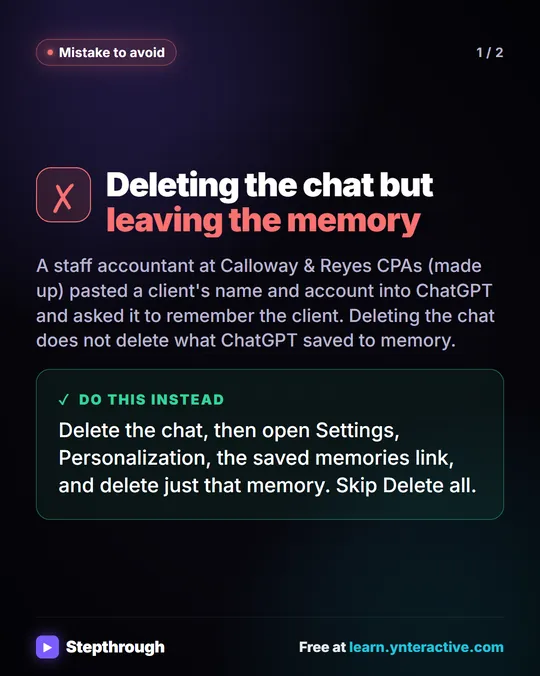
Visual guide
Data minimization in a few slides, with the same guide written out as text.
Frequently asked questions
- Is data minimization a legal rule?
- Some privacy laws use the idea, and rules differ by country and industry. This page is a practical habit, not legal advice. Ask your lawyer or insurer about what applies to you.
- Does using a business ChatGPT plan make minimizing unnecessary?
- No. A business plan can offer stronger data controls, but sending less is still the simplest way to reduce what you have to protect. Check your plan's terms.
- What if I already pasted too much?
- Stop pasting, write down what kind of data went in, which tool and which account, and follow your incident steps. The free incident-response lesson walks through it.