What is fine-tuning in AI?
Updated · By Robert Breen
Fine-tuning is extra training that adjusts an existing AI model using a set of your own examples, so it learns a specific style, format or task. It changes the model itself, unlike instructions or uploaded files, which only guide a model that stays the same.
Why it matters for a small business
Fine-tuning is often the first idea people have for teaching AI about their business, and usually not the right one. It takes a well-prepared set of example inputs and ideal outputs, technical setup through a provider's API, training costs and testing. And it is poor at teaching facts like prices, which change and are better looked up than memorized.
For most small businesses, instructions plus reference documents get you nearly all the benefit with none of the training. Fine-tuning earns its place when you run the same narrow task at high volume, need a very consistent format that prompting cannot hold, or want a smaller, cheaper model to match a bigger one on that one job.
In a real lesson: Build an AI Estimate Writer for Your HVAC Company
The HVAC estimate writer lesson shows the alternative most businesses should try first. You build a Custom GPT named HVAC Estimate Writer for Cedar Ridge Heating & Air, a made-up family-owned company. Nothing is retrained. You click Paste instructions and add rules: explain terms like SEER2 and AFUE in plain words, keep every estimate under 200 words, end with one next step, and "Only use services and prices from the Services & Pricing document. Never invent a price."
Then Upload files attaches Cedar-Ridge-Services-Pricing.pdf, with service call fees, tune-ups, the maintenance plan, install prices, warranties and a sample estimate. When you send "Write an estimate description for a new AC install for my HVAC company", the GPT follows those rules and that price list.
If a price changes next spring, you edit the PDF and upload it again. With a fine-tuned model, the old price would be baked into the training, and you would need to retrain. That is why instructions and knowledge beat fine-tuning for anything factual that changes.
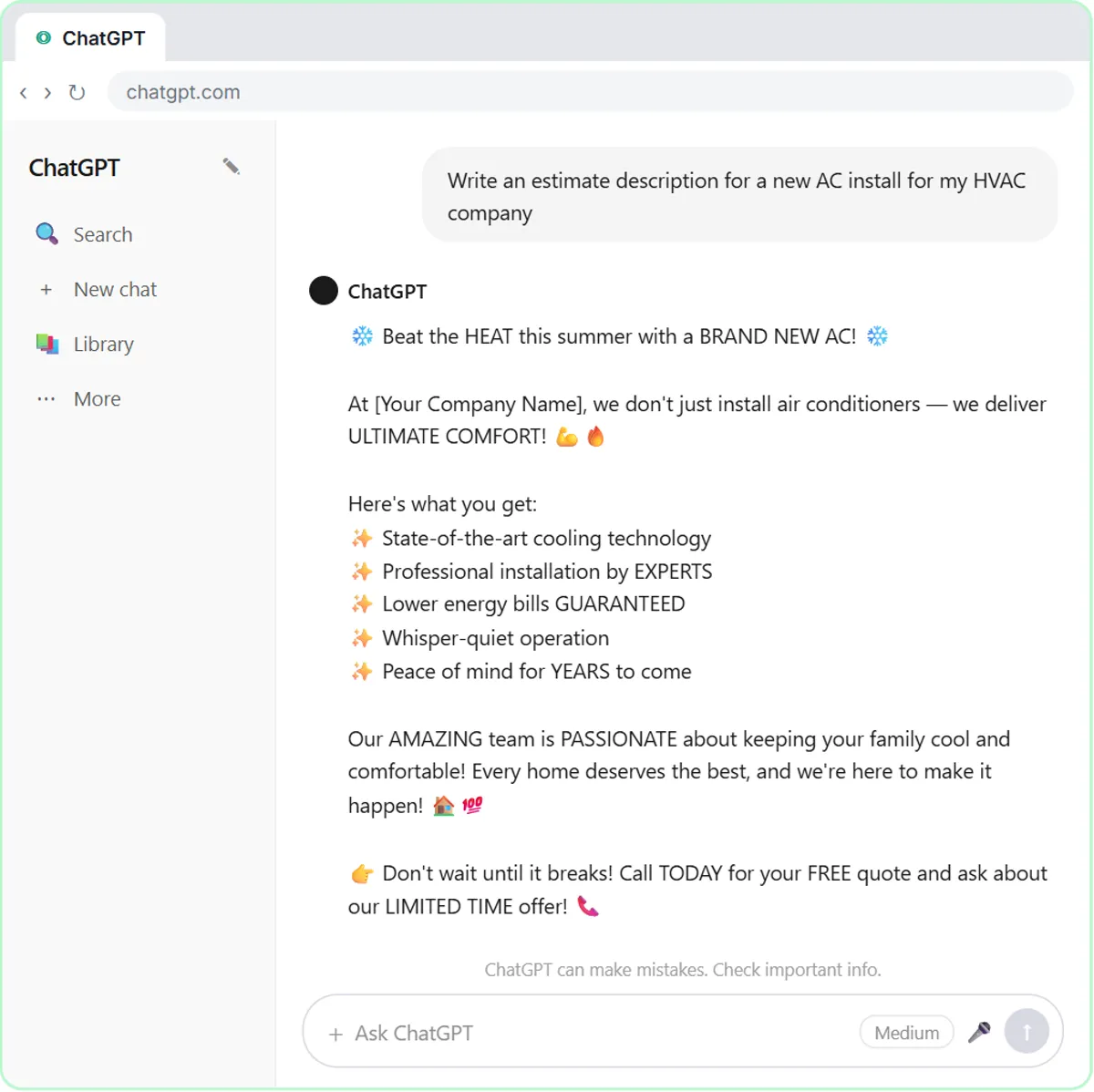
Try this lesson free or read the step-by-step guide.
Common confusions
Fine-tuning vs a Custom GPT
A Custom GPT wraps a standard model with saved instructions, knowledge files and settings. The model underneath is unchanged. Fine-tuning produces a new, altered version of the model.
Fine-tuning vs RAG
RAG looks up relevant information at the moment of answering, so updates take effect immediately. Fine-tuning changes how a model behaves, which suits style and format better than facts.
Tips
- Exhaust better instructions, examples in the prompt and knowledge files before considering fine-tuning.
- Keep facts (prices, policies, dates) in documents you can edit, not in a model's training.
- If you do fine-tune, save a test set of real inputs to compare old and new versions.
Related terms
Frequently asked questions
- Is building a Custom GPT the same as fine-tuning?
- No. A Custom GPT saves instructions and files around a standard model. Fine-tuning retrains the model on your examples, which is done through the provider's developer platform.
- Does a small business need fine-tuning?
- Rarely. Clear instructions, a few examples and a reference document handle most writing and sorting jobs. Consider fine-tuning only for a narrow, high-volume task that prompting cannot get right.