What is data classification for AI use?
Quick answer
Data classification means sorting information by how sensitive it is, then attaching a rule to each level. For AI use, a simple version has three groups: public, internal and confidential. The rule tells staff what they may paste into an AI tool as is, what needs names and numbers replaced, and what must stay out.
Last updated
Take the free module →Module 2 of the free AI at Work: Start Here course, about 7 minutes. No account needed.
Updated · By Robert Breen
Why it matters for a small business
Staff do not paste private data out of carelessness. They do it because nobody told them where the line is. A short classification scheme turns a vague worry into a quick question: which group is this? If it is confidential, such as bank numbers, health details or a client's file, it stays out or goes in only with placeholders.
The scheme works best when it is small and sits inside your AI policy. Pair it with redaction, which replaces names and numbers with placeholders, and with the habit of keeping personal information out of prompts. Settings matter too, such as switching off training on your chats.
A three-level scheme for AI use
| Level | Examples | Rule for AI tools |
|---|---|---|
| Public | Published website text, a price list | Fine to paste |
| Internal | Draft memos, meeting notes without names | Paste into the approved account only |
| Confidential | Bank numbers, IDs, health details, client files | Replace with placeholders or keep out |
The levels and examples are a starting point. Adjust them to your contracts and professional rules.
In a real lesson: Use AI at Work Without Leaking Client Data using ChatGPT
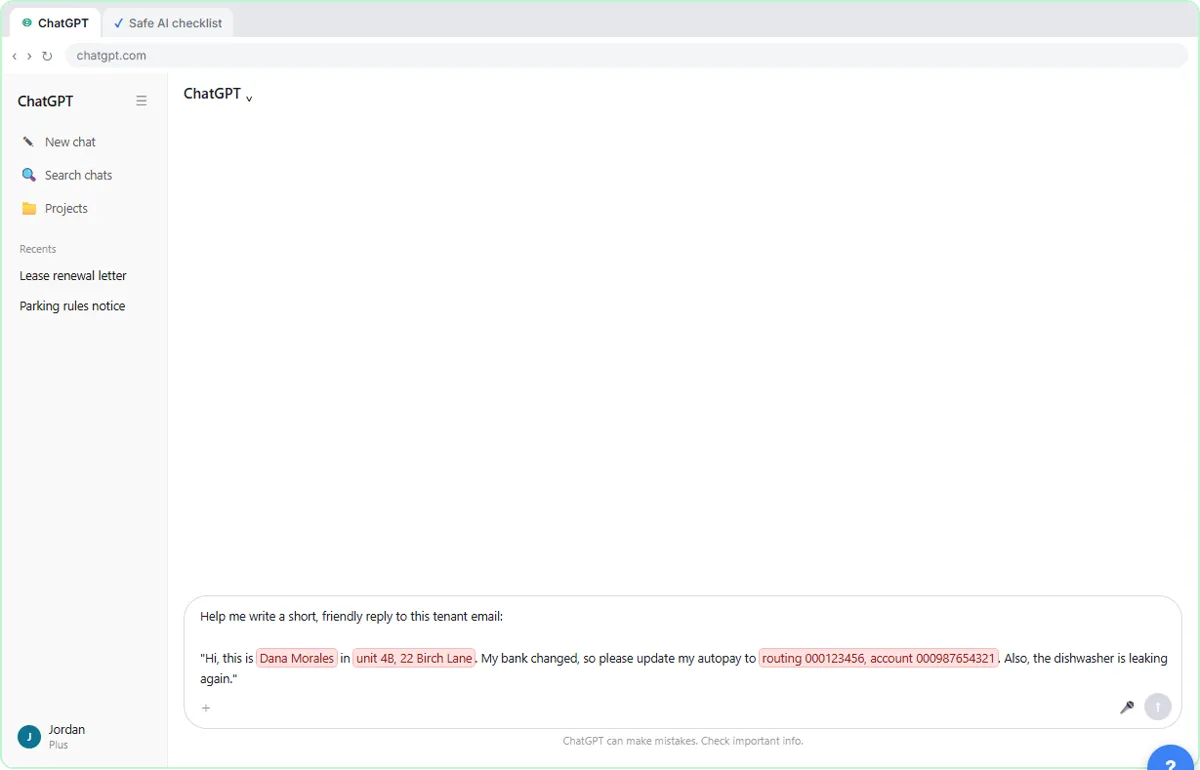
In the Use AI at Work Without Leaking Client Data lesson, a staff member at Lakeside Property Management wants help replying to a tenant. The tenant's email contains a bank account number and a home address, which are confidential.
The lesson shows the second habit: before you paste, take out the names, addresses and account numbers and use placeholders. ChatGPT still writes a useful reply, and the private details never leave the file. Classification is the step that makes you notice which parts to replace.
Try this lesson free or read the step-by-step guide.
Common confusions
Classification vs encryption
Classification decides how sensitive something is. Encryption protects it technically. You need the first to know what rules apply.
Classification vs redaction
Classification is the sorting. Redaction is the action you take on a confidential item, such as swapping a name for a placeholder.
Tips
- Keep the levels to three so people remember them.
- Print examples on the policy page, since people sort by example.
- When in doubt, treat it as confidential and ask the policy owner.
Related terms
More Business terms
Where you use it: free lessons
- Use AI at Work Without Leaking Client Data using ChatGPT (ChatGPT, 7 min)
- Know What Never Goes into AI: a Four-Level Data Cheat Sheet using ChatGPT (ChatGPT, 7 min)
Frequently asked questions
- What kind of data should never go into ChatGPT?
- Passwords, full bank or card numbers, ID numbers, health details and confidential client files. Use placeholders for anything the task does not need.
- Is internal data safe to paste into AI?
- Only in an approved account with the right settings, and only what the task needs. Check your policy and client contracts.
- How many classification levels do I need?
- Three is enough for most small firms: public, internal and confidential.