What is shadow AI?
Quick answer
Shadow AI is when employees use AI tools their company has not approved or does not know about, such as a personal ChatGPT account, a free summarizer website or a browser extension. The work usually gets done. The risk is where the data went and what account it went into.
Last updated
Updated · By Robert Breen
Why it matters for a small business
People reach for AI because it saves them real time, and if the company offers no approved option they find their own. That is understandable, but a free personal account may have different data settings than a business plan, and nobody at the firm can see what was shared, delete it or answer a client who asks.
Banning AI outright tends to push it further into the shadows. A better fix is to offer an approved tool that is easy to use, explain what data must never go in, and make it safe for people to say what they already use. Shadow AI is often a sign of demand. It tells you which jobs your team most wants help with.
In a real lesson: Summarize a Meeting Transcript with ChatGPT
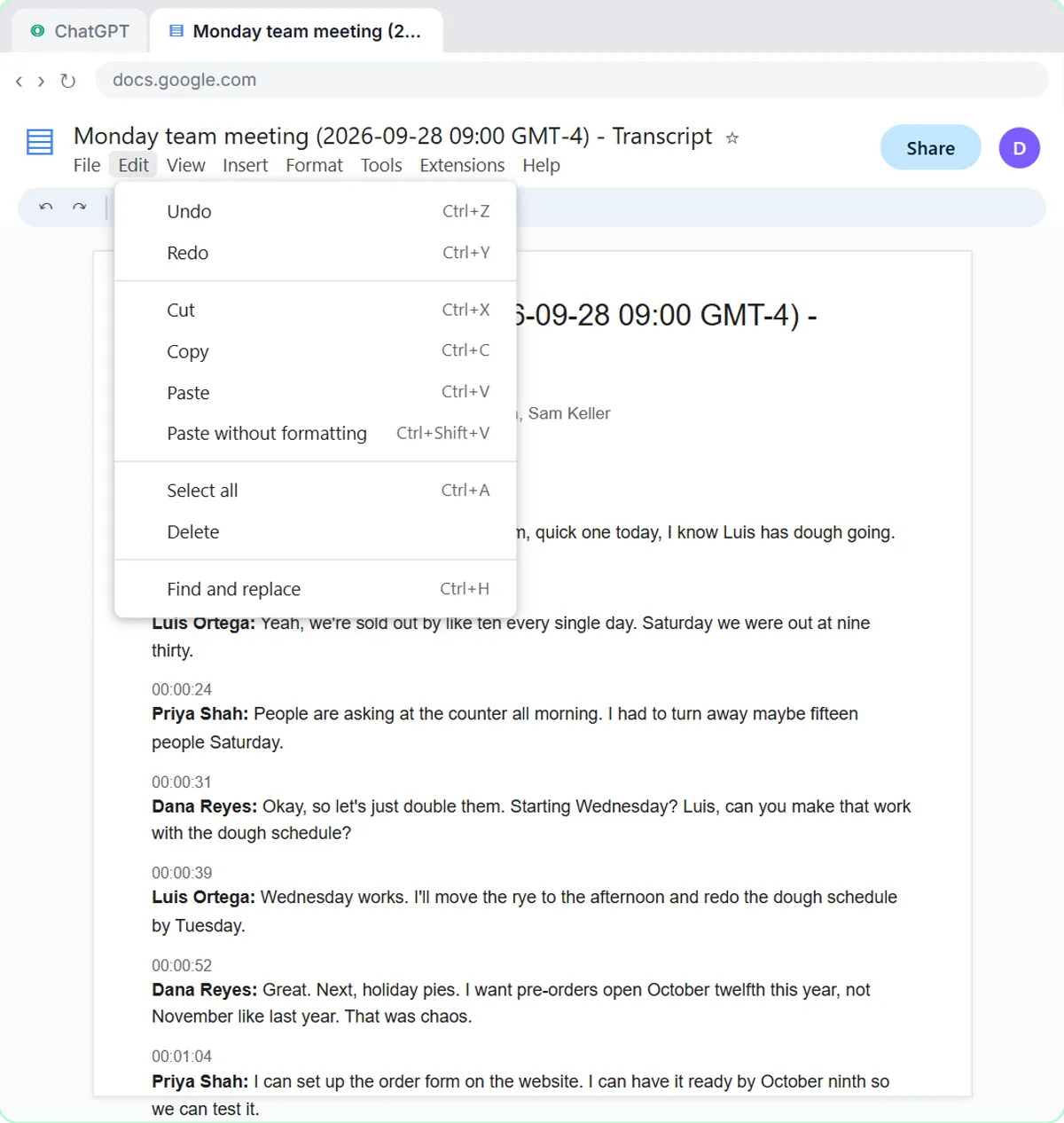
In the Summarize a Meeting Transcript lesson, you copy the transcript Google Meet saved after a Monday team meeting at Harbor Street Bakery, a made-up business, and paste it into ChatGPT under a request for a summary, decisions, an action items table and open questions.
It is exactly the kind of task that turns into shadow AI. The transcript names staff, a catering client, the Oakwood Library order for eighty people, and a broken oven. Pasting it into a work account the bakery approved is one thing. Pasting it into a personal account on a phone during lunch is another, even though the steps look the same.
The lesson ends with the right instinct: "If a transcript has private details in it, check your company's rules before you share it with any AI tool." The client meeting version goes further and says to use a business account that does not train on your data.
Try this lesson free or read the step-by-step guide.
Common confusions
Shadow AI vs shadow IT
Shadow IT is any unapproved software, such as a personal file-sharing app. Shadow AI is the AI slice of it, with the added worry that pasted text may be stored or, on some accounts, used to improve the model.
Shadow AI vs misuse
Most shadow AI is well meant: someone trying to work faster. Treat it as a gap in your approved tools first, and a discipline problem only if someone ignores clear rules.
Tips
- Ask your team, without blame, which AI tools they already use and for what.
- Offer at least one approved option and show people how to turn on the right data controls.
- Spell out what never goes into any AI tool: account numbers, tax IDs, passwords, health details.
Related terms
More Business terms
Where you use it: free lessons
- Summarize a Meeting Transcript with ChatGPT (ChatGPT, 9 min)
- Turn a Client Meeting into Action Items and a Follow-Up Email (Accounting Firms) (ChatGPT, 9 min)
Prompt templates that use it
Frequently asked questions
- How do companies find out about shadow AI?
- Often by asking. Some IT teams also review which apps are connected to company Google or Microsoft accounts, or which sites staff visit. A friendly survey usually tells you more than monitoring does.
- Are AI browser extensions a form of shadow AI?
- They can be. Some extensions read the pages you visit, including email and documents. Treat them like any other AI tool: approved only after someone checks what they can see and where the data goes.