What is days sales outstanding (DSO)?
Quick answer
Days sales outstanding (DSO) is the average number of days it takes a business to collect payment after making a sale on credit. A common formula is accounts receivable divided by credit sales for the period, multiplied by the number of days in that period.
Last updated
Updated · By Robert Breen
Why it matters for a small business
DSO turns a pile of unpaid invoices into one number you can watch. If your terms are 30 days and your DSO is 52, customers are paying three weeks late on average, and that gap is cash your business is lending them for free. A rising DSO is often the first warning of a cash squeeze, weeks before the bank balance shows it.
It is also a fair way to judge whether collection habits are working. Sending invoices the same day, quoting the invoice number in every reminder and following up on a fixed schedule all push DSO down. AI doesn't change the formula, but it makes the follow-up cheap enough that it happens on time, which is what moves the number.
In a real lesson: Build a Custom GPT That Writes Overdue Invoice Reminders
In Build a Custom GPT That Writes Overdue Invoice Reminders, Maple Street Bookkeeping, a made-up firm, bills clients on one rule: "Invoices are due 30 days after the invoice date." The test reminder is for "a client whose $850 invoice is 45 days overdue."
Do the math on that one invoice and you see what DSO measures. The bill went out 75 days ago, so for this client the firm waited two and a half times its own terms. If many clients look like that, the firm's DSO climbs well above 30.
The lesson doesn't calculate DSO. What it builds is the habit that lowers it: a reminder with the invoice number, amount, original due date and days overdue, ready in seconds, so nobody puts off following up.
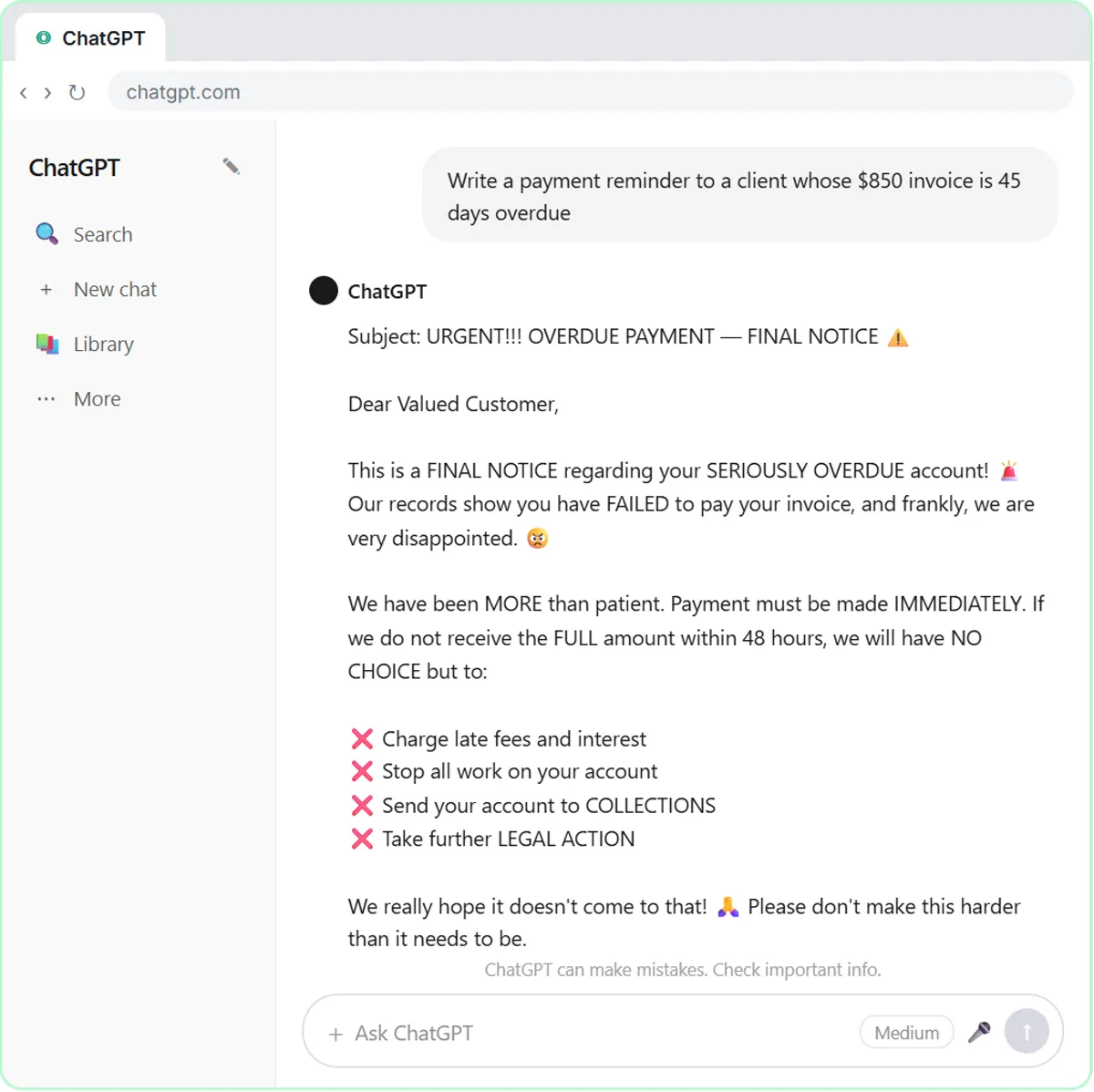
Try this lesson free or read the step-by-step guide.
Common confusions
DSO vs AR aging report
An AR aging report lists each unpaid invoice by how late it is. DSO squeezes the whole picture into one average. Use the aging report to act and DSO to track the trend.
DSO vs payment terms
Payment terms are what you asked for. DSO is what actually happened. The gap between them is the size of your collection problem.
Tips
- Calculate DSO the same way every month so the trend is meaningful.
- Compare DSO to your standard terms, not to other industries.
- When DSO rises, open the aging report and start with the largest overdue invoices.
Related terms
More Business terms
Where to learn more
Frequently asked questions
- What is a good DSO?
- A DSO close to your payment terms is healthy. If you bill on Net 30, a DSO in the low to mid 30s means customers mostly pay on time. Your accountant can tell you what is normal for your type of business.
- Can AI calculate DSO?
- It can explain the formula and check your math, but the inputs should come from your accounting software. Let a spreadsheet or your books do the calculation so the number is exact.