What is bad debt?
Quick answer
Bad debt is an amount a customer owes that the business decides it will not be able to collect, for example because the customer closed, disappeared or simply won't pay. It is removed from accounts receivable and recorded as an expense, often called a write-off.
Last updated
Updated · By Robert Breen
Why it matters for a small business
Every business that lets customers pay later will have some. The question is how much, and how early you see it coming. Invoices rarely go bad overnight; they age past 60 and 90 days first, which is why an AR aging report is the best early warning. The older an invoice gets, the less likely it is to be paid.
Writing off a debt is an accounting decision with tax and legal consequences, so it belongs with your accountant. What everyone else can do is lower the odds: invoice promptly, follow up on a schedule and escalate to a personal call before the account goes silent. AI helps with the steady early reminders. It should not decide that a customer's balance is uncollectable.
In a real lesson: Build a Custom GPT That Writes Overdue Invoice Reminders
The custom GPT in Build a Custom GPT That Writes Overdue Invoice Reminders works on the stretch before an invoice goes bad. Its test request is for an $850 invoice that is 45 days overdue at Maple Street Bookkeeping, a made-up firm whose invoices are due 30 days after the invoice date.
The GPT writes a polite, specific reminder with the invoice number, amount, original due date and days overdue, plus one next step. Its attached collections policy keeps it to the payment options the firm actually accepts.
What the lesson leaves to people matters here too. A reminder is fine to draft with AI. Anything long overdue or disputed should be handled personally, and the decision to stop chasing and write the balance off belongs with the firm and its accountant.
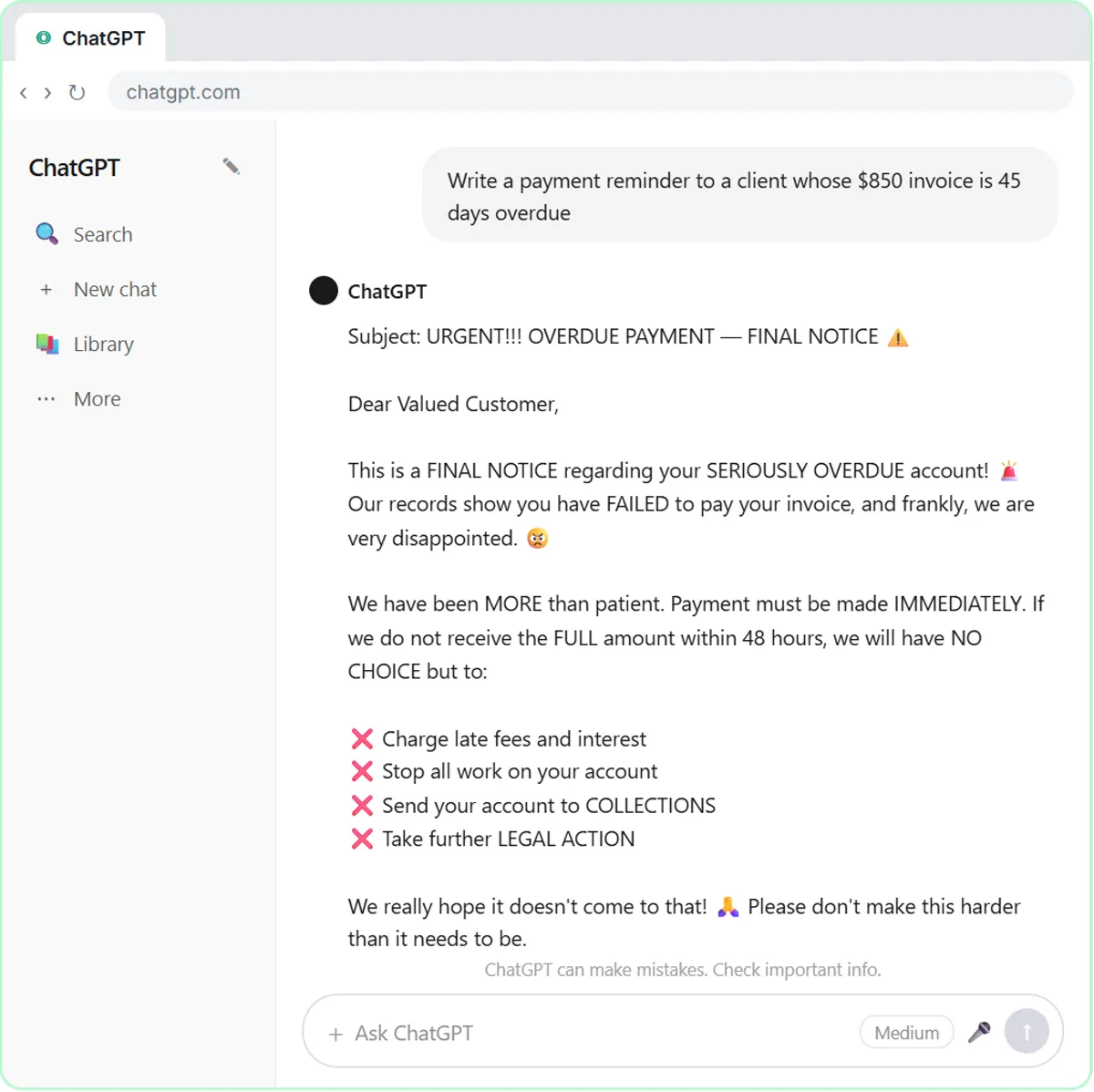
Try this lesson free or read the step-by-step guide.
Common confusions
Bad debt vs overdue invoice
An overdue invoice is late but still expected. Bad debt is a balance you have decided you won't collect. Most bad debt starts as an overdue invoice nobody followed up on.
Bad debt vs a credit memo
A credit memo reduces a bill because of a return, error or agreement. A bad debt write-off happens because the customer won't or can't pay.
Tips
- Review invoices over 60 days old every week and call the largest ones.
- Keep a record of every reminder sent, in case you need it later.
- Ask your accountant how and when your business should write off a balance.
Related terms
More Business terms
Where to learn more
Frequently asked questions
- When should an invoice be written off as bad debt?
- When you have made reasonable efforts to collect and no longer expect payment. The timing and the accounting treatment depend on your books and tax rules, so ask your accountant.
- Can I still collect a debt after writing it off?
- Often yes. A write-off changes your books, not necessarily what the customer owes. If money arrives later, your accountant will record it as a recovery.