What is the allowance for doubtful accounts?
Quick answer
The allowance for doubtful accounts is an estimate of how much of a company's accounts receivable will never be collected. It is recorded as a contra-asset account that reduces receivables on the balance sheet, so the books show the amount the business realistically expects to collect instead of the full amount billed.
Last updated
Updated · By Robert Breen
Why it matters for a small business
Not every invoice gets paid, and waiting until a customer disappears to record the loss makes past months look better than they were. Under accrual accounting, the allowance records the expected loss in the same period as the sales, which gives owners, lenders and buyers a truer picture. Businesses that keep cash-basis books usually don't need one, because unpaid invoices were never counted as income.
A common way to estimate it uses your AR aging report: a small percentage for current invoices and larger ones for older buckets. With made-up numbers: $30,000 current at 1 percent is $300, $6,000 at 31 to 60 days at 5 percent is $300, $3,000 at 61 to 90 days at 20 percent is $600, and $1,000 over 90 days at 50 percent is $500. The allowance is $1,700, so $40,000 of receivables shows as $38,300. Your accountant sets the method and the rates.
In a real lesson: Turn a Client Meeting into Action Items and a Follow-Up Email (Accounting Firms)
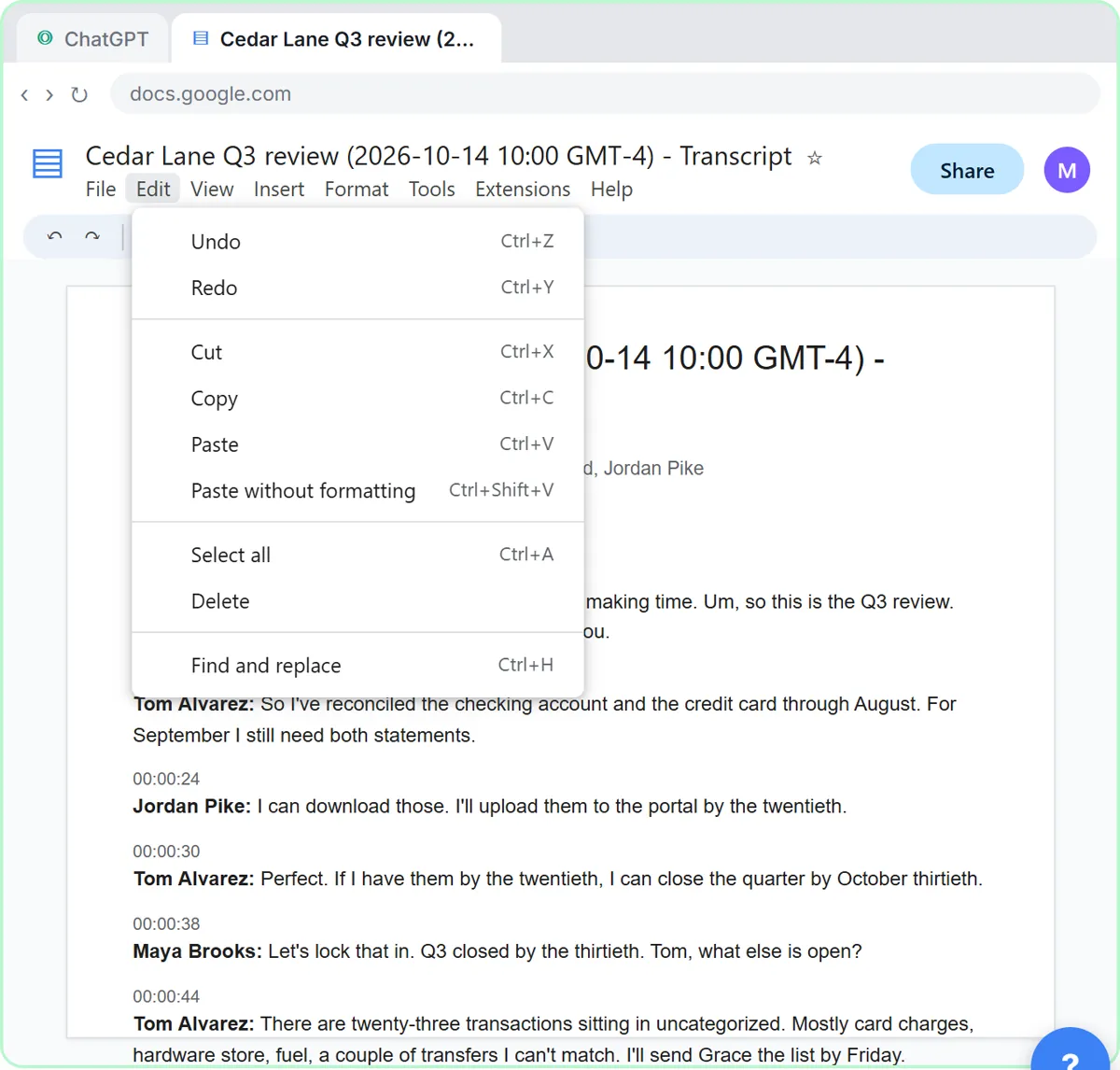
Stepthrough has no lesson that calculates an allowance. The closest is Summarize a Client Meeting, because the allowance is usually reviewed at a period close, and this lesson is a quarter-close meeting. Millbrook Accounting, a made-up firm, holds a Q3 review with its client Cedar Lane Landscaping, where the bookkeeper says, "If I have them by the twentieth, I can close the quarter by October thirtieth."
The request you paste asks ChatGPT for "The action items as a table: task, owner, due date" and tells it to write "Not stated" when an owner or date is missing. The transcript never mentions receivables, so the summary doesn't either.
That is the honest link. If a review like this included updating the allowance, the table would show who owns it and by when. A "Not stated" in that row is a cue to assign it before the quarter closes.
Try this lesson free or read the step-by-step guide.
Common confusions
Allowance vs bad debt
The allowance is an estimate of future losses across all receivables. Bad debt is a specific balance you have decided you won't collect. When you write one off, it is charged against the allowance.
Allowance vs bad debt expense
Bad debt expense is the cost recorded on the income statement for the period. The allowance is the running balance on the balance sheet that the expense builds up.
Tips
- Review the allowance at every month or quarter close, not just at year end.
- Base the rates on your own collection history, with your accountant.
- Ask AI to explain the entries in plain words, but keep the estimate in your books.
Related terms
More Business terms
Where you use it: free lessons
More free tutorials
Frequently asked questions
- Is the allowance for doubtful accounts an asset or a liability?
- Neither, exactly. It is a contra-asset: an account with a credit balance that sits under accounts receivable on the balance sheet and reduces it. Receivables minus the allowance is the net amount you expect to collect.
- How is the allowance for doubtful accounts calculated?
- Two common methods are a percentage of credit sales for the period and an aging method that applies higher percentages to older invoices. Either way, the rates should come from your own history, and your accountant should choose the method.
- Does the allowance affect taxes?
- Tax rules for bad debts often differ from accounting rules, and many businesses can only deduct specific debts once they are actually written off. Your accountant handles how the book allowance and the tax return line up.