This guide is for owners and marketers at small local firms (accountants, law offices, insurance agencies, dental practices, consultants) who already use ChatGPT and have noticed it never names them.
Myth or fact: does ChatGPT pick favorites?
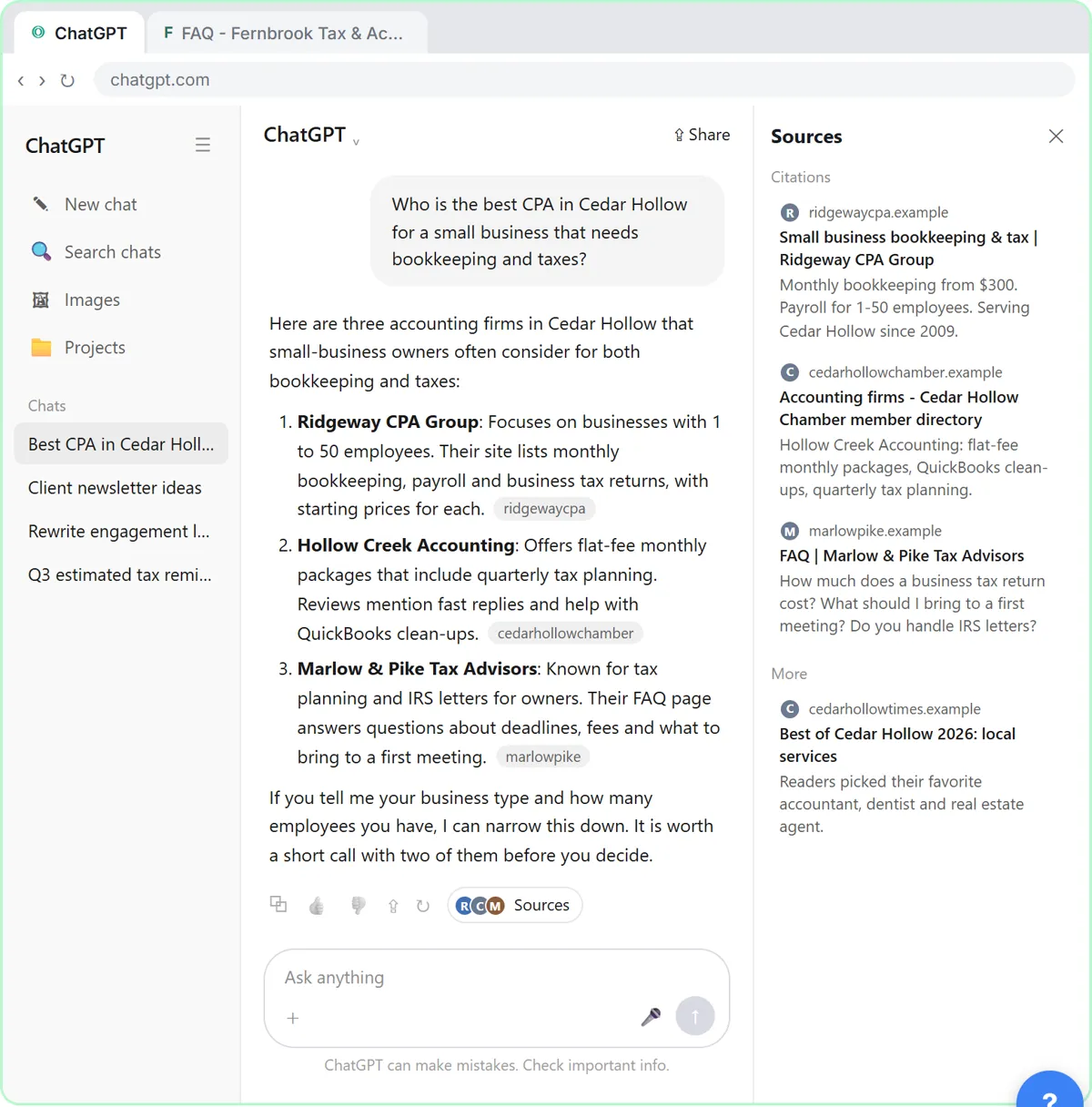
Myth. ChatGPT doesn't keep a list of favorite businesses. For a local question it searches the web, reads a handful of pages and names the businesses those pages make easy to recommend. The lesson's made-up firm, Fernbrook Tax & Accounting in the made-up town of Cedar Hollow, asks ChatGPT the question a new client would ask:
Who is the best CPA in Cedar Hollow for a small business that needs bookkeeping and taxes?
ChatGPT names three other firms, each with a citation. Fernbrook isn't one of them. Nothing personal happened. The other firms simply had pages that answered the question, and Fernbrook's didn't.
How do I see why ChatGPT chose them?
Look at the citations and the Sources list under the answer. In the lesson you point to a citation to preview the page behind it, then click Sources to see everything ChatGPT read. In the real app, Sources is the last icon in the row under the answer, and the list opens on the right.
For Fernbrook, the sources were the other firms' own websites, the local Chamber of Commerce member directory and a "Best of Cedar Hollow" list in the local paper. That mix is the whole story: pages that answer the question clearly, plus other sites that mention the firm.
A local question in real ChatGPT often shows a map too, with each firm's star rating and review count. Those come from map listings such as your Google Business Profile, which is why reviews matter.
What do the recommended businesses have in common?
Ask ChatGPT directly. The lesson's second question is:
We're Fernbrook Tax & Accounting in Cedar Hollow, and we weren't named. Based on the pages you found, what did those firms make easy to find that helped you recommend them? Then list the 10 questions small-business owners ask before choosing an accountant, in their own words.
The answer lists four things the named firms did:
- Their pages say plainly who they serve (small businesses, 1 to 50 employees) and that they are in Cedar Hollow.
- Each service has its own section, often with a starting price.
- Their FAQ answers the questions people actually type, in full sentences.
- Other sites mention them: the Chamber directory, a local "best of" list and reviews.
None of that is a keyword trick. It's the same information a person needs to choose a firm, written where both people and AI tools can find it. The AI search glossary entry puts it simply: the response is mostly old-fashioned clarity.
How do I fix it with my own facts?
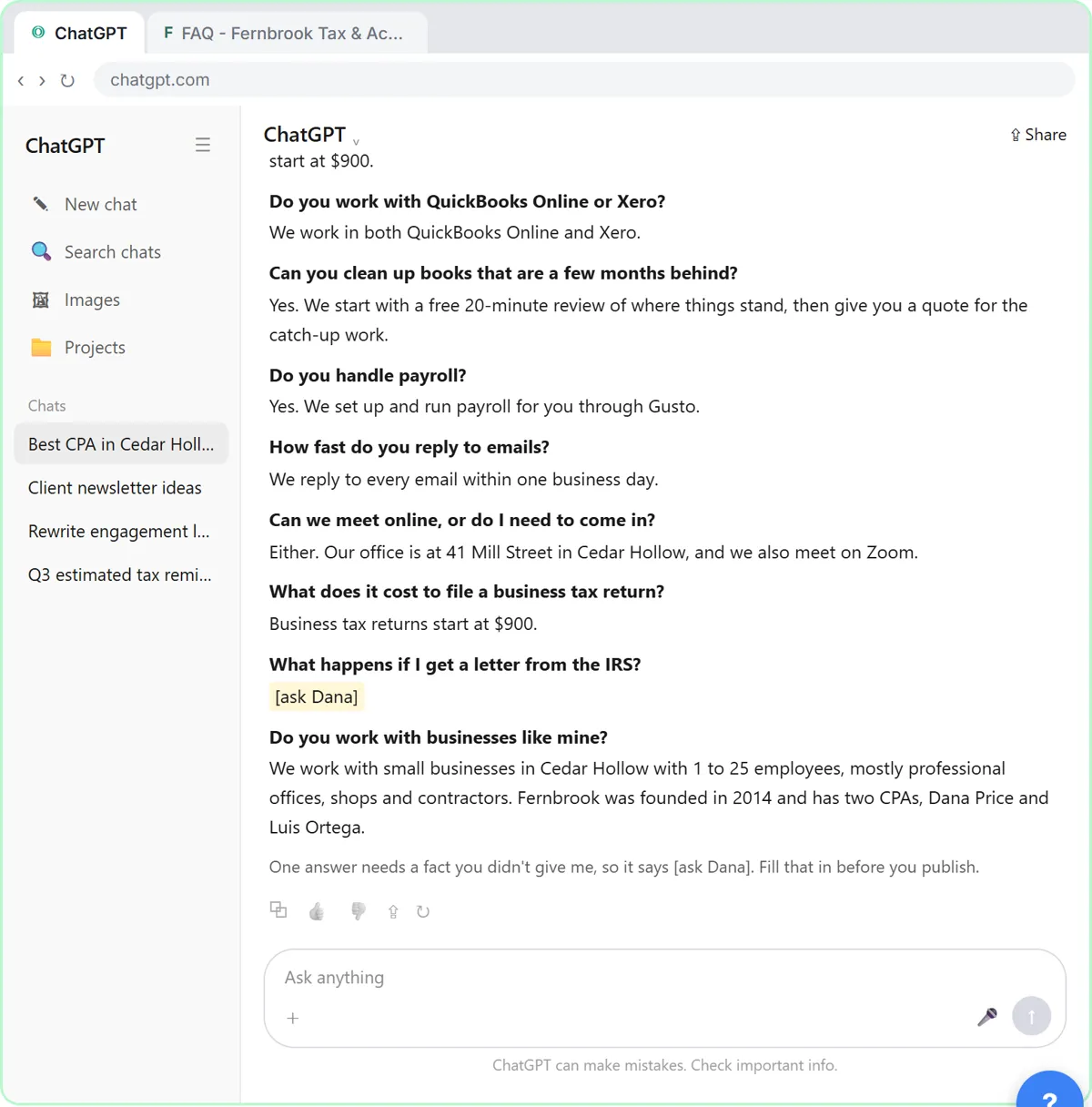
Turn the ten customer questions into an FAQ page, using only facts you give ChatGPT. This is the step where most people go wrong, because an AI asked to "write an FAQ page for my firm" will happily invent prices and promises. The lesson's request lists Fernbrook's real facts (address, who they serve, starting prices, software, payroll provider, reply time, the two CPAs and the year they started) and adds one rule:
If a question needs a fact that isn't here, write [ask Dana] instead of guessing.
When the answer comes back, the question about IRS letters says [ask Dana], because the facts never covered it. That's exactly what you want: a gap you can see and fill, instead of a confident sentence someone invented.
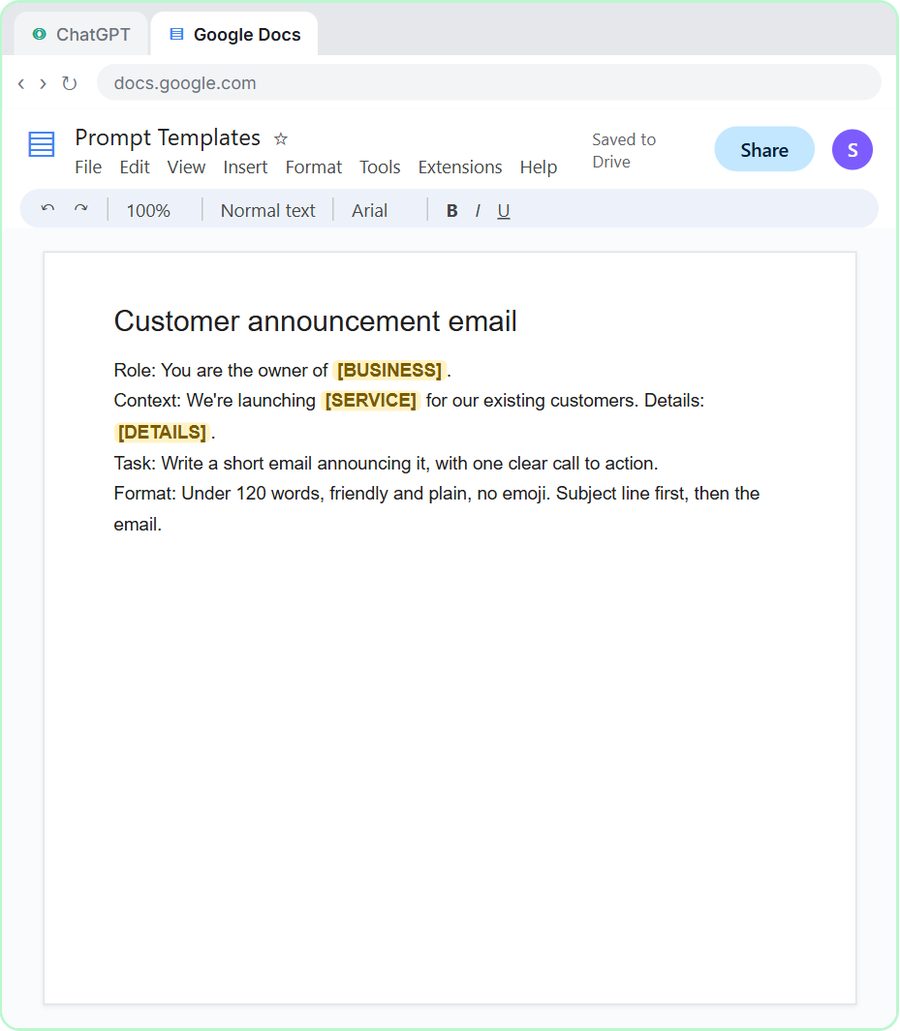
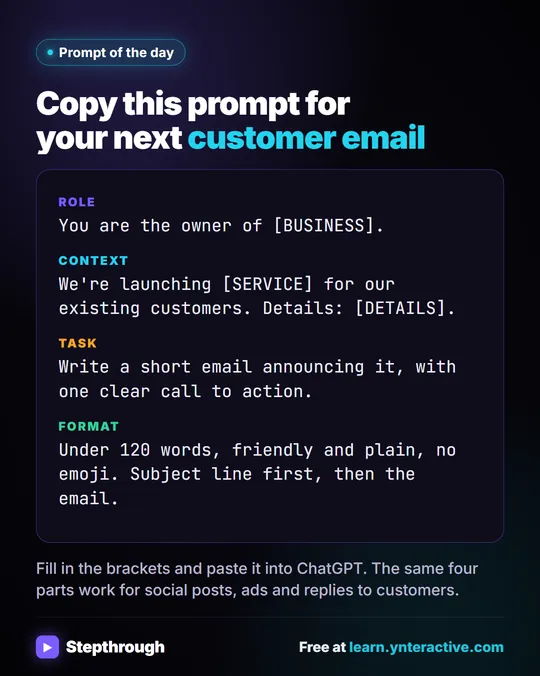
The same four-part habit from Prompt Writing 101 is at work here: say who you are, give the context ChatGPT can't guess, name the task and set the format. Asking for a fixed shape, one short paragraph per question, is a simple case of structured output.
Try it free, step by step
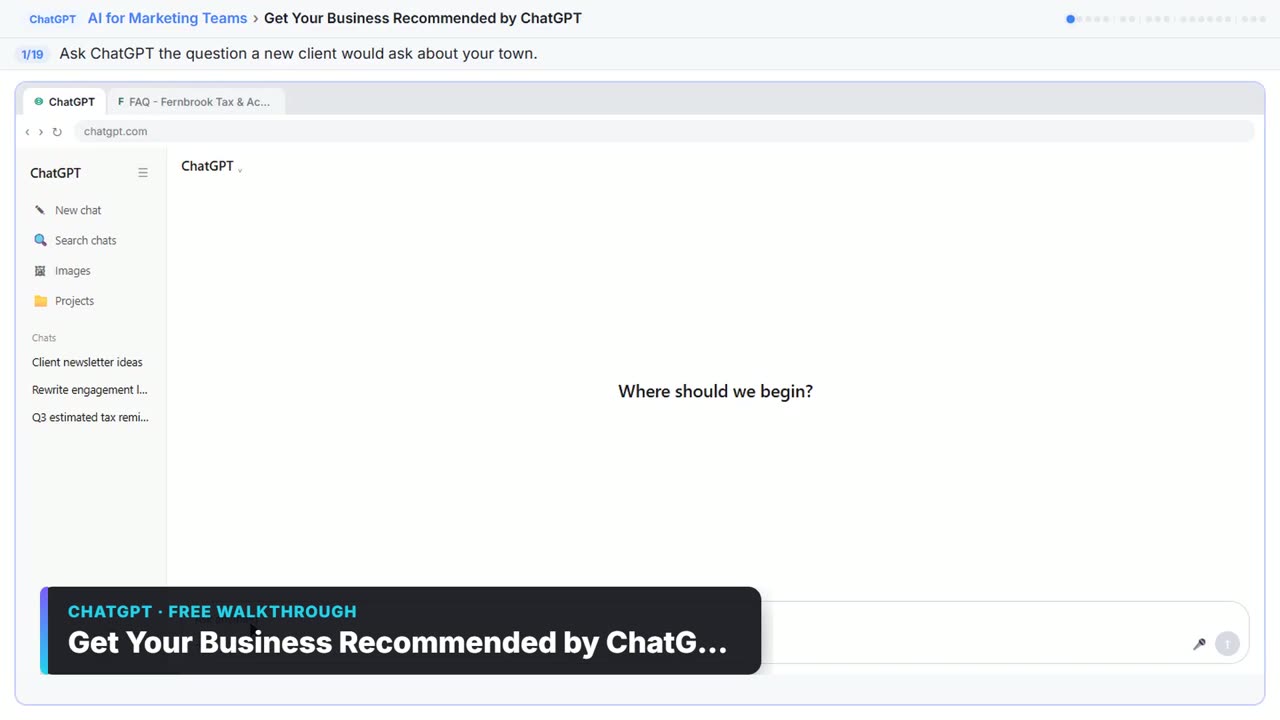
Get Your Business Recommended by ChatGPT. Ask ChatGPT who it recommends in your town, see which pages it trusts, then use it to write an FAQ page and Business Profile copy that answer real customer questions. You do every step yourself in a practice copy of ChatGPT, it checks your work as you go, and “Do it for me” finishes any step you get stuck on. Free, and nothing touches your real accounts.
Start the free lessonWhat else should I update besides my website?
Your Google Business Profile and the local sites that mention you. In the lesson, after the FAQ page, you ask ChatGPT for a new Business Profile description under 750 characters (Google's limit) and a services list, from the same facts. You paste it in under Edit profile. Google Business Profile Description: Write It with ChatGPT covers that step on its own.
Then come the outside mentions, which you can't write yourself but can encourage:
- Ask happy clients for a Google review. Reviews show on the map listing next to your name.
- Check your Chamber or trade-association listing. Make sure the services, town and contact details match your website.
- Keep the facts consistent everywhere. The same services, the same town and the same starting prices on your site, your profile and directories.
For your web person, the lesson also asks ChatGPT for the FAQ as FAQPage schema markup. It labels each question and answer so search tools read the page cleanly. It won't win you a special spot on its own.
How do I check whether it worked?
Paste your finished page back into ChatGPT and ask what it would now say about you. The lesson's check prompt asks ChatGPT to read the page "the way you would to answer a customer" and say what's still missing. For Fernbrook it finds two gaps: the IRS answer still says [ask Dana], and there are no reviews or outside mentions yet.
Then, in a few weeks, click New chat and ask the first question again. Try Perplexity and Google's AI Mode too, and note who is named and which sources are cited. Doing this once a month is enough to see whether anything has changed.
Can anyone guarantee my business gets recommended?
No. OpenAI says placement in ChatGPT search results isn't guaranteed, and anyone who promises a spot in ChatGPT, Google's AI Overviews or Perplexity is guessing. What you control is whether your own answers are clear, true and easy to find, and whether other local sites mention you.
One technical item to check: OpenAI says sites must allow its crawler, OAI-SearchBot, in robots.txt to be eligible for ChatGPT search results. Ask your web person to confirm it isn't blocked. The What Is GEO? post explains the wider idea behind all of this.
Glossary terms used in this post: AI search, AI citations and grounding.
Key takeaways
- ChatGPT recommends the local businesses whose pages answer the customer's question plainly and that other sites, such as a Chamber directory or a local "best of" list, also mention.
- Click Sources under a ChatGPT answer to see exactly which pages it read before naming your competitors.
- Ask ChatGPT what made those businesses easy to recommend and which 10 questions customers ask, then answer those questions on your own FAQ page.
- Give ChatGPT only your real facts and tell it to write a placeholder such as [ask Dana] when a fact is missing, so nothing is invented.
- No one can guarantee a place in ChatGPT's answers; re-ask the same question every few weeks and keep your facts consistent everywhere.
Frequently asked questions
- Does ChatGPT search the web for local recommendations?
Yes, for questions like "best CPA in my town" it usually searches the web and shows citations. Web search works on the free plan and every paid plan, and even without signing in, so your customers can ask it this today.
- Why does ChatGPT name a firm I've never heard of?
Because that firm's pages, or pages that mention it, answered the question clearly. Open Sources under the answer to see which sites it relied on. Often it's a firm's FAQ page or a local directory listing.
- Do I need an SEO agency to fix this?
Not to start. The lesson's steps all happen in a ChatGPT chat: find the questions, write answers from your facts, update your Business Profile and check the result. You may need your web person to publish the page and add the FAQ markup.
- Will FAQ schema markup get me recommended?
Not by itself. FAQPage markup labels each question and answer so tools read your page cleanly. The content of the answers, and other sites mentioning you, matter more.