What is workflow automation?
Quick answer
Workflow automation connects the steps of a repeated business task so they run on their own, in order, after a trigger. A new invoice arrives, its details are read, a row is added to a sheet and a message goes to a person who approves it. AI can read or draft inside a step, and a person can approve at the points that matter.
Last updated
Take the free module →Module 11 of the free AI for Accounting & Bookkeeping Firms course, about 14 minutes. No account needed.
Updated · By Robert Breen
Why it matters for a small business
Most office work is the same few steps repeated: something arrives, someone copies details into a place, someone else is asked to approve. Each hand-off is a chance to forget, mistype or delay. Automating the sequence removes the copying and keeps a record of every run, so the work moves even when no one is watching.
The practical rule is to automate the repeating part and keep a person on the decisions. A workflow starts with a trigger, runs steps, and can pause at an approval step. It differs from a one-off chat with an AI because it runs again the same way tomorrow. See also automation and SOP for the documented version of the same steps.
A simple invoice workflow, step by step
| Step | What happens | Who or what does it |
|---|---|---|
| Trigger | An invoice email arrives | The workflow |
| Read | Vendor, number, dates and total are pulled out | AI inside one step |
| Record | A row is added to a sheet | The workflow |
| Approve | Large invoices wait for a yes | A person |
This is the shape of the lesson below, simplified. Real workflows add error handling and tests.
In a real lesson: Invoices from Your Inbox to Google Sheets, with Approval
In the Invoices from Your Inbox to Google Sheets, with Approval lesson, you keep the books at Cobalt Street Architects, a made-up firm. Vendor invoices land in the inbox as PDFs and someone retypes the vendor, invoice number and total into a sheet.
You add an Information Extractor to read each invoice, log every one in Google Sheets, and use an If node so that anything over $1,000 goes to the owner with an Approve button. The copying is automated, and the one decision that needs judgment still goes to a person.
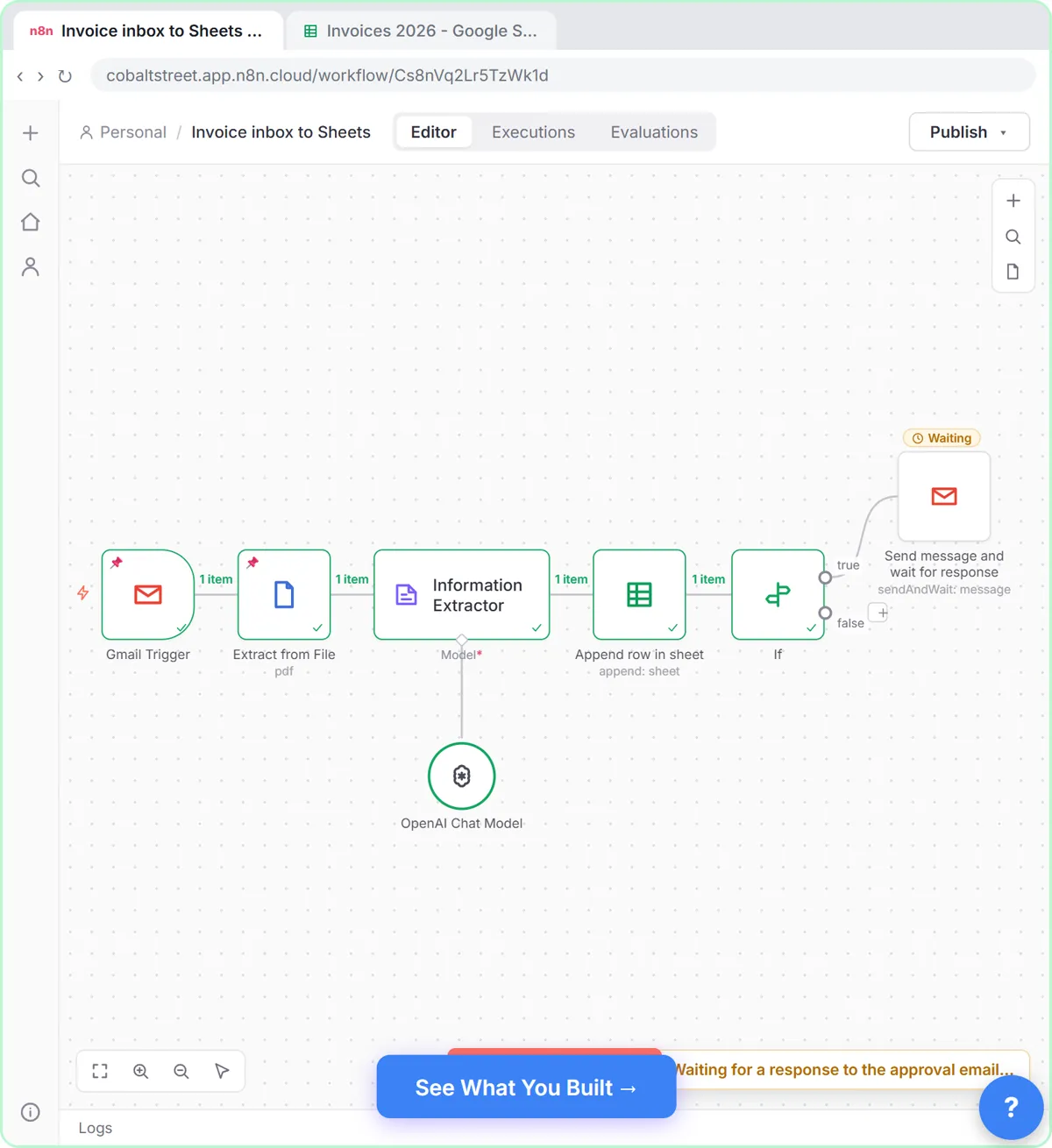
Try this lesson free or read the step-by-step guide.
Common confusions
Workflow automation vs AI agent
A workflow follows steps you laid out. An agent chooses its own steps. Many workflows contain an AI step without being an agent.
Workflow automation vs macros
A macro repeats actions inside one app. A workflow connects several apps, such as email, a sheet and a chat tool.
Tips
- Write the steps by hand first. If you cannot list them, you cannot automate them.
- Start with one boring, repeated task and test it with sample data.
- Add a person at any step that spends money or contacts a client.
- If no one on the team has time to build it, n8n consulting can set up the first workflow and hand it over.
Related terms
More n8n and automation terms
Where you use it: free lessons
- Invoices from Your Inbox to Google Sheets, with Approval (n8n, 14 min)
- n8n AI Agent Tutorial: Save Social Media Ideas to Google Sheets (n8n, 12 min)
- Lovable + n8n: Build a Web App with an AI Backend (Lovable and n8n, 15 min)
- Build an AI Demo Request Form That Qualifies Leads (Lovable and n8n, 15 min)
Watch it in a free lesson: Build an AI Demo Request Form That Qualifies Leads
 8:57
8:57AI Demo Request Form: video walkthrough
Build a "Book a demo" form in Lovable for Northwind Scheduling Software and connect it to n8n — the AI agent rates each lead hot, warm or nurture, saves it to Google Sheets and emails the right next step. The whole lesson narrated step by step, recorded in Stepthrough’s simulated practice environment.
Frequently asked questions
- What is an example of workflow automation?
- An invoice email arrives, its details are read and logged in a sheet, and any large invoice is sent to the owner for approval, all without retyping.
- Is workflow automation the same as AI?
- No. Automation runs fixed steps. AI can be used inside one step, for example to read a PDF, but it is not required.
- Which tasks should I automate first?
- Repeated tasks with clear steps and low risk, such as logging invoices or sending confirmations. Keep a person on money and client decisions.