What is role prompting?
Quick answer
Role prompting means telling an AI who it is, or who it is writing as, before you give the task. For example, "You are the owner of a small lawn care company." The role sets the point of view, the vocabulary and the level of detail, so the answer sounds like your business, not a generic template.
Last updated
Take the free module →Module 6 of the free AI at Work: Start Here course, about 8 minutes. No account needed.
Updated · By Robert Breen
Why it matters for a small business
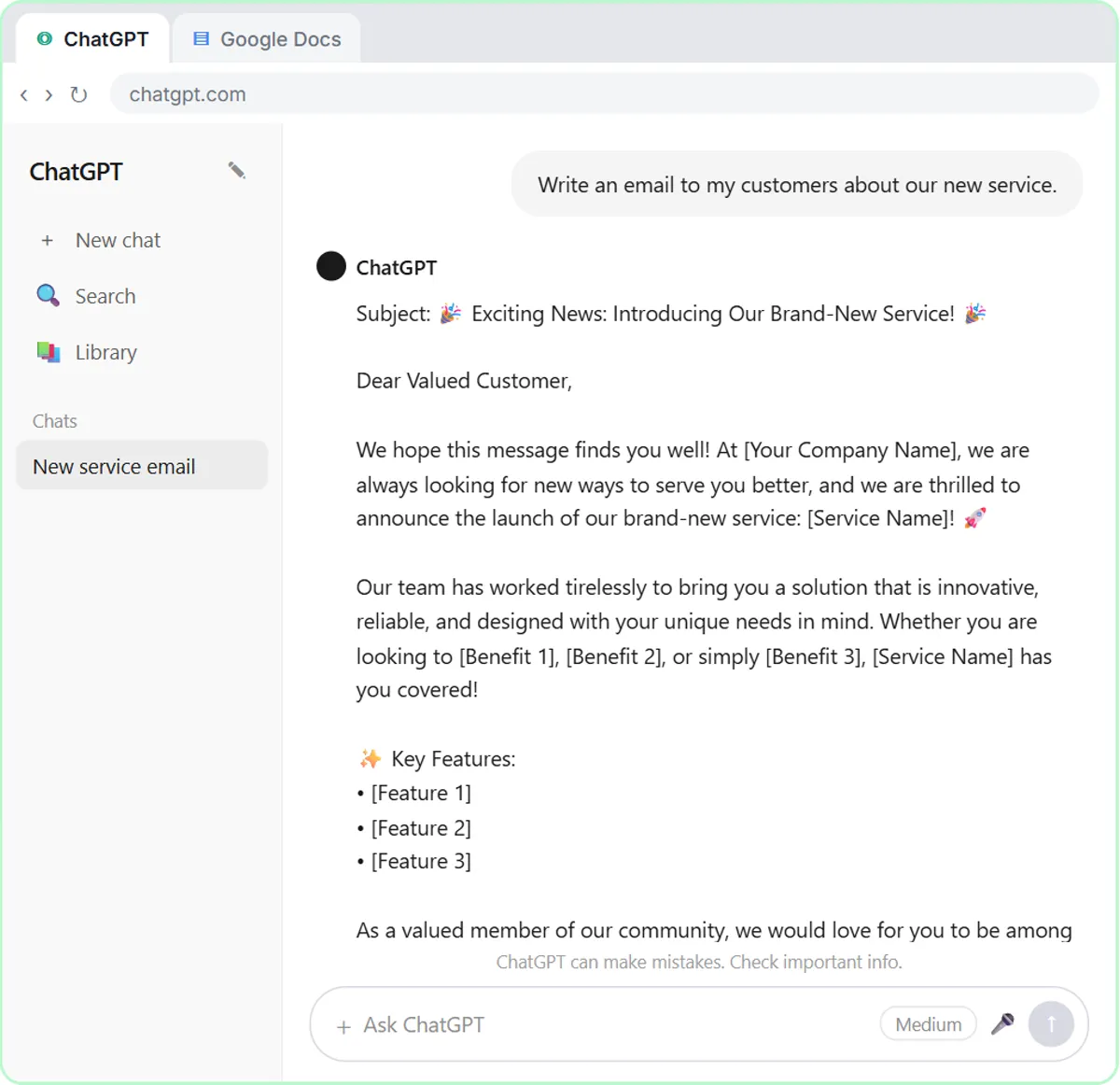
Without a role, an AI writes for nobody in particular. Ask for "an email to my customers" and you get a long, generic message full of blanks like a company name in square brackets. A role gives the model a seat to write from: an owner, an office manager, a recruiter. It then picks a more fitting tone and word choice on its own.
A role is only one part of a good prompt. It does not give the AI your facts, so it will not know your prices or dates. That is why the common layout pairs it with context, a task and a format. Think of the role as who is talking, and the other three parts as what they know, what to do and how to hand it back. See role, context, task, format for the full pattern.
In a real lesson: Prompt Writing 101: Role, Context, Task, Format
In Prompt Writing 101, you first ask ChatGPT, "Write an email to my customers about our new service." The answer is long, generic and full of blanks. Then you build the same request in four parts. The first part, the Role, is pasted as: You are the owner of Summit Lawn Care, a small family-run lawn company in Harrisburg, PA.
The other parts then supply the facts (fall aeration and overseeding for $149), the task (a short email with one call to action) and the format (under 120 words, friendly, no emoji). The second answer is specific, short and ready to send.
In the Prompter AI lesson, a different role does the same job for meeting notes: You are an office manager who writes clear recaps for a busy team.
Try this lesson free or read the step-by-step guide.
Common confusions
Role prompting vs a system prompt
A role can be one line you type in a chat. A system prompt is the standing set of instructions a tool or developer sets up behind the scenes, and it often includes a role.
Does a role make the AI an expert?
No. It changes the voice and focus, not the facts the model knows. A "tax expert" role can still be wrong, so check anything that matters, as in human in the loop.
Tips
- Be specific: "office manager at a four-person insurance agency" beats "expert".
- Say who the reader is as well, such as existing customers.
- Put the role first, then your facts, so the AI does not fill gaps with guesses.
Related terms
More Prompting terms
Where you use it: free lessons
- Prompt Writing 101: Role, Context, Task, Format (ChatGPT, 8 min)
- The Prompter AI: Prove a Better Prompt Works on Your Own Meeting Notes (The Prompter AI, 8 min)
Frequently asked questions
- What is role prompting in simple terms?
- It is starting a prompt by saying who the AI is writing as, for example "You are the owner of a small lawn care company." That one line shapes the voice and level of detail.
- What is an example of role prompting?
- "You are an office manager who writes clear recaps for a busy team. Write a recap of these notes." The role comes first, then the task.
- Is role prompting still useful?
- Yes, for tone and point of view, but it works best with your facts, a clear task and a format. A role alone will not stop the AI from guessing missing details.