What is a profit and loss statement?
Quick answer
A profit and loss statement, or P&L, is a report that shows a business's sales, its costs and what is left over as profit for a period, such as a month or six months. It is also called an income statement. It answers one question: did the business make money in that period, and where did the money go?
Last updated
Take the free module →Module 6 of the free AI for Accounting & Bookkeeping Firms course, about 11 minutes. No account needed.
Updated · By Robert Breen
Why it matters for a small business
Owners make their biggest decisions from the P&L: whether to raise prices, cut a cost or hire. If the report is wrong, the decision is wrong. The two most common reasons a P&L is off are not exotic. A transaction gets counted twice, or a transaction never gets an account and so sits outside every line.
That is why an accountant checks the detail before anyone reads the summary. AI tools such as ChatGPT can add up thousands of rows quickly, but only after you have looked at the file and decided what to do with the problems. Related reports: the trial balance lists every account balance, and the general ledger holds every posting.
What a P&L summary shows, using the lesson's January numbers
| Line | January | What it means |
|---|---|---|
| Sales | $68,400 | Money earned from customers in the month |
| Food and beverage cost | $19,840 | What it cost to buy what was sold |
| Labor | $22,570 | Wages for the month |
| Operating expenses | $18,900 | Rent, utilities, linen and the rest |
| Net profit | $7,090 | Sales minus all three cost lines |
Figures are from the made-up Copper Pot Kitchen in the free P&L lesson, after cleanup.
In a real lesson: Analyze a Client's P&L Export with ChatGPT (Accounting & Bookkeeping Firms)
In the free Analyze a Client's P&L Export lesson, Millbrook Accounting (a made-up firm) keeps the books for Copper Pot Kitchen, a made-up 60-seat restaurant. The bookkeeper exports the Profit and Loss Detail report for January to June: 1,862 rows and 7 columns, one row per transaction.
Before any totals, ChatGPT is asked only to check the file. It finds 4 transactions that appear twice, which would count $3,475.00 of costs twice, and 9 rows with a blank account worth $2,140.00. You decide the fix: remove the second copy of each duplicate and park the blank rows in Needs review. Only then does ChatGPT build the monthly P&L summary, which shows sales up 33% from January to June.
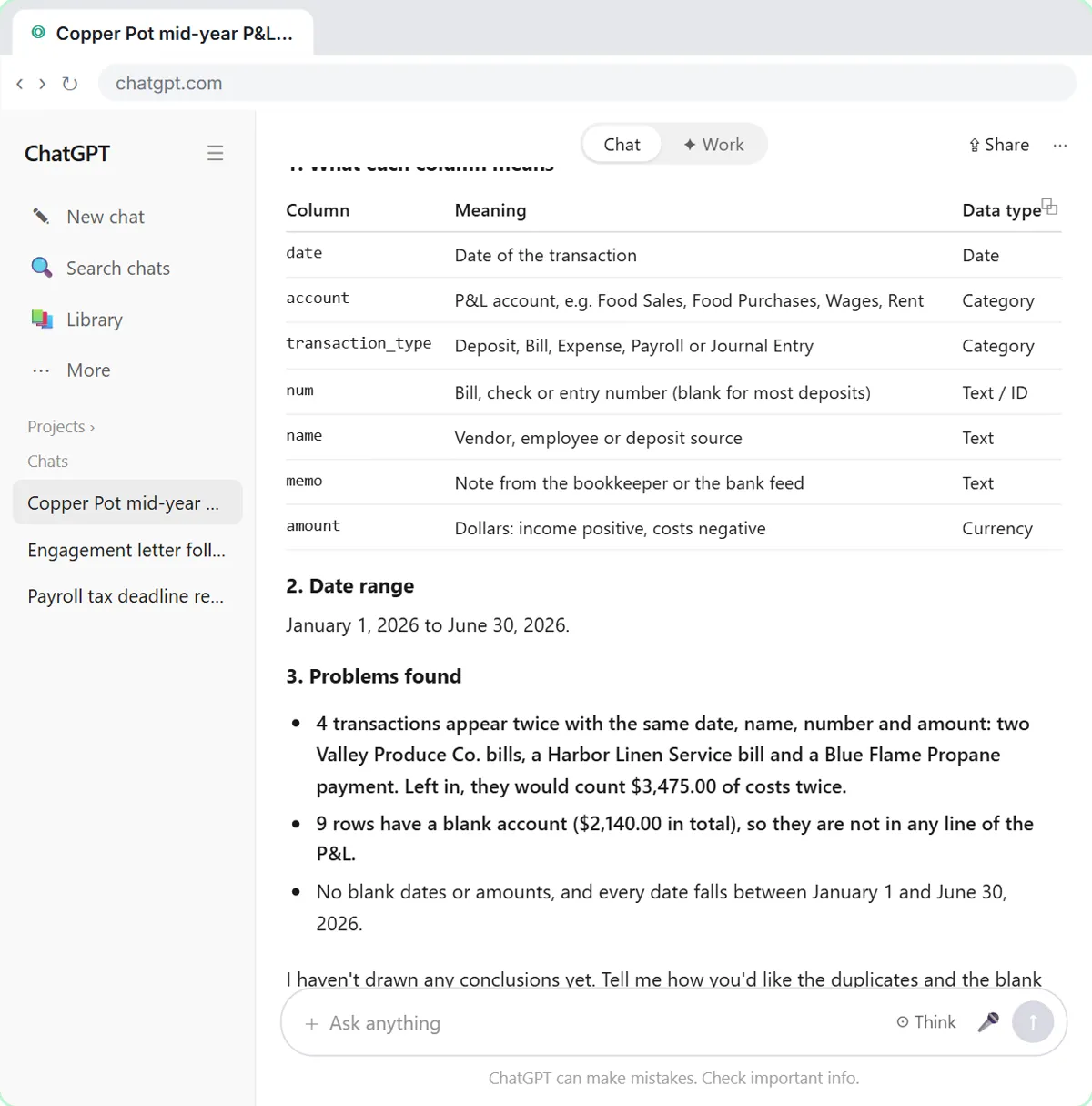
Try this lesson free or read the step-by-step guide.
Common confusions
P&L vs balance sheet
A P&L covers a period: what came in and went out between two dates. A balance sheet is a snapshot on one date: what the business owns and owes. Both come from the same books.
P&L summary vs P&L detail
The summary shows one total per line. The detail lists every transaction behind those totals. Check the detail first, because that is where duplicates and uncategorized rows hide.
Tips
- Decide yourself how duplicates and blank accounts are handled. That is an accounting call.
- Tie the AI's totals back to the P&L in your accounting software before the client sees them.
Related terms
More Business terms
Where you use it: free lessons
- Analyze a Client's P&L Export with ChatGPT (Accounting & Bookkeeping Firms) (ChatGPT, 11 min)
- Analyze a Spreadsheet with ChatGPT: Upload a CSV, Get a Chart and Three Takeaways (ChatGPT, 10 min)
- Month-End Bank Reconciliation with ChatGPT: 20 Minutes, Not 3 Hours (ChatGPT, 12 min)
Prompt templates that use it
Frequently asked questions
- Is a P&L the same as an income statement?
- Yes. Profit and loss statement, P&L and income statement are names for the same report.
- Can ChatGPT build a P&L summary from an export?
- It can total an export by month and line, as the free lesson shows. Check the file first, fix duplicates and blank accounts yourself, and tie the totals back to your accounting software.