What is net profit margin and how do you calculate it?
Quick answer
Net profit margin is the share of sales a business keeps as profit after all its costs. In words: take net profit, divide it by sales, and show the result as a percent. A margin of 10% means the business kept 10 cents of every sales dollar.
Last updated
Take the free module →Module 6 of the free AI for Accounting & Bookkeeping Firms course, about 11 minutes. No account needed.
Updated · By Robert Breen
Why it matters for a small business
Dollar profit alone can fool an owner. Profit can rise in a busy month while the business keeps a smaller share of each sale, which means costs are growing faster than sales. Net profit margin puts every month on the same scale, so a quiet month and a busy month can be compared fairly.
What counts as a cost in net profit depends on the report. A full income statement subtracts everything, including interest and taxes. A management P&L for a small client may stop at operating costs. Say which one you mean, keep it the same each month, and let a spreadsheet or your accounting software do the division. Compare it with gross margin, which subtracts only the direct cost of what was sold.
Net profit margin by month, Copper Pot Kitchen
| Month | Sales | Net profit | Margin |
|---|---|---|---|
| January | $68,400 | $7,090 | 10.4% |
| February | $64,900 | $4,760 | 7.3% |
| May | $88,600 | $12,580 | 14.2% |
| June | $91,300 | $12,470 | 13.7% |
| January to June | $467,200 | $55,080 | 11.8% |
Worked out from the made-up monthly figures in the free P&L lesson. Net profit here is sales minus food and beverage cost, labor and operating expenses.
In a real lesson: Analyze a Client's P&L Export with ChatGPT (Accounting & Bookkeeping Firms)
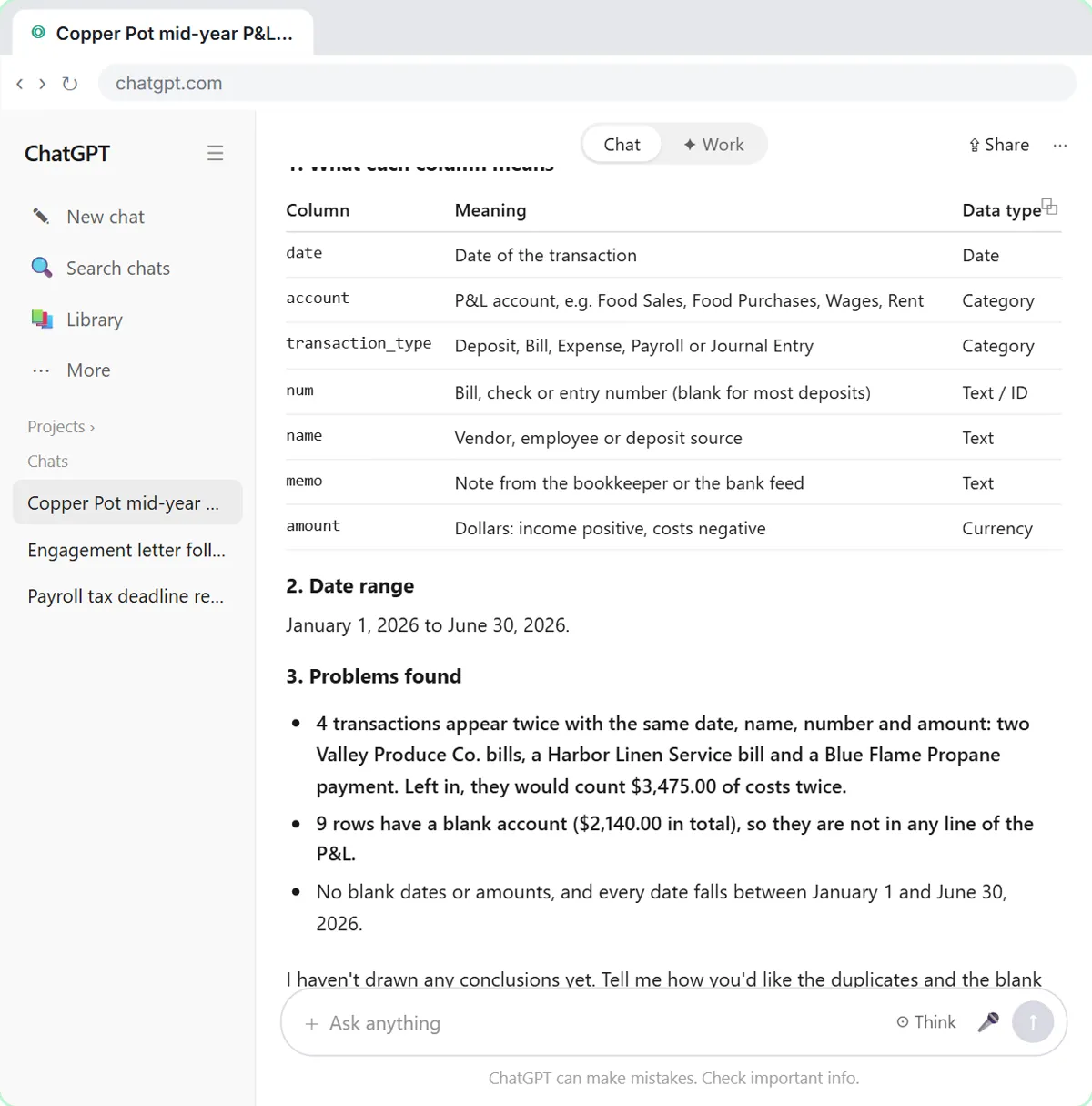
In the free Analyze a Client's P&L Export lesson, you ask ChatGPT for a monthly summary of sales, total costs, net profit and net margin for Copper Pot Kitchen, a made-up restaurant client of the made-up Millbrook Accounting. Net profit peaks in May and dips slightly in June, even though June sales are higher.
The margin explains why. The second table shows each cost as a percent of sales: food and beverage cost went from 29.0% in January to 34.0% in June, the only line that grew faster than sales. That one line is the takeaway for the owner, and the lesson's double-check reminds you to categorize the 9 rows in Needs review before calling it a trend.
Try this lesson free or read the step-by-step guide.
Common confusions
Net profit margin vs gross margin
Gross margin subtracts only the direct cost of what was sold. Net profit margin subtracts every cost on the report, so it is lower or equal.
Margin vs markup
Margin divides profit by sales. Markup divides profit by cost. The same deal gives a smaller margin than markup, so do not swap the two in a client conversation.
Tips
- Show margin next to dollar profit. One without the other tells half the story.
- When margin falls, look at each cost as a percent of sales to find the line that moved.
- Use AI to explain the change in plain words, and check every percent against your sheet.
Related terms
More Business terms
Where you use it: free lessons
Prompt templates that use it
Frequently asked questions
- What is a good net profit margin?
- It depends on the industry and the business, so there is no single good number. Compare against the client's own history and ask an accountant who knows the industry.
- Can profit go up while margin goes down?
- Yes. In the lesson's made-up numbers, June sales were higher than May but net profit and margin were slightly lower, because food cost grew faster than sales.