What is an indemnification clause in a contract?
Quick answer
An indemnification clause is a promise by one side to cover the other's losses from certain events, usually claims brought by someone else, such as a lawsuit over the vendor's work. It says who pays, for what, and often who runs the defense.
Last updated
Take the free module →Module 7 of the free Claude Jump Start course, about 11 minutes. No account needed.
Updated · By Robert Breen
Why it matters for a small business
Indemnity moves risk from one party to the other, and it is easy to sign without noticing which direction it runs. A one-way indemnity where your company protects the vendor, but not the other way round, can leave you paying for problems the vendor caused or could have prevented.
It also interacts with the limitation of liability clause. If indemnity sits outside the cap, it can be the largest exposure in the contract. These clauses are dense and full of defined terms, which is exactly where an AI first read helps you spot them and a lawyer helps you judge them.
In a real lesson: Check a Contract for Red Flags with Claude
In Check a Contract for Red Flags with Claude, Harbor Lane Accounting, a made-up firm, uploads a three-year managed IT agreement. One of the seven risky clauses Claude lists, with the exact words and clause number, is a one-way indemnity.
The lesson then has Claude turn each High and Medium item into a question for the vendor, such as asking for the indemnity to be mutual. The same approach works in Foxit Workspace: the free Foxit contract review lesson asks for risky terms with section numbers and checks each one through its citation.
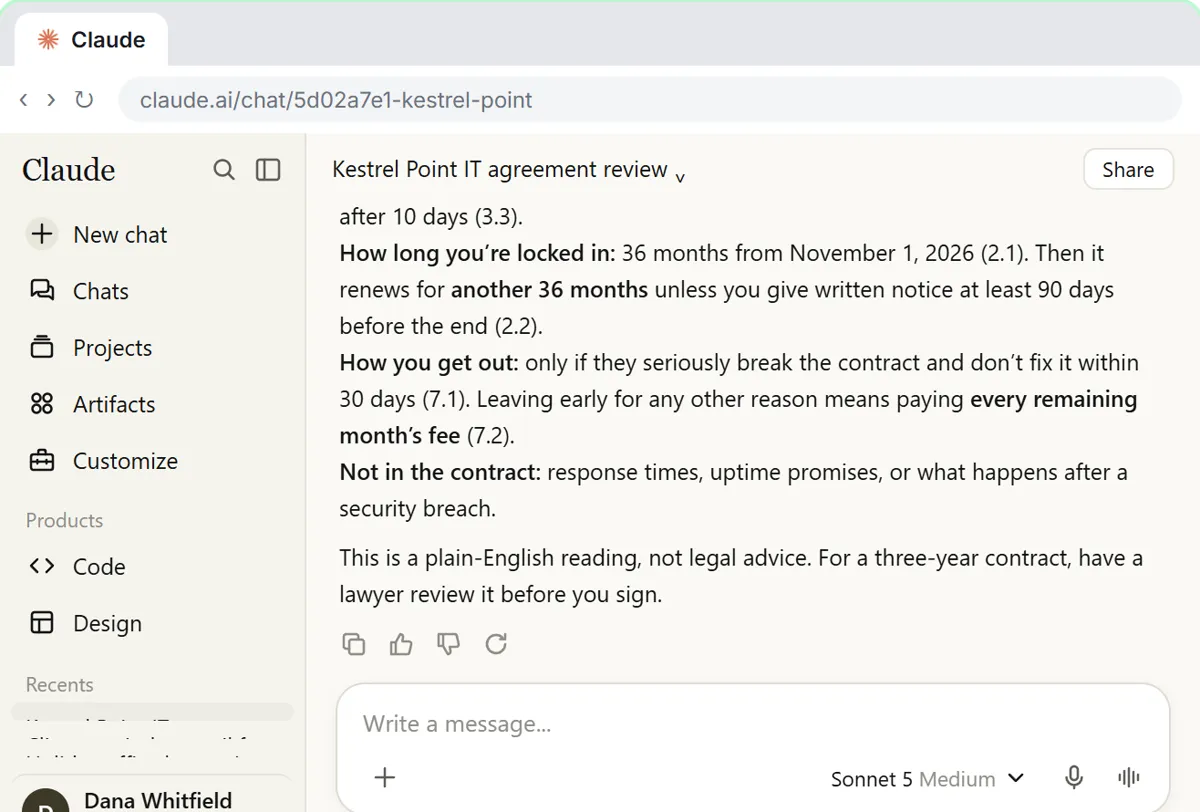
Try this lesson free or read the step-by-step guide.
Common confusions
One-way vs mutual indemnity
One-way indemnity protects only one side. Mutual indemnity has each side cover the losses it causes, which is usually the fairer starting point.
Indemnification vs warranty
A warranty is a promise that something is true or will work. Indemnity is a promise to pay for certain losses or claims if they happen.
Tips
- Ask the AI who indemnifies whom, for what, and whether it is capped.
- Read the defined terms the clause uses, such as "Losses" or "Claims".
- Have a lawyer review indemnity in any large or long contract.
Related terms
More Business terms
Where you use it: free lessons
- Check a Contract for Red Flags with Claude (Claude, 11 min)
- AI Contract Review in 10 Minutes using Foxit AI (Foxit, 10 min)
Frequently asked questions
- What does "indemnify and hold harmless" mean?
- In plain terms, one side agrees to cover the other's losses from certain claims and not to hold the other responsible for them. The exact effect depends on the wording and the law, so ask a lawyer.
- Is a one-way indemnity a red flag?
- It is worth questioning, especially if it protects the vendor from problems the vendor controls. Asking for a mutual indemnity is a common request.
- Can AI explain an indemnification clause?
- It can put it into plain English and list the questions to ask, which is a good first read. It cannot tell you whether the clause is acceptable for your situation; a lawyer can.