What is an evaluation rubric for AI output?
Quick answer
An evaluation rubric is a written list of what a good answer must get right, with a clear way to score each point. Instead of asking "is this good?", you check named items: the date is correct, every owner is listed, nothing was invented. Anyone using the same rubric should reach the same score.
Last updated
Take the free module →Module 2 of the free Intro to AI Automation course, about 8 minutes. No account needed.
Updated · By Robert Breen
Why it matters for a small business
People judge AI answers by feel, and feel changes with mood and with how polished the writing looks. A rubric turns taste into checks. It makes a fair comparison possible across tools, prompts and weeks, and it lets a colleague repeat your test without asking what you meant.
Good rubrics mix two kinds of items. Hard checks are yes or no: the total matches, the VIN request is there, no owner was made up. Softer checks use a short scale with examples of each level, such as tone from 1 to 3. Keep it to a handful of items that matter for the job. A rubric is also what you hand to an AI judge, so plain wording helps there too.
In a real lesson: Choose the AI Assistant Your Team Should Use, Tested on ChatGPT, Claude, Gemini and Copilot
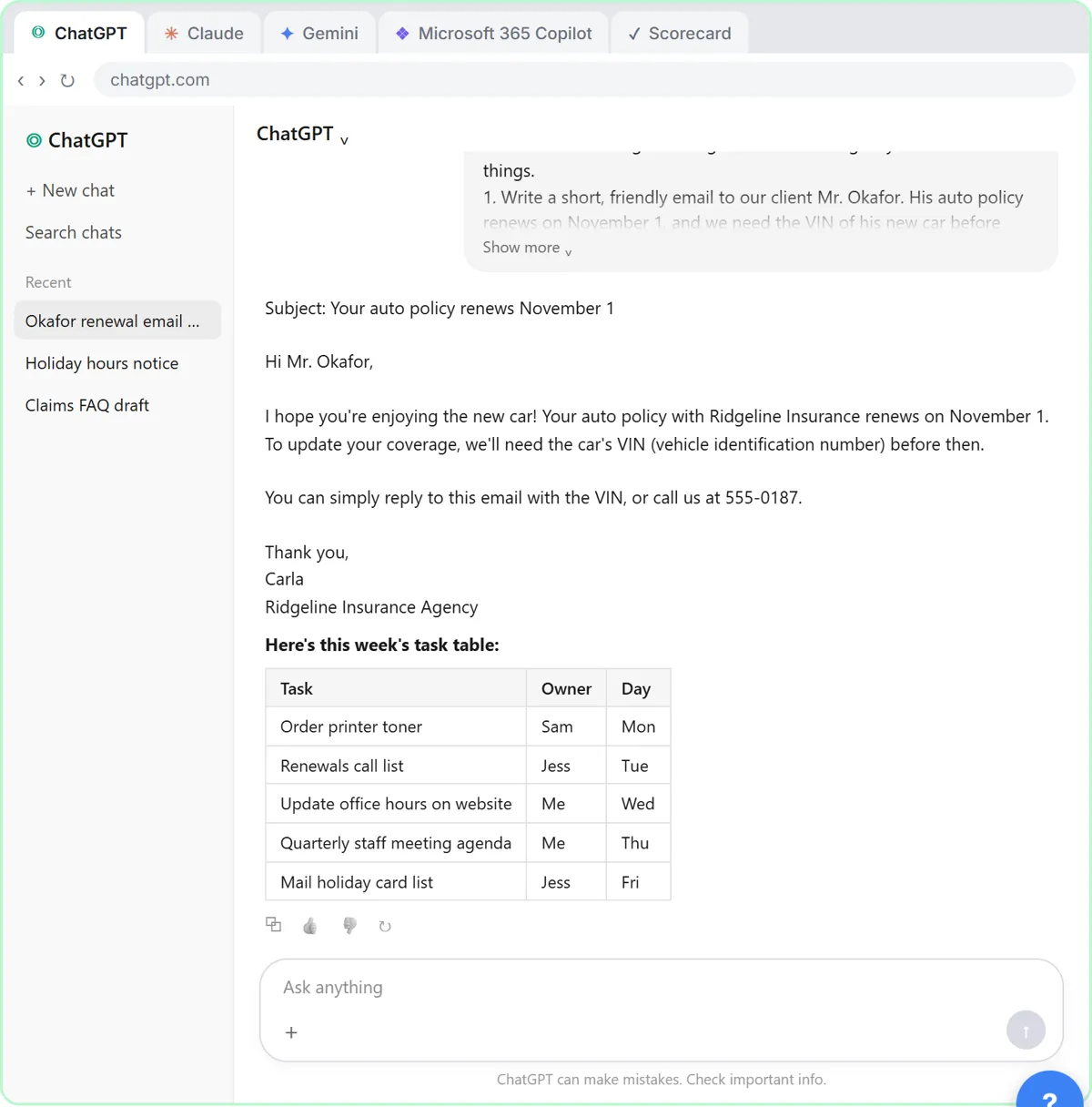
In Choose the AI Assistant Your Team Should Use, Carla pastes the same task, a client reminder email and a table of the week's tasks, into ChatGPT, Claude, Gemini and Microsoft Copilot. Then she opens the Scorecard tab, which works as a simple rubric: each assistant's row is checked on the same facts, such as the date, the VIN request and the five table rows.
All four rows come out All 3 correct, so the rubric shows the facts were a tie. That is useful: it moves the decision to the things that really differ, such as extra details nobody asked for and which tool Ridgeline already pays for. Carla picks Copilot Chat because the agency has Microsoft 365.
Try this lesson free or read the step-by-step guide.
Common confusions
Rubric vs scorecard
The rubric is the set of rules for scoring. A scorecard is the sheet where you record each answer's results against those rules.
Rubric vs prompt
The prompt tells the AI what to do. The rubric tells the person or judge how to grade what came back. Some items can appear in both.
Tips
- Write the rubric before you read any answers, so a smooth reply can't move the bar.
- Make every fact item yes or no; save scales for tone and style.
- Include one item for "nothing invented", since that is the mistake that costs most.
Related terms
More Prompting terms
Where you use it: free lessons
- Choose the AI Assistant Your Team Should Use, Tested on ChatGPT, Claude, Gemini and Copilot (ChatGPT, Claude, Gemini and Copilot, 8 min)
- The Prompter AI: Prove a Better Prompt Works on Your Own Meeting Notes (The Prompter AI, 8 min)
Frequently asked questions
- How many items should a rubric have?
- Usually three to seven. More than that and people skim, which defeats the point.
- Can an AI score answers with my rubric?
- Yes, that is called LLM as a judge. Check a sample of its scores by hand first, because judges can be lenient or inconsistent.
- Should I reuse one rubric for every task?
- Keep a few general items, like nothing invented, and add task-specific ones, like the total matches the timesheet.