What is collections in accounts receivable?
Quick answer
Collections is the part of accounts receivable focused on getting paid for invoices that are past due. It includes reminders, phone calls, payment plans, holding further work and, as a last step, handing the debt to an outside collection agency or a lawyer. The goal is to recover the money while keeping good customers.
Last updated
Updated · By Robert Breen
Why it matters for a small business
A late invoice is a loan you never agreed to make. Without a collections policy, chasing it depends on whoever notices, and the response swings from silence to an angry call. A written policy settles the questions in advance: how many days past due before each step, who makes the phone call, when work on the account pauses and when an account leaves your hands.
The last step is where risk rises. Once a debt goes to an agency or a lawyer, debt collection laws apply, and they vary by country and state. That is why AI belongs in the early, routine part of collections, drafting the reminders in a dunning sequence, and not in the escalation. Escalation is a person's decision, made with the full history of the account and, where needed, your accountant or attorney.
In a real lesson: Build a Custom GPT That Writes Overdue Invoice Reminders
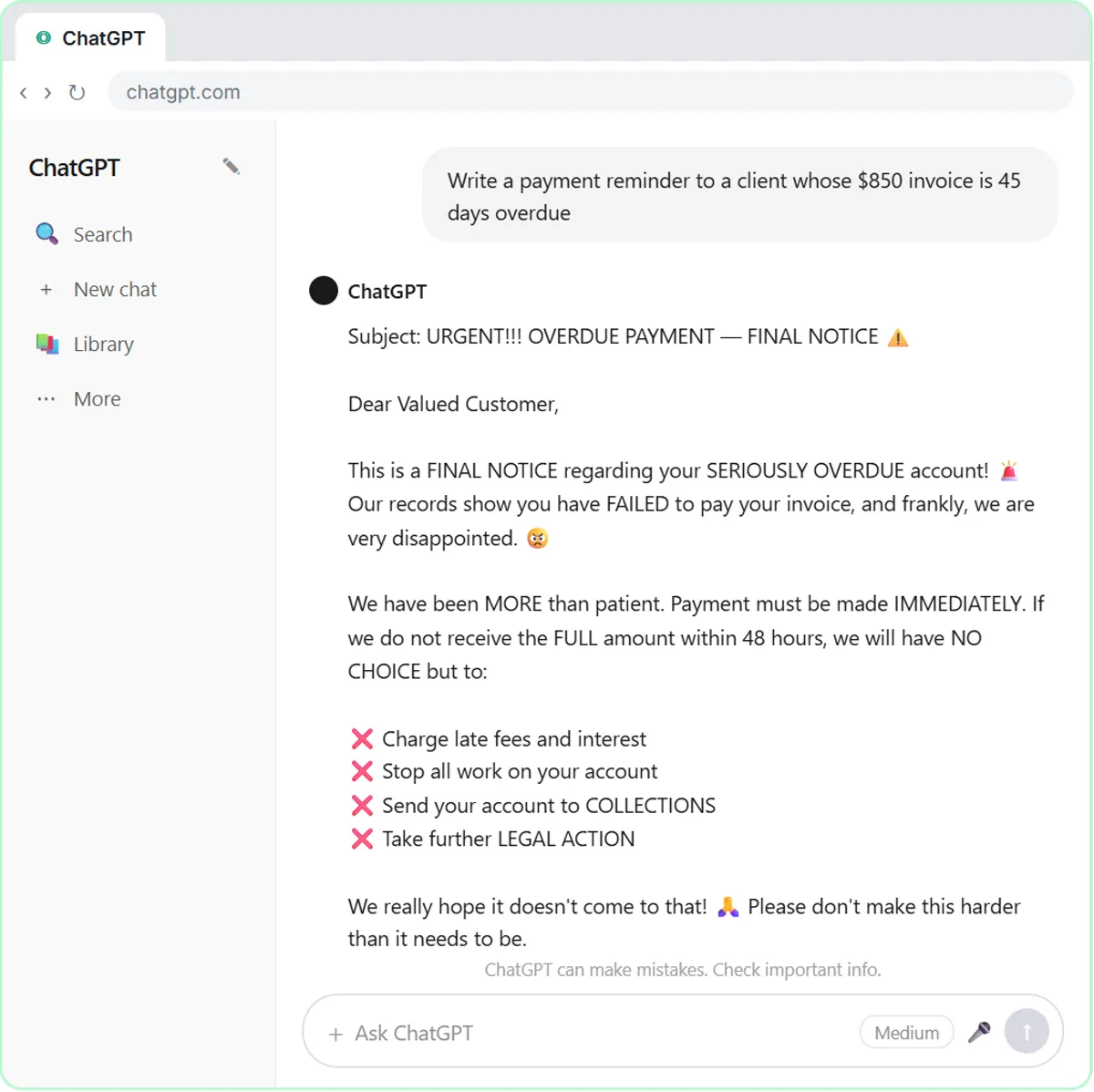
Build a Custom GPT That Writes Overdue Invoice Reminders starts with what goes wrong without a policy. The bare prompt for an $850 invoice 45 days overdue gets back a reply with all caps, emojis and threats of collections and legal action, with no invoice number or way to pay.
The fix is to give the AI the policy, and to give it limits. The GPT for Maple Street Bookkeeping, a made-up firm, works from Maple-Street-Collections-Policy.pdf. Its instructions say "Never mention collection agencies, credit reports or lawyers," and at "61 days or more: do not write the email. Say the owner handles it personally."
That split is the useful lesson about collections. The GPT drafts reminders up to 60 days, including the 31 to 60 day step that offers "a short call or a payment plan." Anything older, and any talk of escalation, belongs to the owner.
Try this lesson free or read the step-by-step guide.
Common confusions
Collections vs dunning
Dunning is the staged reminder sequence itself. Collections is the whole job of recovering past-due money, which includes dunning plus calls, payment plans, write-offs and any outside help.
In-house collections vs a collection agency
In-house collections is your own team asking a customer to pay. A collection agency is a third party that takes over the account, usually for a fee or a share of what it recovers, under its own legal rules.
Collections vs bad debt
Collections is the effort to get paid. Bad debt is what you record once you decide the money won't come.
Tips
- Write your collections steps with day ranges, and share them with everyone who talks to customers.
- Call before you escalate. A short conversation often uncovers a lost invoice or a dispute.
- Tell your AI tool where it must stop, in plain words, and test that it does.
Related terms
More Business terms
Where to learn more
Frequently asked questions
- What are the steps in the collections process?
- A common order is a friendly reminder after the due date, firmer reminders as the invoice ages, a phone call, an offer of a payment plan, a pause on new work, and finally a decision to use an agency, take legal action or write the balance off.
- When should a business send an invoice to collections?
- There is no single rule. Many businesses decide after a set number of days past due and several documented attempts to collect. Weigh the amount, the relationship and the fees, and ask your accountant or attorney before you escalate.
- Is collections the same as accounts receivable?
- No. Accounts receivable is all the money customers owe you, current or late. Collections is the work done on the part that is past due.