What is collision coverage?
Quick answer
Collision coverage is the part of an auto policy that pays to repair or replace your own vehicle after it collides with another vehicle or an object, such as a pole, guardrail or wall, or rolls over. It usually applies no matter who caused the accident, and the payment is reduced by the collision deductible.
Last updated
Updated · By Robert Breen
Why it matters for a small business
Collision is often the coverage people assume they have. A client who carries only the legal minimum may have liability coverage that pays for the other driver's car and nothing for their own. Getting that answer right early, before a repair starts, avoids a painful conversation later.
It also matters which coverage a claim falls under, because each can have its own deductible and rules. For office staff at an agency, the job is to explain what the policy shows and who decides. This is general information, not insurance advice: only the policy, the carrier and a licensed agent can confirm which coverage applies to a claim, so have a licensed professional review the reply.
In a real lesson: Reply Faster to Claim-Status Emails: ChatGPT for Independent Insurance Agencies
In Reply Faster: Claim-Status Emails, the claim is not a collision claim, and the facts say so first. Denise Harper tells the made-up Stonebridge Insurance Agency she hit a deer, and Fact 1 reads: "Hitting a deer is a comprehensive claim." Her damage is real, "the front of my CR-V is smashed," but it falls under comprehensive coverage.
That is the useful contrast. If Denise had swerved to miss the deer and hit a guardrail, many policies would treat it as collision instead, with its own deductible. The lesson doesn't cover that case, which is exactly why the coverage belongs in the facts you give ChatGPT rather than in its general knowledge.
The lesson's routine handles it: name the coverage and its deductible in a numbered fact, then have ChatGPT match every claim in the draft to a fact.
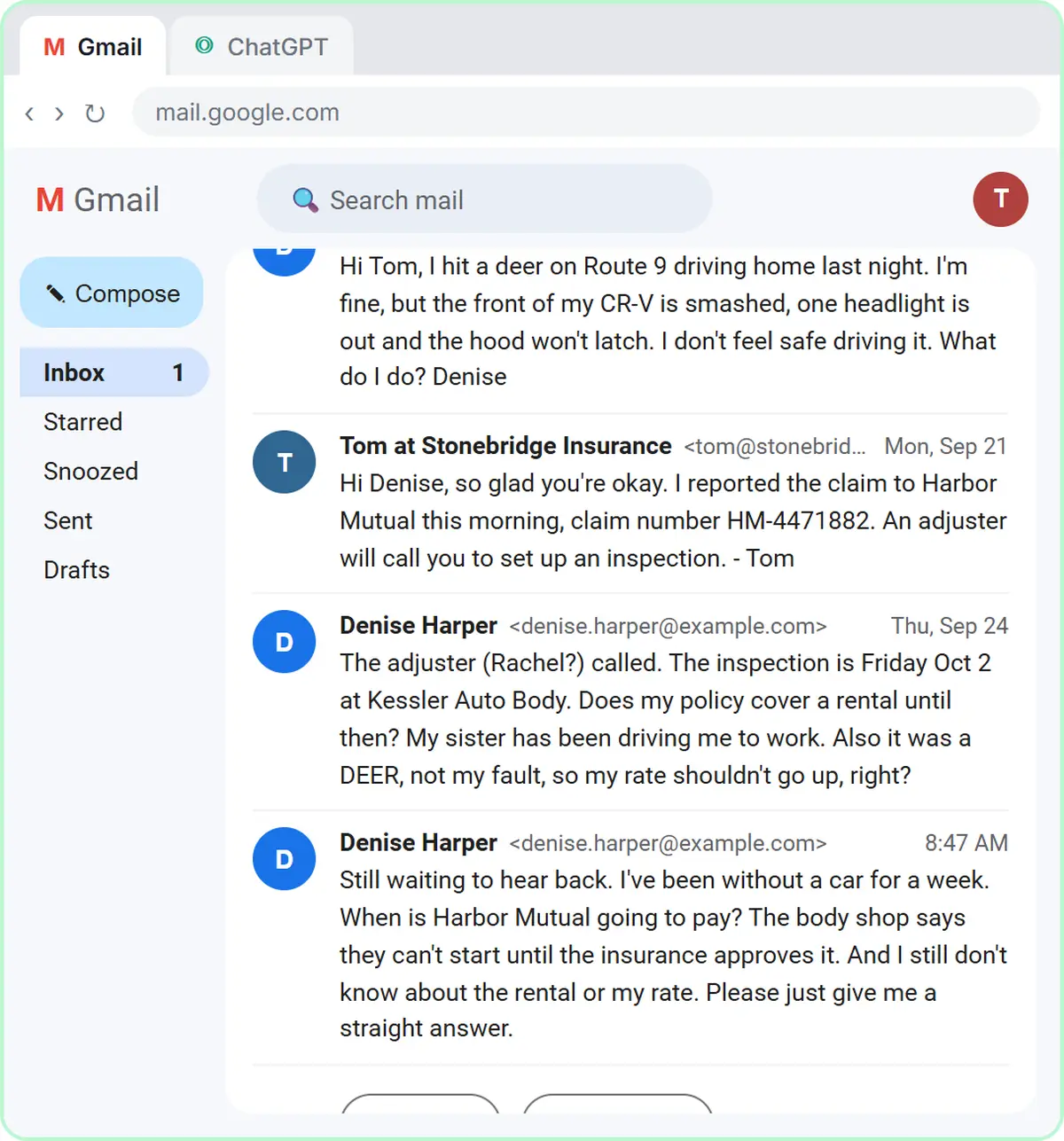
Try this lesson free or read the step-by-step guide.
Common confusions
Collision vs comprehensive
Collision covers crashes into vehicles or objects. Comprehensive covers most other physical damage, such as theft, hail, fire and animal strikes. A policy can carry both, each with its own deductible.
Collision vs liability
Collision pays for your own car. Liability pays for damage and injuries you cause to other people. Most states require liability; collision is usually optional unless a lender requires it.
Tips
- Check the declarations page to confirm collision is on the policy before discussing a repair.
- Quote the collision deductible as a dollar amount.
- When the cause is unclear, let the carrier decide which coverage applies.
Related terms
More Business terms
Where you use it: free lessons
Frequently asked questions
- Is collision coverage required?
- State laws generally require liability, not collision. A lender or leasing company often requires collision while you still owe money on the car. Check your loan terms and ask a licensed agent.
- Does collision cover hitting a deer?
- Usually not. Hitting an animal is commonly a comprehensive claim, as it is in the Stonebridge lesson. Swerving and hitting something else may be collision. The carrier makes the call.
- Does collision coverage pay if the accident was my fault?
- Yes, that is its main job. Collision generally pays for your car's damage regardless of fault, minus your deductible. If the other driver was at fault, your carrier may try to recover the cost from their insurer.