What is a multi-agent system?
Quick answer
A multi-agent system is a setup where several AI agents, each with its own instructions and tools, work on parts of one job and pass results between them. A common pattern is a coordinator agent that hands tasks to specialist agents, such as a planner, a writer and a checker.
Last updated
Updated · By Robert Breen
Why it matters for a small business
One agent with a long list of duties can get muddled. Its instructions grow, it has many tools to choose from, and a mistake in one part of the job is hard to trace. Splitting the work gives each agent a short, focused brief, like giving separate tasks to different people on a team. It also lets you use a cheaper model for simple steps and a stronger one where judgment matters.
The cost is complexity. More agents mean more model calls, more places for a handoff to lose detail and more runs to inspect when something goes wrong. For most office tasks, a single well-instructed agent is the right starting point. Reach for several only when one agent keeps failing at a part of the job that a separate, focused agent could own.
In a real lesson: Build an n8n AI Agent That Plans Your Content Calendar
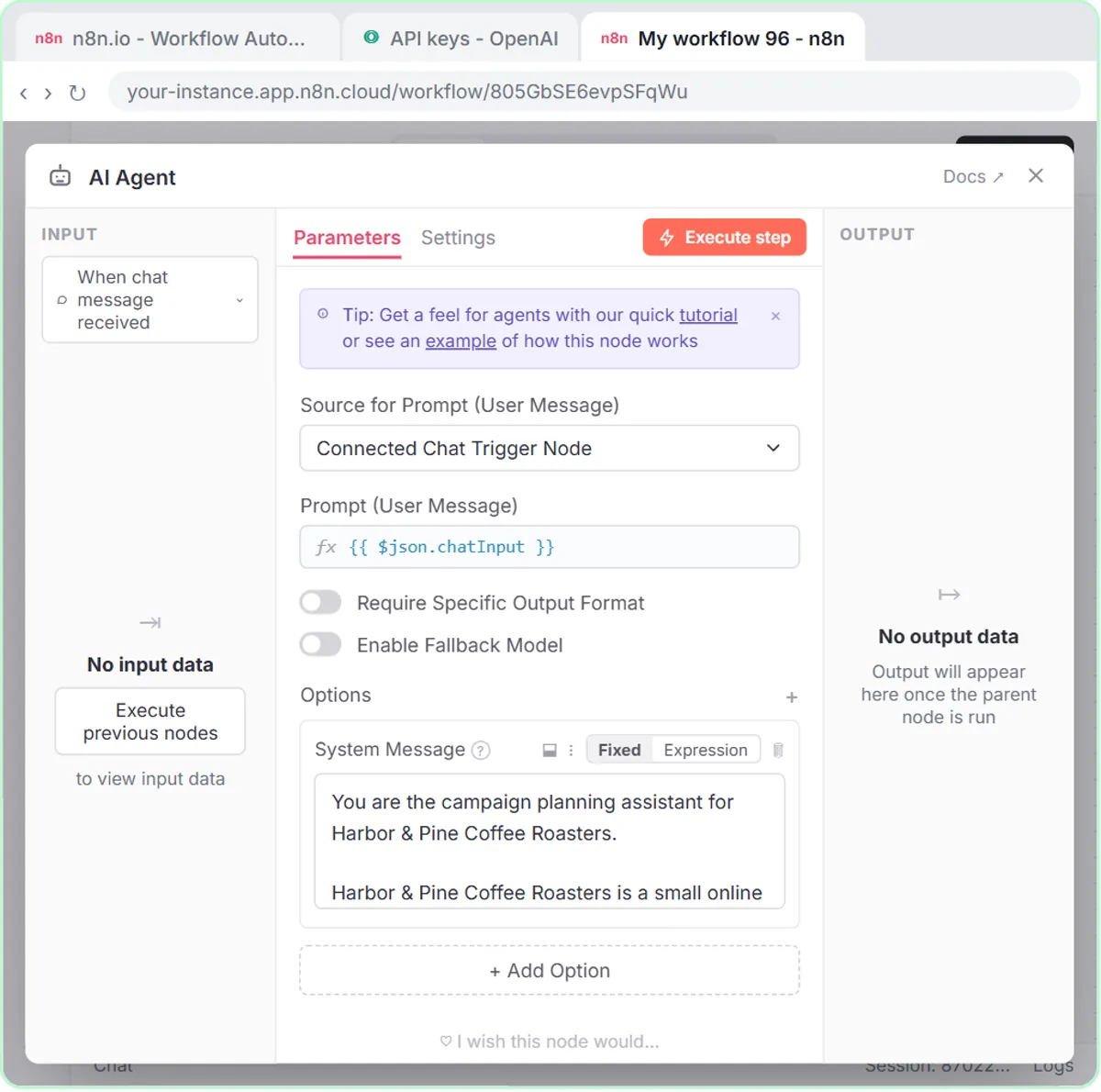
Stepthrough's live lessons build single agents, but the AI Campaign Calendar Agent lesson shows where a split could come later. You build one agent for Harbor & Pine Coffee Roasters, a made-up online coffee brand, and ask it to plan a two-week email and social calendar for the Holiday Ember Blend launch starting Monday Nov 2, with free shipping over $35 as the only offer.
That one system message carries several jobs. It plans the schedule (no more than 2 emails a week, a different angle for every item), writes the copy (warm, specific about flavor, never pushy), enforces the rules ("Never invent a discount", no health claims) and saves each item to the Campaign Calendar sheet with Date, Channel, Topic, Draft Copy and Status set to "Draft."
In a multi-agent version, a planner agent would pick dates and angles, a writer agent would draft each item, and a reviewer agent would check every line against the offer and the rules before anything is saved. For six calendar rows, one agent is plenty. For a large team calendar, the split might be worth it.
Try this lesson free or read the step-by-step guide.
Common confusions
Multi-agent system vs one agent with many tools
One AI agent can use several tools, like Sheets and Gmail. A multi-agent system has several separate agents, each deciding for itself. More tools is not the same as more agents.
Multi-agent system vs prompt chaining
Prompt chaining runs fixed prompts in a set order. In a multi-agent system, agents can decide what to do and when to hand off. Chains are simpler and easier to predict.
Tips
- Build one agent first. Split only the part that keeps failing.
- Give each agent a one-sentence job description and only the tools that job needs.
- Make the last agent before any customer-facing step a checker, and still keep a human review.
Related terms
More AI agents terms
Where you use it: free lessons
- Build an n8n AI Agent That Plans Your Content Calendar (n8n, 12 min)
- n8n AI Agent Tutorial: Save Social Media Ideas to Google Sheets (n8n, 12 min)
- Build a Lead Magnet Signup Form with an AI Welcome Email (Lovable and n8n, 15 min)
Frequently asked questions
- Can I build a multi-agent system in n8n?
- Yes. A workflow can hold more than one AI Agent node, and you can pass one agent's output to the next. Start with two agents and a clear handoff before adding more.
- Do more agents give better results?
- Not automatically. Extra agents add cost and new places for errors. They help when each has a clear, separate job and you test the whole chain on real examples.