What are false positives and false negatives in AI?
Quick answer
A false positive is when a check flags something that is actually fine, like labeling a newsletter as a sales lead. A false negative is when it misses something real, like letting a fake bank-change email through. Every AI filter, sorter or scam check makes both kinds of mistake, so you decide which one you can least afford.
Last updated
Take the free module →Module 4 of the free AI Security for Small Business course, about 7 minutes. No account needed.
Updated · By Robert Breen
Why it matters for a small business
False positives waste time and wear down trust: if the scam alert fires on every vendor email, staff start ignoring it. False negatives are quieter and often more expensive: one missed fraudulent payment can cost more than a year of false alarms. Tuning a tool to catch more usually raises false alarms, and tuning it to be quieter usually raises misses.
That is why a sensible process never relies on the AI check alone for high-stakes calls. A scam or injection check is a helpful extra pair of eyes, but the rule that actually protects you, such as calling the vendor back on a number you already have, works whether the AI caught the problem or not.
In a real lesson: Stop a Fake Vendor Bank-Change Request Before You Pay using Claude
In Stop a Fake Vendor Bank-Change Request Before You Pay, Priya pastes a vendor's "we changed banks, pay today" email and a voicemail transcript into a new Claude chat. Claude calls it a textbook vendor-impersonation scam and lists red flags. That is a true positive: a real scam, correctly flagged.
The lesson doesn't stop there, because a false negative is always possible. Its three rules, call back on a number you already have, a second person approves any bank change, and slow down when it is urgent, still work on the day the AI misses one. The prompt injection lesson says the same: Claude caught the hidden line in the test, but a different email or assistant may not.
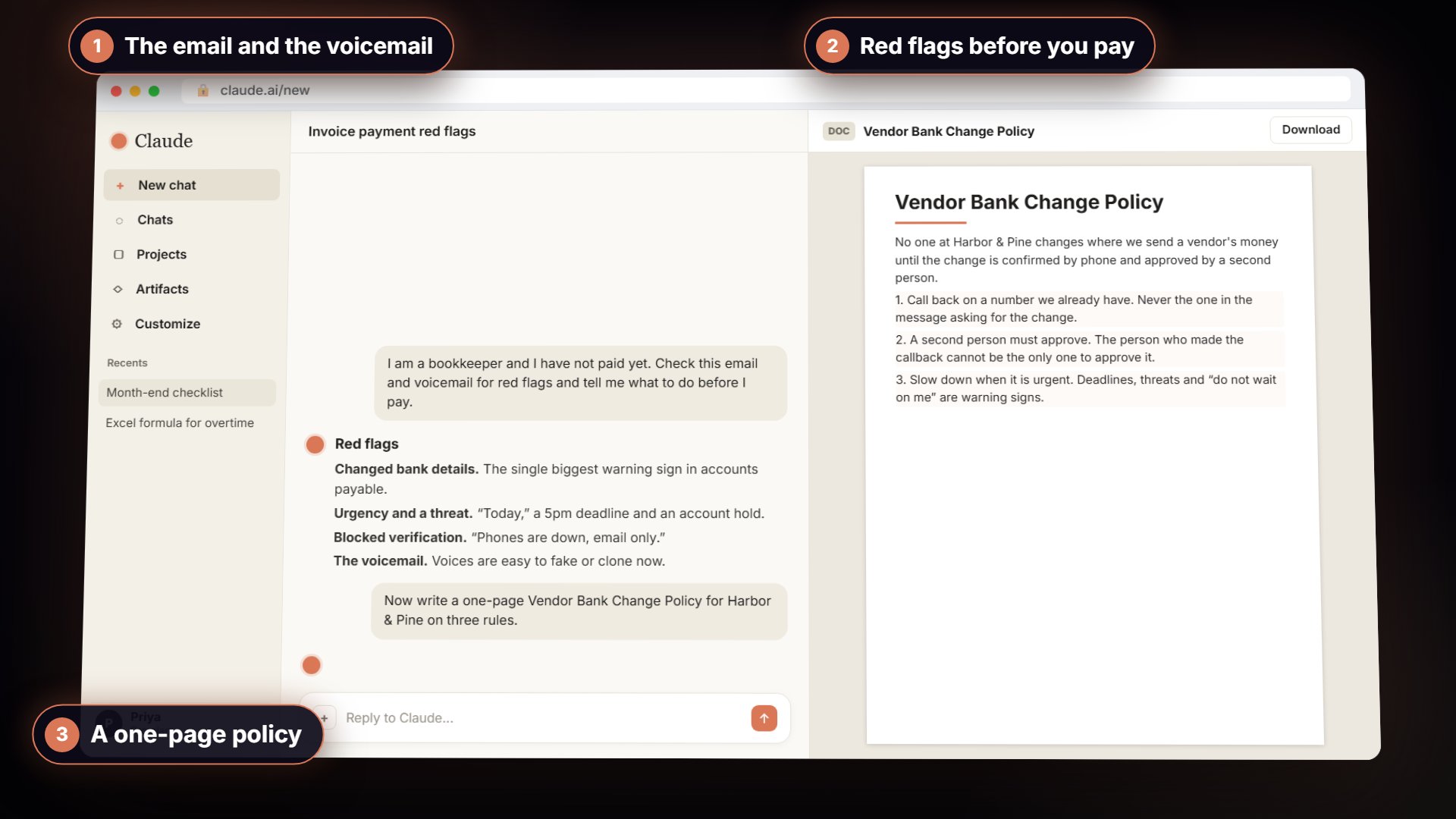
Try this lesson free or read the step-by-step guide.
Common confusions
False positive vs false negative
Positive means the check said "yes, flag it". A false positive flagged something harmless. A false negative said "fine" about something that wasn't.
False positive vs hallucination
A hallucination is invented content. A false positive is a wrong yes from a check or classifier, even if everything it wrote is real.
Tips
- Decide which mistake costs more for each check before you tune it.
- Keep a human step, like a callback, that works even when the AI misses something.
- Log false alarms too; if there are many, people will stop reading the alerts.
Related terms
More AI basics terms
Where you use it: free lessons
- Stop a Fake Vendor Bank-Change Request Before You Pay using Claude (Claude, 7 min)
- Gmail AI Triage: Auto-Label Every Email and Draft Replies (n8n, 18 min)
- Catch a Poisoned Email Before Your AI Assistant Obeys It using Claude (Claude, 6 min)
Frequently asked questions
- Which is worse, a false positive or a false negative?
- It depends on the task. For payment scams a miss is usually worse. For an auto-reply to customers, a wrong action is usually worse.
- Can I get rid of both?
- Not completely. You can reduce them with clearer instructions and better examples, then catch the rest with a human step.
- How does this show up in email sorting?
- In the Gmail AI triage lesson, a newsletter labeled Lead would be a false positive, and a real lead left unlabeled would be a false negative.