What are precision and recall in AI?
Quick answer
Precision and recall are two ways to score an AI that sorts or flags things. Precision is the share of items it flagged that really belonged there. Recall is the share of all the items that belonged there that it actually found. A good classifier needs both, and they often pull against each other.
Last updated
Take the free module →Module 10 of the free AI for Customer Support course, about 18 minutes. No account needed.
Updated · By Robert Breen
Why it matters for a small business
Say an AI labels 10 emails as Lead and 8 really are leads: precision is 80 percent. If the inbox held 16 real leads, it found 8 of them, so recall is 50 percent. The first number tells you how much you can trust a label. The second tells you how much slipped past. The F1 score is a single number that balances the two.
Which one matters more depends on the cost of each mistake. For a fraud or scam check, missing a real case is expensive, so you want high recall even if staff check a few false alarms. For an auto-reply that goes to customers, a wrong action is expensive, so you want high precision. Asking a vendor "what is the precision and recall on data like ours?" is a fair question.
In a real lesson: Gmail AI Triage: Auto-Label Every Email and Draft Replies
In Gmail AI Triage, you add a Text Classifier with three categories, Lead, Client and Invoice, and wire each one to a Gmail label. The newsletter in Sam's inbox should fit none of them and stay unlabeled. The lesson doesn't calculate precision or recall, but its advice to watch the labels for a week is exactly how you would.
Count the emails labeled Client and how many really were clients: that is precision. Count the real client emails that week and how many got the label: that is recall. If clients keep landing under Lead, the lesson's fix is to sharpen the category description in the Text Classifier and watch again.
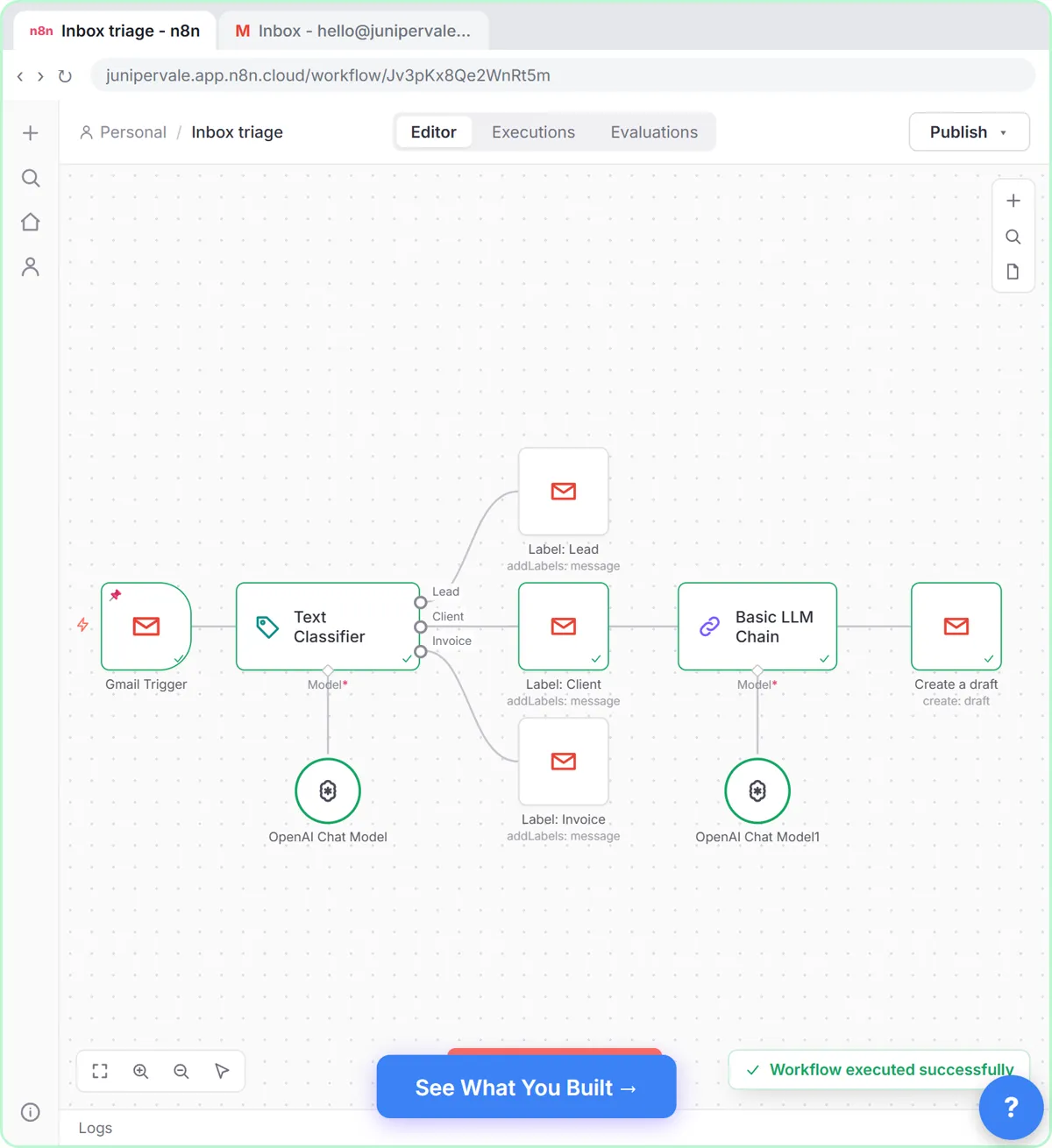
Try this lesson free or read the step-by-step guide.
Common confusions
Precision vs accuracy
Accuracy counts all correct answers, including correct "no" answers. When most emails are not leads, a tool can look accurate while finding very few leads.
Recall vs memory
Here recall is a score for how much a filter catches. It has nothing to do with whether the AI remembers earlier chats.
Tips
- Decide which mistake costs more, a wrong flag or a missed one, before you tune anything.
- Measure on a sample a person has labeled, not on the AI's own guesses.
- Check each category separately: one weak label can hide inside a good overall score.
Related terms
More AI basics terms
Where you use it: free lessons
- Gmail AI Triage: Auto-Label Every Email and Draft Replies (n8n, 18 min)
- An AI Resume Screener, with a Fairness Step (Recruiting & HR) (n8n, 14 min)
Frequently asked questions
- Is high precision or high recall better?
- It depends on which mistake hurts more. Missing a scam calls for recall. Sending a wrong reply to a customer calls for precision.
- What is an F1 score?
- A single score that combines precision and recall. It is only high when both are reasonably high.
- How does this apply to resume screening?
- A screener with low recall misses good candidates. That is why the resume screener lesson ranks applicants instead of rejecting them, and you spot-check the low scores.