What is candidate sourcing?
Quick answer
Candidate sourcing is the recruiting work of finding potential candidates for an open role and getting them to apply. It includes posting the job, asking for employee referrals, searching professional networks and resume databases, and reaching out directly to people who aren't actively job hunting.
Last updated
Updated · By Robert Breen
Why it matters for a small business
Every later step depends on who shows up. Screening, interviews and offers can only choose among the people sourcing brings in, so a thin or narrow pool leads to slow hiring or a compromise hire. Sourcing is also where time to hire is often lost, waiting on applicants who never arrive.
There are two broad kinds. Inbound sourcing attracts applicants with a clear posting and a fair pay range. Outbound sourcing means a recruiter goes looking and writes to promising people directly. AI helps with both: drafting a posting that says what the job really involves, and writing short, personal outreach messages you then check and send yourself.
In a real lesson: Make ChatGPT Ask You Questions First: The Interview Prompt
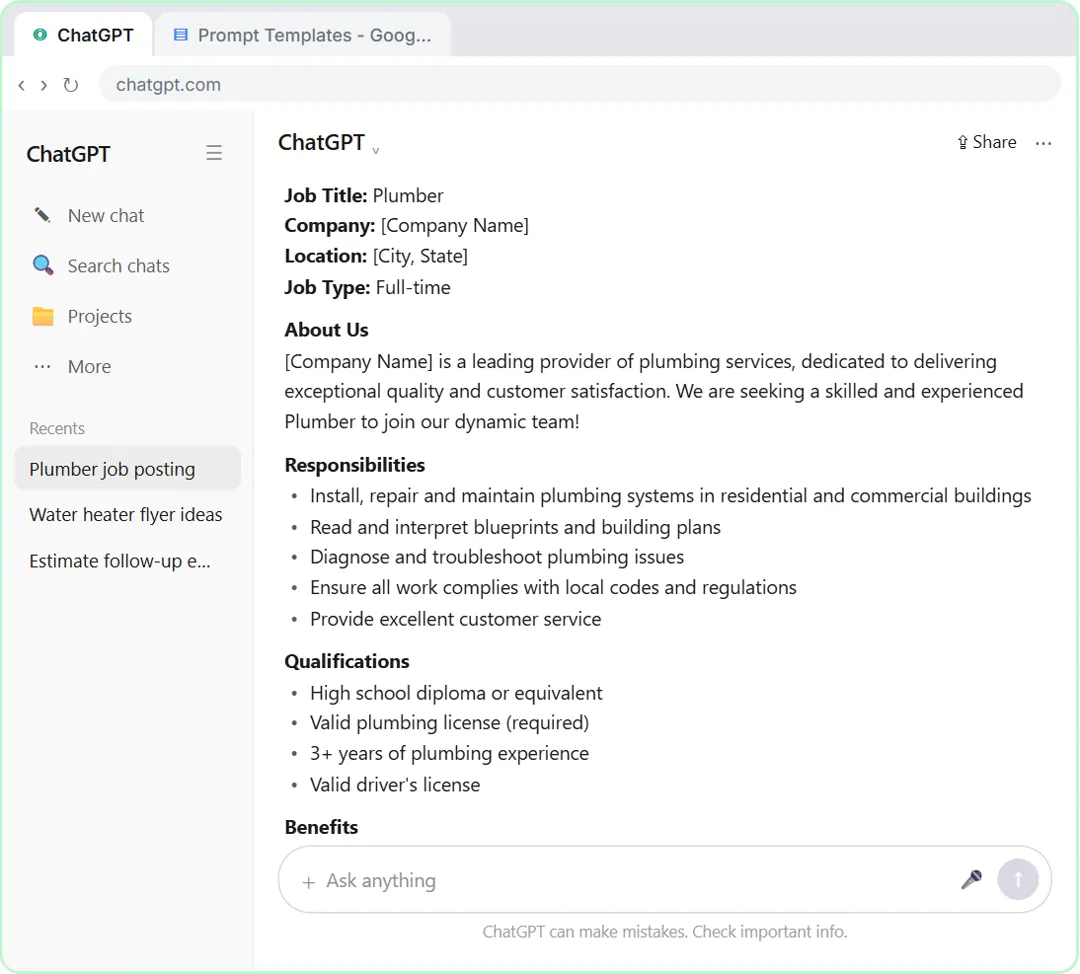
Stepthrough has no lesson on outreach or search tools. The closest is Make ChatGPT Ask You Questions First, which works on inbound sourcing: a job posting good enough to bring in the right applicants. The business is Red Oak Plumbing, a made-up family company in Reading, PA, hiring an apprentice.
The quick prompt, "Write a job posting for a plumber," comes back with blanks like [Company Name], pay left as "competitive" and requirements for an experienced plumber. That posting would source the wrong people. The interview prompt has ChatGPT ask up to 5 questions first, and the answers fix it: "$20 to $24 an hour depending on experience," "No license needed, we train," and "call or text the office at 610-555-0142. No resume needed."
The same approach works for an office role. Let AI ask about the job before it writes, and your posting reaches the people you actually want.
Try this lesson free or read the step-by-step guide.
Common confusions
Sourcing vs recruiting
Sourcing finds and attracts candidates. Recruiting is the whole process, from sourcing through screening, interviews and the offer.
Sourcing vs screening
Sourcing fills the top of the candidate pipeline. Screening, such as resume screening, narrows it to the people worth interviewing.
Tips
- Put real pay, hours and must-haves in every posting.
- Ask current staff for referrals before you pay for ads.
- Keep outreach messages short, personal and specific to the person.
- Track where each hire came from, so you know which sources work.
Related terms
More Business terms
Where you use it: free lessons
- Make ChatGPT Ask You Questions First: The Interview Prompt (ChatGPT, 6 min)
- Turn an Interview Debrief into a Scorecard and a Candidate Follow-Up (Recruiting & HR) (ChatGPT, 9 min)
Frequently asked questions
- What are the main candidate sourcing methods?
- Job postings on boards and your website, employee referrals, professional networks, resume databases, past applicants already in your system, schools and training programs, and direct outreach to people in similar roles.
- What is the difference between active and passive candidates?
- Active candidates are looking for a job and will see your posting. Passive candidates are employed and not looking, so you usually reach them through referrals or a direct, personal message.
- Can AI help with candidate sourcing?
- Yes. It can draft postings, rewrite them for different job sites and write outreach messages. Check every message before it goes out, and don't paste candidates' personal details into a tool your policy doesn't allow.