What is the difference between actual cash value and replacement cost?
Quick answer
Actual cash value (ACV) is the amount an insurer pays for damaged or stolen property based on what it was worth at the time of the loss, usually its replacement cost minus depreciation for age and wear. Replacement cost pays what it costs to replace the item with a new one of similar kind and quality.
Last updated
Updated · By Robert Breen
Why it matters for a small business
The difference can be large, and clients rarely learn about it until a claim pays. A business that loses five-year-old office furniture on an ACV policy may receive a fraction of what new furniture costs. Knowing which basis applies helps an owner choose coverage and set expectations before anything goes wrong.
Auto claims are usually settled at ACV: if a car is totaled, the payment is based on what the car was worth, not a new one. This is general information, not insurance advice. Valuation rules differ by policy and state, and only the policy, the carrier and a licensed agent can confirm how a loss will be valued.
In a real lesson: Reply Faster to Claim-Status Emails: ChatGPT for Independent Insurance Agencies
A made-up example: an office laptop bought three years ago is stolen. A comparable new one costs $1,200, and the insurer judges it has lost $700 in value. With a $250 deductible, an ACV policy pays $1,200 minus $700 minus $250, or $250. A replacement cost policy pays $1,200 minus $250, or $950, though some policies pay in stages once you actually buy the new one.
Stepthrough has no lesson about valuing a loss. In Reply Faster: Claim-Status Emails, the made-up Stonebridge Insurance Agency leaves the amount to the carrier on purpose. Fact 3 says "Harbor Mutual decides when and how much it pays," and "After the inspection, Rachel writes the estimate and works with the body shop."
That is where valuation happens on a car claim: the claims adjuster's estimate. An agency reply should say who sets the amount and when, not guess at it.
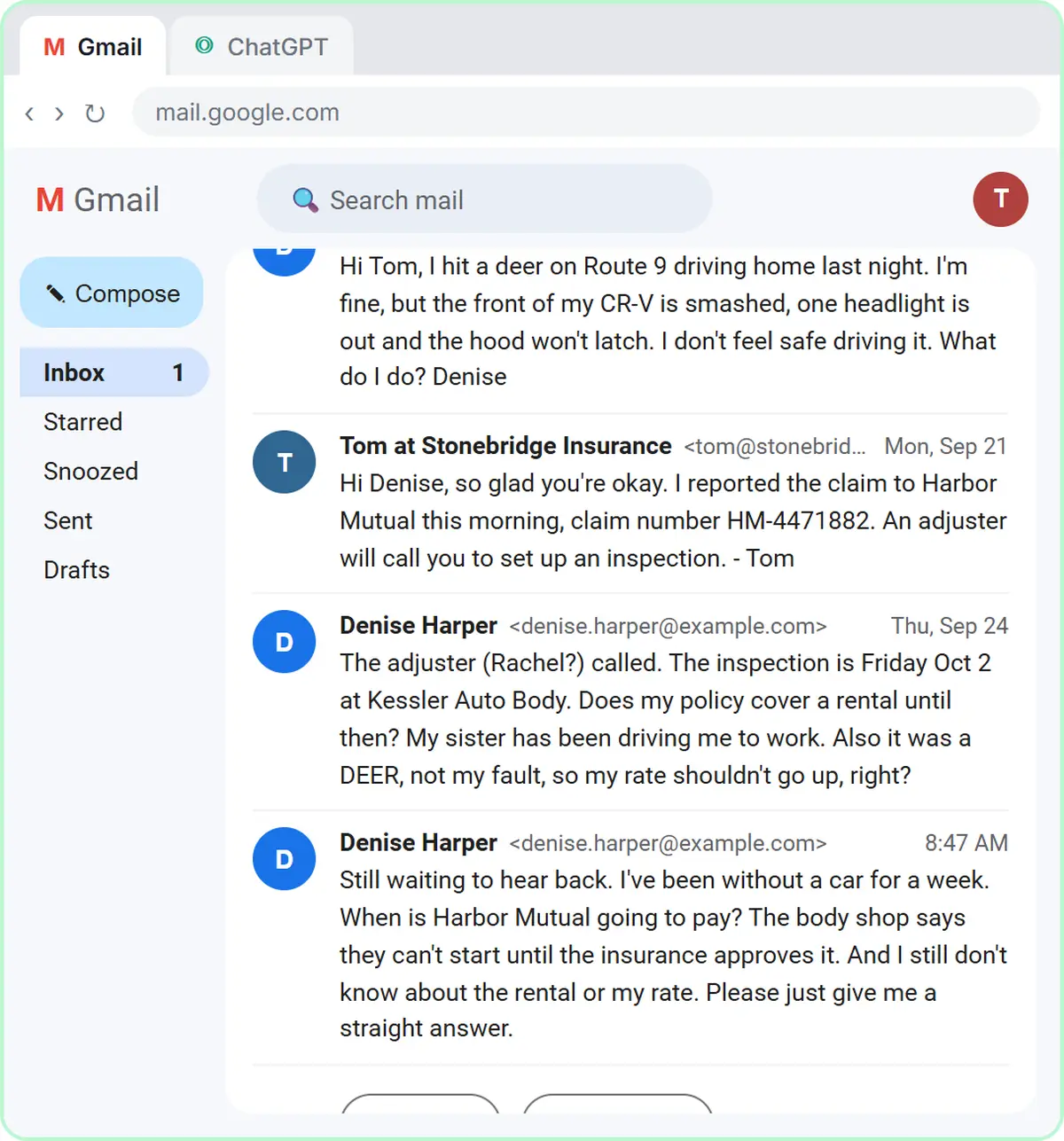
Try this lesson free or read the step-by-step guide.
Common confusions
Actual cash value vs market value
They are often close, and some states define ACV using market value. Others use replacement cost minus depreciation. The policy and state rules decide which method applies.
Replacement cost vs agreed value
Replacement cost pays to buy a new equivalent. Agreed value is an amount the policyholder and insurer set in advance, common for collectible cars and specialty items.
Tips
- Check whether each property coverage on a business policy is ACV or replacement cost.
- Keep receipts and photos of equipment so valuation is easier after a loss.
- Never let an AI draft estimate a claim payment; the adjuster sets it.
Related terms
More Business terms
Where you use it: free lessons
Frequently asked questions
- How is actual cash value calculated?
- Commonly as replacement cost minus depreciation, the value lost to age, wear and condition. Some states and policies use fair market value instead. The carrier's adjuster makes the calculation for each claim.
- Is replacement cost coverage worth it?
- It usually costs more in premium but pays closer to the price of new items. It matters most for property that loses value quickly, like electronics and furniture. A licensed agent can compare the two for your business.
- Does car insurance pay actual cash value?
- For a totaled car, most auto policies pay actual cash value, meaning what the car was worth before the loss, minus the deductible. Some offer new car replacement as an add-on. Check the policy.