What is the difference between accounts receivable and accounts payable?
Quick answer
Accounts receivable is money customers owe your business for goods or services already delivered. Accounts payable is money your business owes vendors for goods or services already received. Receivables are an asset and payables are a liability. The same unpaid invoice is a receivable for the seller and a payable for the buyer.
Last updated
Updated · By Robert Breen
Why it matters for a small business
Think of one $2,000 invoice. You finish a project and bill a client on Net 30. On your books it is a $2,000 receivable. On the client's books it is a $2,000 payable. When the client pays, both disappear at once. Every business that buys and sells on credit runs both sides at the same time.
The goals point in opposite directions. On accounts receivable, you want to bill fast and collect on time. On accounts payable, you want to pay on time but not early, unless a vendor offers a discount, so cash stays in your account as long as the terms allow. When receivables come in slowly and payables come due fast, a profitable business can still run short of cash.
In a real lesson: Gmail AI Triage: Auto-Label Every Email and Draft Replies
In Gmail AI Triage you are Sam at Juniper & Vale Marketing, a made-up agency. You add a Text Classifier that sorts each new email as Lead, Client or Invoice, and each answer adds a matching Gmail label.
Lead and Client both get descriptions, because they sound alike. Invoice gets none; the lesson calls it obvious. For one inbox that is fine. But "invoice" emails come from both sides: a vendor sending a bill you must pay is payables, and a client asking about a bill you sent is receivables.
If different people handle those, you could split the category in two with descriptions such as "A vendor sending us a bill" and "A client paying or asking about an invoice we sent." That is our suggestion, not a lesson step. For the receivables side, the overdue reminders lesson picks up where this one stops.
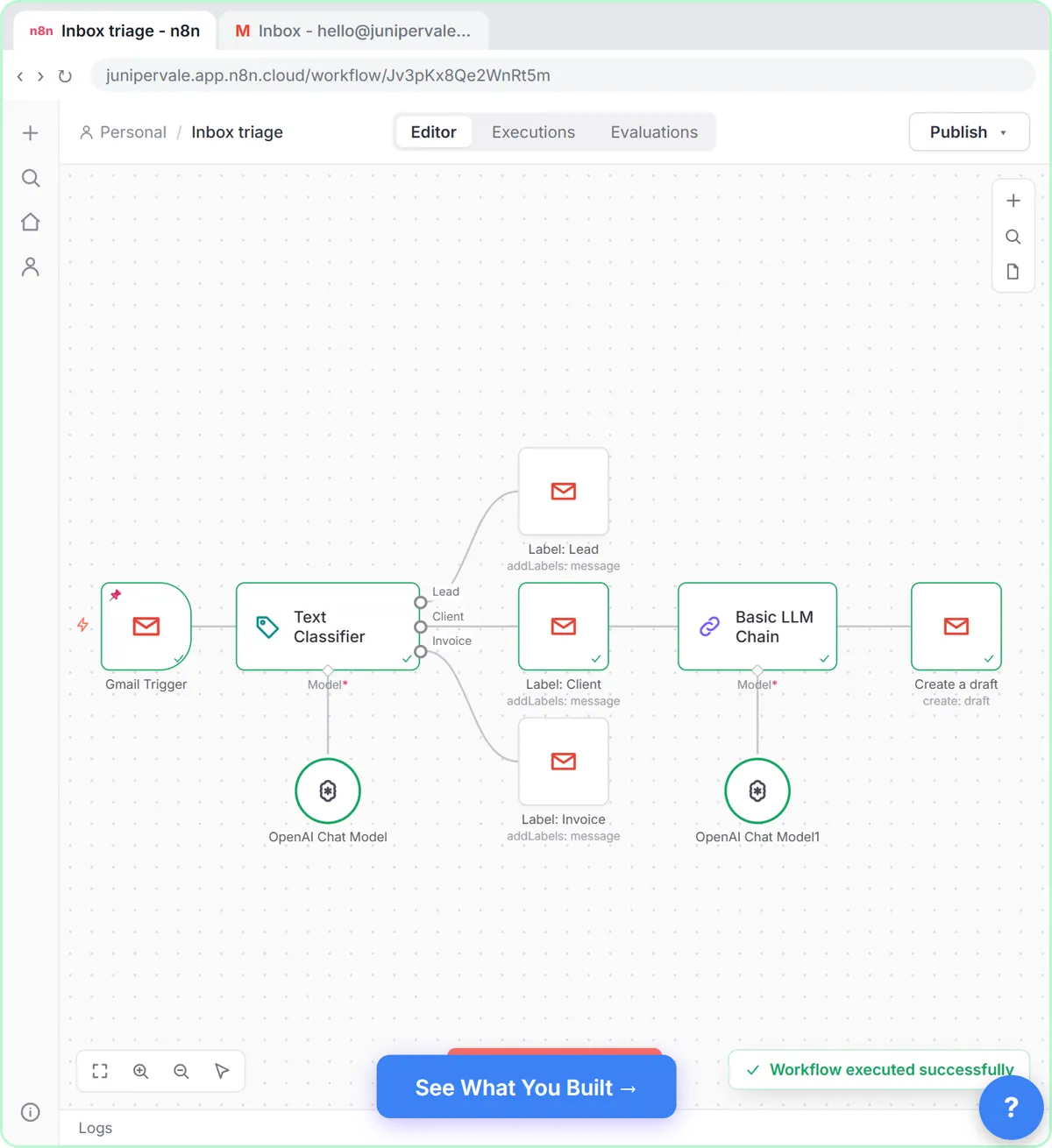
Try this lesson free or read the step-by-step guide.
Common confusions
Which one is the asset?
Receivables are an asset because they will turn into cash. Payables are a liability because they will take cash out. Both sit on the balance sheet, not the income statement.
AR aging vs AP aging
An AR aging report shows what customers owe you by how late it is. An AP aging report shows what you owe vendors by due date.
Tips
- Keep separate inboxes or labels for bills you owe and payments you are owed.
- Review both aging reports in the same weekly meeting to see your cash picture.
- When AI sorts finance emails, describe each category in a full sentence.
Related terms
More Business terms
Where you use it: free lessons
More free tutorials
Frequently asked questions
- Is accounts receivable an asset or a liability?
- Accounts receivable is a current asset, because it is money you expect to collect soon. Accounts payable is a current liability, because it is money you expect to pay soon. Both appear on the balance sheet.
- What is an example of accounts receivable and accounts payable?
- A marketing agency bills a client $2,000 for a campaign. The agency records a receivable. The same month it receives a $300 bill from its printer and records a payable. Each balance is cleared when the money moves.
- Can one company be both a customer and a vendor to you?
- Yes. If you sell to a company and also buy from it, you carry a receivable and a payable for the same business. Track them separately, and only net them against each other if both sides agree in writing.