What is a transformer model in AI?
Quick answer
A transformer is the neural network design that today's large language models are built on. It reads every word in your prompt at the same time, works out which words matter to each other, and uses that to predict the next word of the answer. The "T" in GPT stands for transformer.
Last updated
Take the free module →Module 2 of the free Claude Jump Start course, about 7 minutes. No account needed.
Updated · By Robert Breen
Why it matters for a small business
Google researchers introduced the transformer in a 2017 paper called "Attention Is All You Need". Older language models read text one word at a time and lost track of long sentences. Transformers look at the whole passage at once, which made it practical to train models on huge amounts of text, and that is what led to ChatGPT, Claude and Gemini.
You never set up a transformer yourself, but knowing the idea explains everyday behavior. The model writes by predicting likely next words, not by looking facts up, so a fluent answer can still be wrong. And because it weighs everything in the chat together, the facts and examples you include shape the answer directly.
In a real lesson: Your First Chat with Claude: Models, Files and a Great First Prompt
In Your First Chat with Claude, you open the model picker and see four Claude models: Fable for the toughest challenges, Opus for complex and everyday work, Sonnet for simpler tasks and Haiku for quick answers. Anthropic doesn't publish the full design of each one, but models like these belong to the family of transformer-based language models.
What matters for the lesson is the practical side. You attach Linda's complaint email as a file instead of summarizing it, so the model weighs her exact words when it drafts the reply. That is why Claude's draft names the sunken pavers and the debris, and flags the refund request for you to decide.
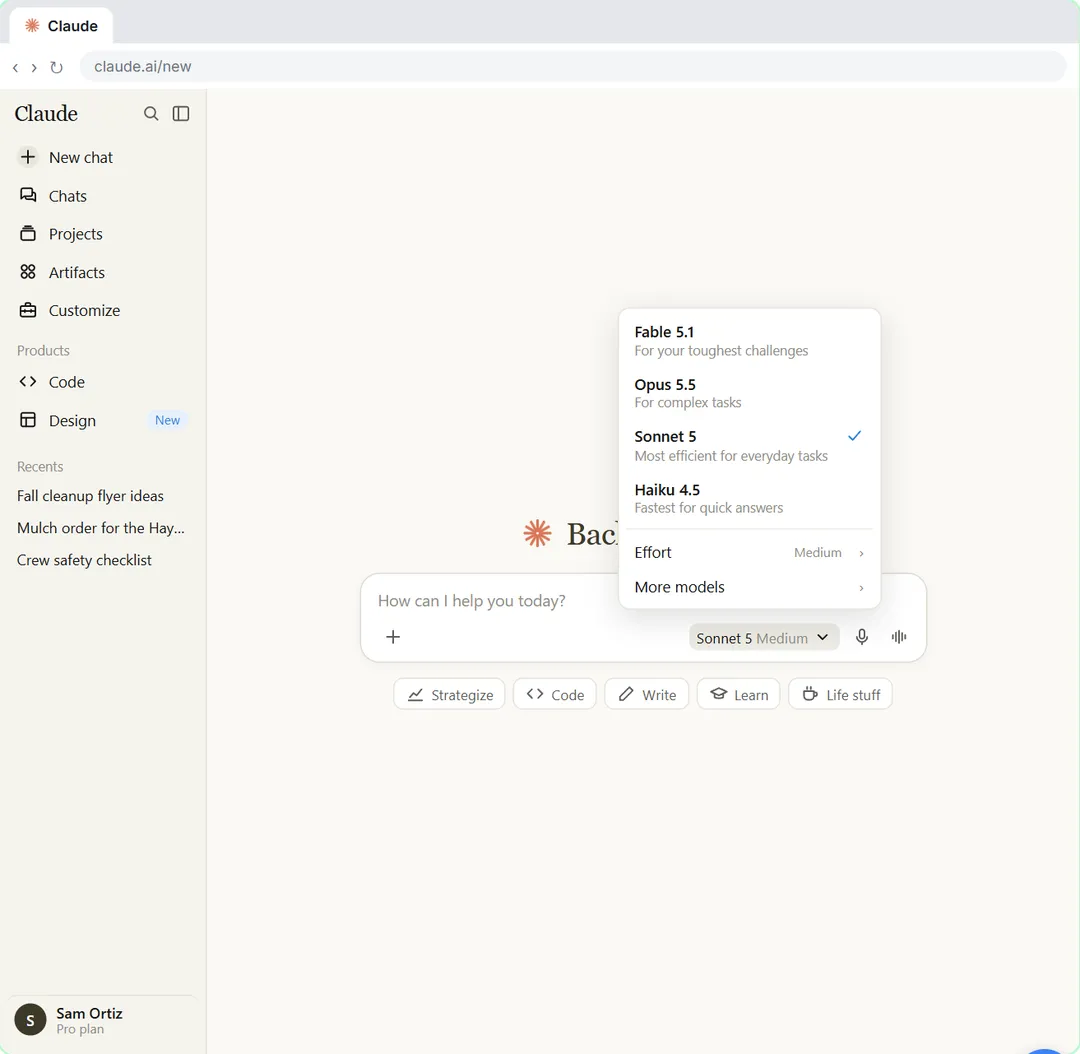
Try this lesson free or read the step-by-step guide.
Common confusions
Transformer vs large language model
The transformer is the design. A large language model is a specific model, such as Claude Sonnet, built with that design and trained on a lot of text.
Transformer vs the Python library
Hugging Face also has a popular code library called Transformers. It is a toolkit for developers, not the model design itself.
Tips
- Give the model the real source text, such as the email or the policy, rather than your summary of it.
- Treat fluent answers as drafts: the model predicts likely words, it does not check facts.
- You don't need to know the architecture to pick a model; test the options on your own task.
Related terms
More AI basics terms
Where you use it: free lessons
- Your First Chat with Claude: Models, Files and a Great First Prompt (Claude, 7 min)
- Prompt Writing 101: Role, Context, Task, Format (ChatGPT, 8 min)
Frequently asked questions
- What does GPT stand for?
- Generative Pre-trained Transformer: a model that generates text, is trained on a large amount of text first, and uses the transformer design.
- Do Claude and Gemini use transformers too?
- Today's leading large language models are generally built on the transformer idea, though each company keeps the details of its own models private.
- Do I need to understand transformers to use AI at work?
- No. It helps to know that the model predicts likely next words, so you give it real facts and check what it writes.
- Who invented the transformer?
- A team of Google researchers, in the 2017 paper Attention Is All You Need.