What does Net 30 mean on an invoice?
Quick answer
Net 30 is a single, very common payment term: the full amount of the invoice is due 30 calendar days after the invoice date. "Net" means the whole balance, after any credits, with no discount for paying sooner. If the invoice is dated March 1, payment is due March 31.
Last updated
Updated · By Robert Breen
Why it matters for a small business
The broader idea of agreed due dates is covered under payment terms. This entry is about the one term people meet most and still misread. The usual mistakes are counting from the day the invoice was opened instead of its date, counting business days instead of calendar days, and forgetting that a short month moves the due date.
For the seller, Net 30 is a decision to wait a month for money already earned, so it belongs in the cash flow forecast. For the buyer, it is a deadline that drives the payment run. Either way, write the actual due date on the invoice. "Due March 31" leaves nothing to interpret, while "Net 30" alone leaves the arithmetic to every reader.
In a real lesson: Build an AI Vendor Follow-Up Agent in n8n
The AI Vendor Follow-Up Agent lesson does not involve invoices, but it shows how to hand an AI a timing rule. You build an n8n agent for Ridgeline Supply Co., a made-up warehouse and distribution business, and its system message says to give each vendor "a reply-by date: 1 business day if late, 2 if pending."
The agent then writes a date into the Due Date column of the Vendor Follow-Ups sheet for each of three purchase orders, such as Sep 29 for Tallpine Pallet Co. on PO 4471. A rule plus a starting date produces a deadline, which is exactly how Net 30 works.
There is a lesson in the limits, too. Date math is easy for a spreadsheet and easy for a language model to get slightly wrong. If you track Net 30 bills in a sheet, compute the due date with a formula that adds 30 to the invoice date, and let AI write the reminder text around that date instead of calculating it.
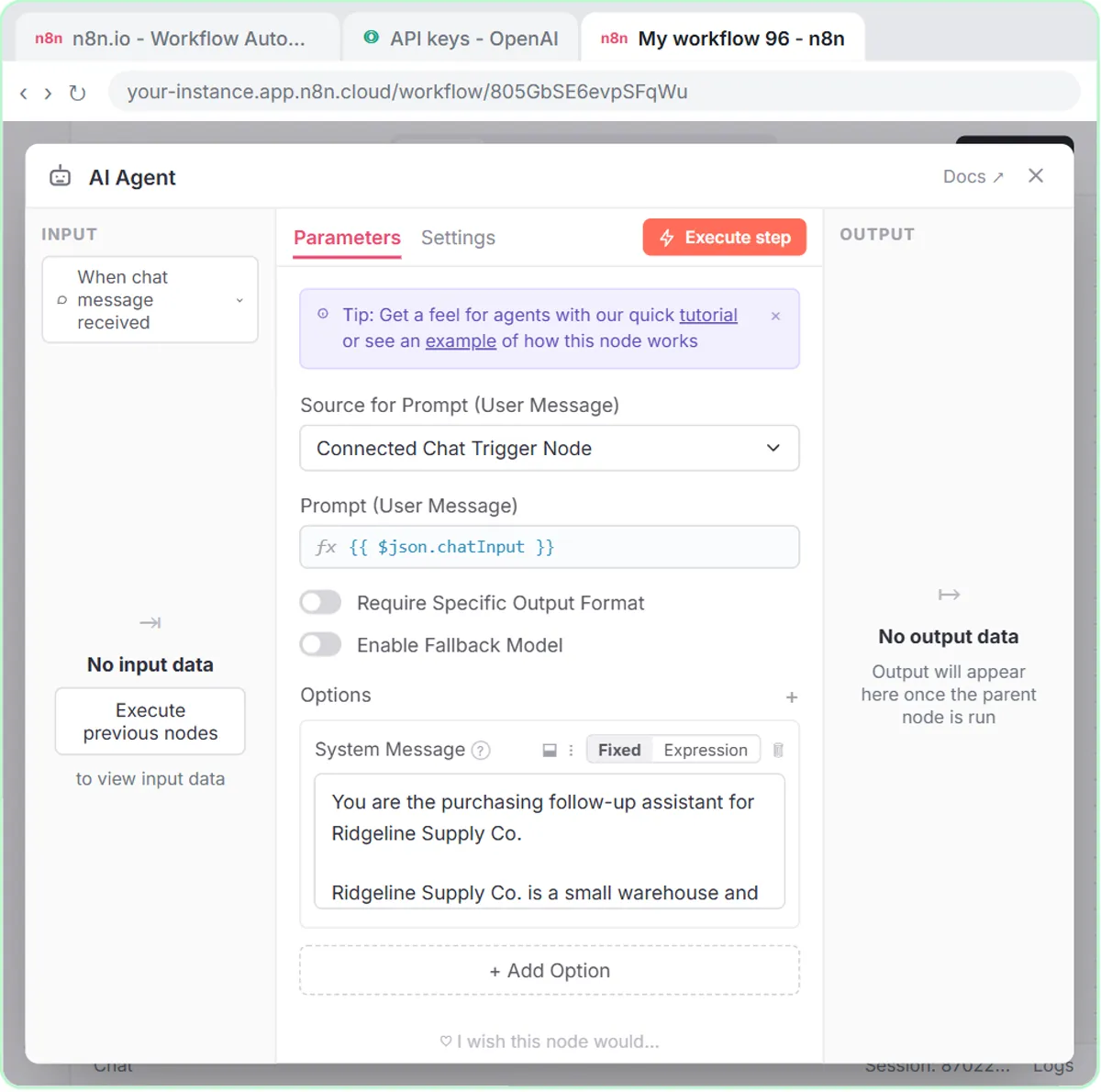
Try this lesson free or read the step-by-step guide.
Common confusions
Net 30 vs payment terms
Payment terms is the whole category: Net 15, due on receipt, early-payment discounts and so on. Net 30 is one member of it. The payment terms entry explains how to choose and write terms.
Net 30 vs Net 30 EOM
EOM stands for end of month. It is commonly read as 30 days after the end of the month the invoice is dated, which can add weeks. Usage varies, so spell out the exact due date whenever EOM appears.
Tips
- Store the invoice date and the terms in separate columns, and let a formula produce the due date.
- Count calendar days unless the agreement says business days.
- If a due date lands on a weekend, check your agreement or ask your accountant which day counts. Don't guess.
Related terms
More Business terms
Where you use it: free lessons
- Build an AI Vendor Follow-Up Agent in n8n (n8n, 12 min)
- Reply Faster to Clients Chasing Their Refund: ChatGPT for Tax and Bookkeeping Firms (ChatGPT, 10 min)
Prompt templates that use it
Frequently asked questions
- Does Net 30 start when the customer receives the invoice?
- Normally it starts on the invoice date. If you want it to start on delivery or receipt, the terms have to say so in writing.
- Is a payment on day 31 late?
- By the plain terms, yes. Whether you charge anything for it depends on what was agreed in advance and on local rules, which is a question for your accountant or lawyer.