What is an OKR (objectives and key results)?
Quick answer
An OKR is a goal-setting format with one objective, a short statement of what you want to achieve, and two to four key results, the measurable outcomes that would prove you got there. It usually covers a quarter and is reviewed often.
Last updated
Updated · By Robert Breen
Why it matters for a small business
Plain to-do lists describe activity, not outcomes. A team can send ten emails and still be unsure whether anything improved. An OKR forces the question of what changed, by when and by how much. The objective gives people a reason to care, and the key results give them a scoreboard.
A good key result is a number, not a task. "Send more newsletters" is a task. "Reach 400 new subscribers" is a result. Teams often set stretch targets on purpose, so hitting 70 percent can be a good outcome. That makes OKRs useful for direction, but a poor fit for pay or performance reviews if people start hiding ambition.
In a real lesson: Build an n8n AI Agent That Plans Your Content Calendar
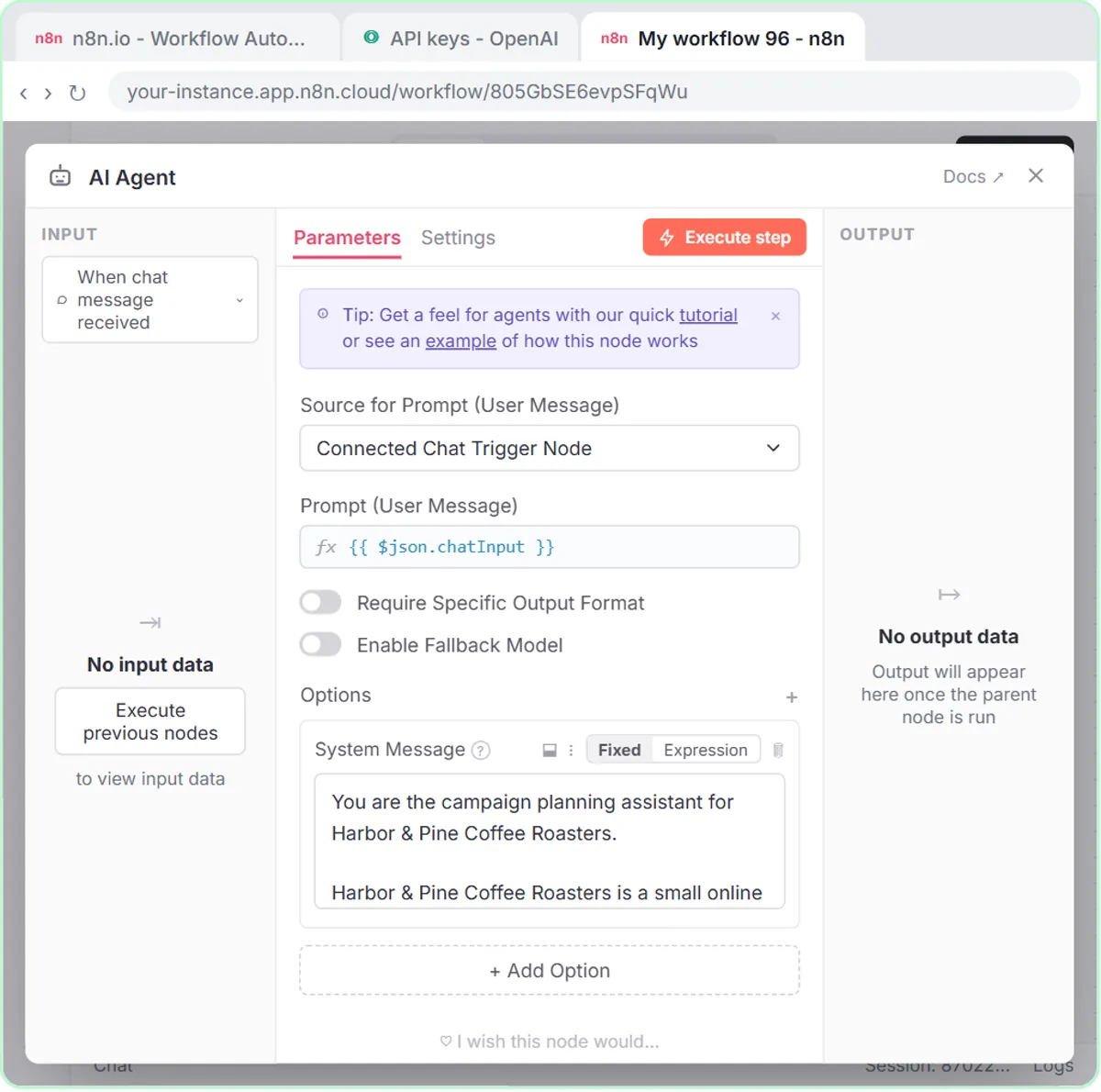
The AI Campaign Calendar Agent lesson is not about OKRs, but it shows how a goal gets turned into scheduled work. You build an n8n agent for Harbor & Pine Coffee Roasters, a made-up online coffee brand. You give it one theme, "our Holiday Ember Blend launch, starting Monday Nov 2," with an offer of free shipping over $35.
The system prompt sets limits that behave like guardrails: at most two emails a week, a different angle for each item, and "Only mention offers the user gives you." The agent returns a two-week plan with a Date, Channel, Topic, Draft Copy and Status for each row, then saves it to a sheet called Campaign Calendar.
The lesson never sets an objective or a measurable result. You would add those yourself, for example an objective of a successful launch and a key result like a number of orders from launch emails. The calendar is the activity underneath. The OKR is how you would judge whether that activity worked.
Try this lesson free or read the step-by-step guide.
Common confusions
OKR vs KPI
A KPI tracks the ongoing health of something, often forever. An OKR is a time-boxed push to change something. A KPI might be your monthly sales. An OKR might aim to raise it by a set amount this quarter.
OKR vs to-do list
Tasks are what you will do. Key results are what will be true if the work succeeded. You can complete every task and still miss the key result, which is the whole point of measuring it.
Tips
- Limit yourself to one to three objectives per team per quarter. More means none get real attention.
- Write each key result as a number with a start and an end, like "from 120 to 300."
- Check progress every week or two, and let the plan change if the numbers say it should.
Related terms
More Business terms
Where you use it: free lessons
- Build an n8n AI Agent That Plans Your Content Calendar (n8n, 12 min)
- Build a Lead Magnet Signup Form with an AI Welcome Email (Lovable and n8n, 15 min)
Frequently asked questions
- Do small businesses need OKRs?
- Not necessarily. A short quarterly goal with one or two numbers gets most of the benefit. Use the full format only if it helps your team focus rather than adding paperwork.
- Can AI help me write OKRs?
- It can suggest wording and spot vague key results, but it does not know your real numbers or capacity. Supply those, and edit the result so the targets feel honest to your team.