What is LLM observability?
Quick answer
LLM observability means recording what every AI step did: the prompt it received, the answer it gave, any tools it called, how many tokens it used, how long it took and any error. With that record you can trace a wrong result back to the exact step and input that caused it, instead of guessing.
Last updated
Take the free module →Module 7 of the free n8n Jump Start course, about 10 minutes. No account needed.
Updated · By Robert Breen
Why it matters for a small business
An AI step is a black box unless you log it. When a customer gets a strange reply, you need to see the prompt the model actually saw, which may differ from the one you think you wrote because of a missing field or a stray value. Observability tools group these records into a trace: one run, step by step, from trigger to final output.
It also shows trends a single test can't. Rising token counts mean rising cost, slower responses frustrate users, and a growing share of fallback answers can mean your knowledge base is out of date. Dedicated tools such as Langfuse and LangSmith exist for this, and many automation platforms keep a basic run log of their own. Logs can hold customer data, so decide who can see them and how long you keep them.
In a real lesson: Get Alerted When an n8n Automation Fails, and Let It Retry by Itself
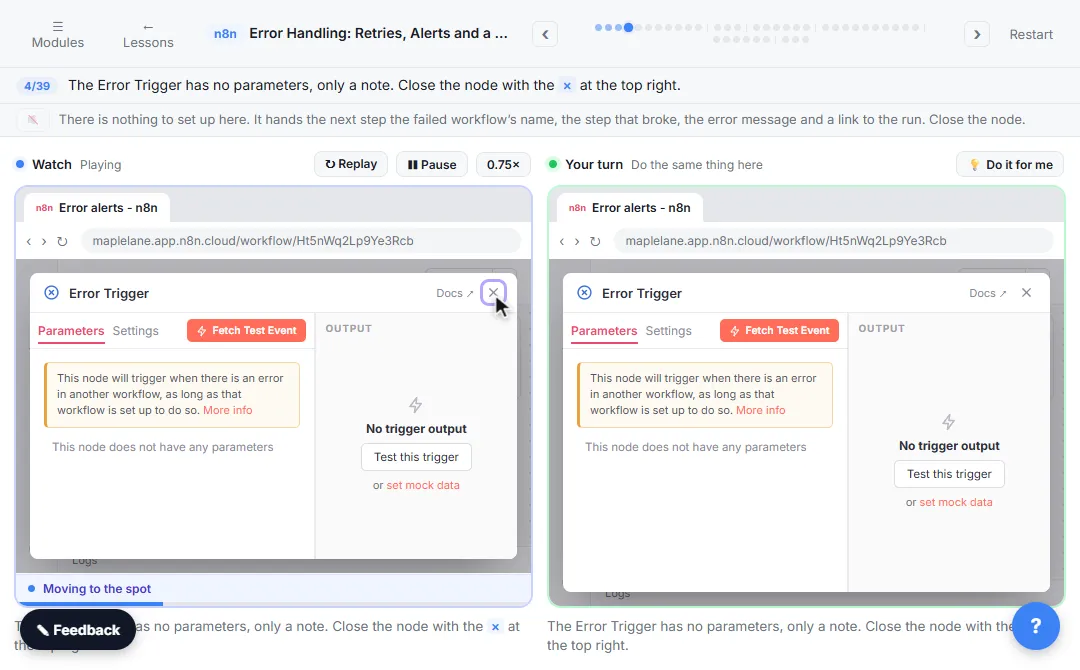
In Get Alerted When an Automation Fails, Maple Lane Florist's 6am supplier price check failed and nobody noticed for three days. You build an Error alerts workflow whose Gmail message includes the workflow name, the last node that ran, the error message and a link to the run. Then you open Executions, the run log, find this morning's run with Get supplier prices marked red, and retry it.
That lesson has no AI step, but it teaches the base layer of observability: every run is recorded, and failures reach a person. For an AI step you also want the prompt, the answer and the token count. In the Truquence lesson, the full execution export holds every node's output under data.resultData.runData, which is the kind of record a check needs.
Try this lesson free or read the step-by-step guide.
Common confusions
Observability vs monitoring
Monitoring tells you something is wrong, such as an error alert. Observability gives you enough detail to find out why.
LLM observability vs a work trace
A work trace is the activity log an agent shows you for one task. Observability is the wider practice of logging and reviewing all AI calls over time.
Tips
- Log the final prompt the model received, after all fields were filled in, not just your template.
- Watch tokens and response time weekly; a jump usually means something changed.
- Keep customer data in logs only as long as you need it, and limit who can read them.
Related terms
More AI agents terms
Where you use it: free lessons
- Get Alerted When an n8n Automation Fails, and Let It Retry by Itself (n8n, 10 min)
- Truquence: Catch an n8n Run That Says Success but Gets It Wrong (Truquence, 11 min)
Frequently asked questions
- Do I need a special tool for this?
- Not at first. Your automation platform's run log is a start. Dedicated tools help once you have many AI calls and want to search, compare and chart them.
- What is a trace?
- A record of one run, step by step, including each AI call, its input, its output and how long it took.
- Is it safe to log prompts?
- Prompts often contain customer details, so treat logs like any other customer record: limited access and a set retention period.