Why this matters
A vendor says its system cuts no-shows 40%, and the contract is on your desk. Nobody in a small office has an afternoon to read studies, so the number goes unchecked, and the yearly bill is real.
Paperguide searches published research and answers with links to each paper. It found the papers in under a minute and caught what mattered most for our made-up clinics. It also gave two different headlines for one question, so this lesson builds in reading the numbers yourself.
Practice
Do every step yourself in a practice copy of the real tool. It checks your work, and “Do it for me” finishes any step you get stuck on.
What you’ll build
You run three made-up physical therapy clinics. You ask what the research says about text reminders, push back on the first answer, and open the papers to read the numbers yourself.
Then you write a short brief for the owner, with three questions for the vendor, and save your sources. The screens are real screenshots from my own Free plan account, captured November 2026.
What you need
- Nothing to start the practiceThe lesson is a practice copy. The clinics and the vendor are made up, and the papers are real.
- A Paperguide account, to do it for realThe pricing page lists a Free plan with 1,500 AI credits a month. Our three questions used 117. Check the current plans.
- A real vendor claimUse one from a sales deck or a proposal. Ask about the idea, not the vendor, and leave out anything about your own patients or customers.
Concepts
Always ask what a result was compared with
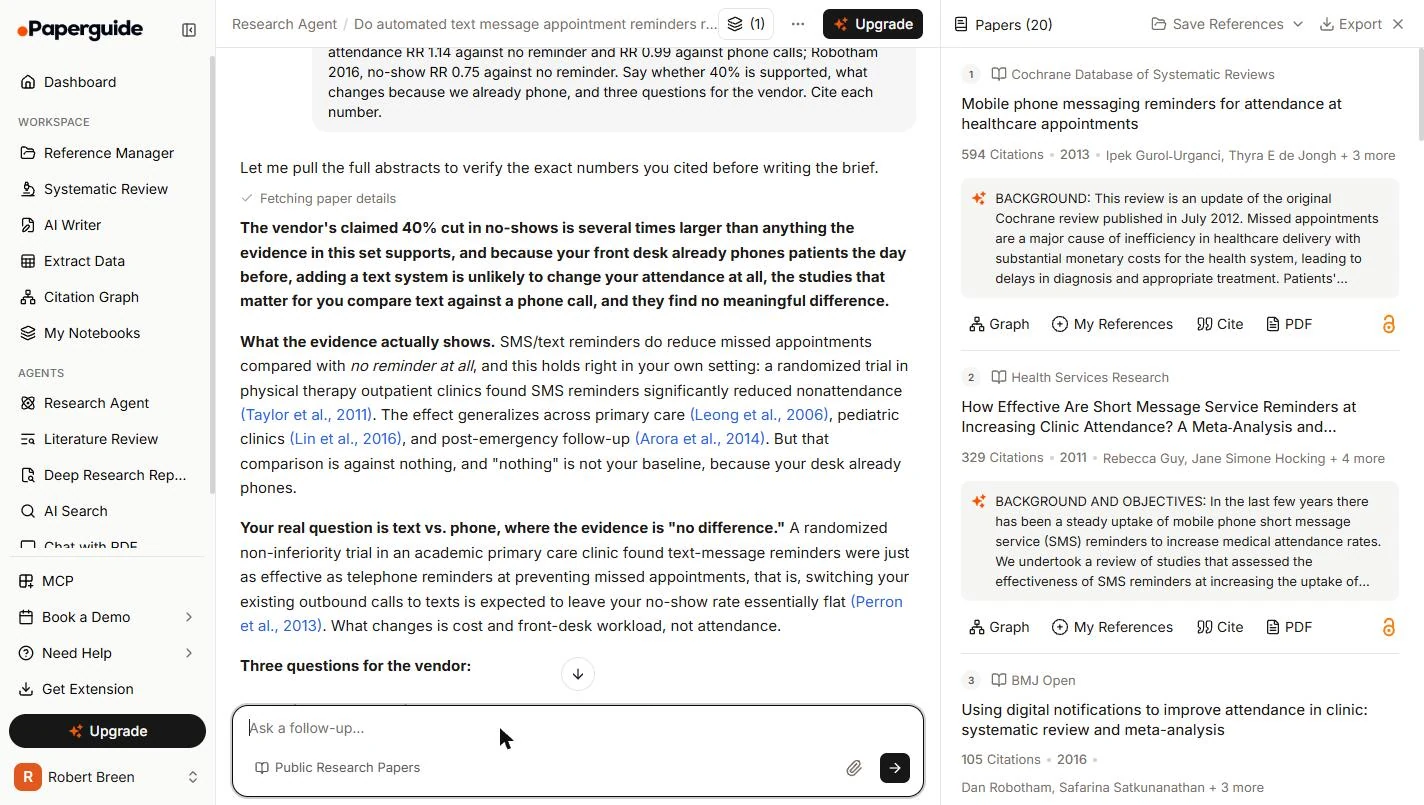
The Cochrane review we read found texts improved attendance against no reminder, with a risk ratio of 1.14. Against phone calls it was 0.99, about the same.
Our made-up front desk already phones, so the second number is the one that matters. A vendor can be right about the first and still not change your attendance.
Two runs of one question can disagree
Our first answer led with a 9-20% improvement. A new chat with the same question led with reminders roughly halving the odds of a no-show. After we pushed back, both chats moved closer, to about 9-25% and 20-25%.
The agent is a fast way to find the papers. It is not the place to take your final number from.
The paper page can show more than the agent sees
The agent said several abstracts gave no number, and in the second chat it said they were truncated for it. Opening the same papers showed 1.48 for one and 1.14 and 0.99 for another.
It was right not to vouch for what it could not see. That leaves the reading to you, and it takes a minute a paper.
Do it for real
Now repeat it in your own account. Tick each step as you go.
Quick check
3 questions to check you’ve got it.
1. Your front desk already phones patients. Which result matters most for the vendor decision?
- Text reminders against phone calls
- Text reminders against no reminder
- The citation count of the paper
Show the answer
Text reminders against phone calls. You already remind people. In the Cochrane review we read, text against phone was RR 0.99, about the same.
2. The agent says a number is not in the abstract. What should you do?
- Open the paper page and read the abstract yourself
- Assume the paper has no number
- Ask it to estimate the number
Show the answer
Open the paper page and read the abstract yourself. In our test the number was on the page. The agent told us several abstracts were truncated for it.
3. You ask the same question in a new chat and get a much bigger headline. What does that tell you?
- Take your number from the papers, not from either headline
- The newer answer is correct
- The first answer was made up
Show the answer
Take your number from the papers, not from either headline. Our two chats led with different claims from overlapping papers. Both moved after we pushed back with a number from a paper.