What are speaker labels in a meeting transcript?
Quick answer
Speaker labels are the names or tags, such as "Dana Reyes:" or "Speaker 2:", at the start of each line in a meeting transcript. They say who spoke. When you hand a transcript to AI, they are how it works out who owns each action item.
Last updated
Updated · By Robert Breen
Why it matters for a small business
Without labels, a transcript is a wall of sentences. "I'll send the quote by Wednesday" means nothing if you can't tell who said it. With labels, an AI summary can write "Priya: send the quote, by Wednesday" instead of guessing.
Labels are made by software that tells voices apart, so they can be wrong. Two people with similar voices get merged, or a guest shows up as "Speaker 3". Before anyone acts on an action items table, check the names against what you remember of the meeting.
In a real lesson: Summarize a Meeting Transcript with ChatGPT
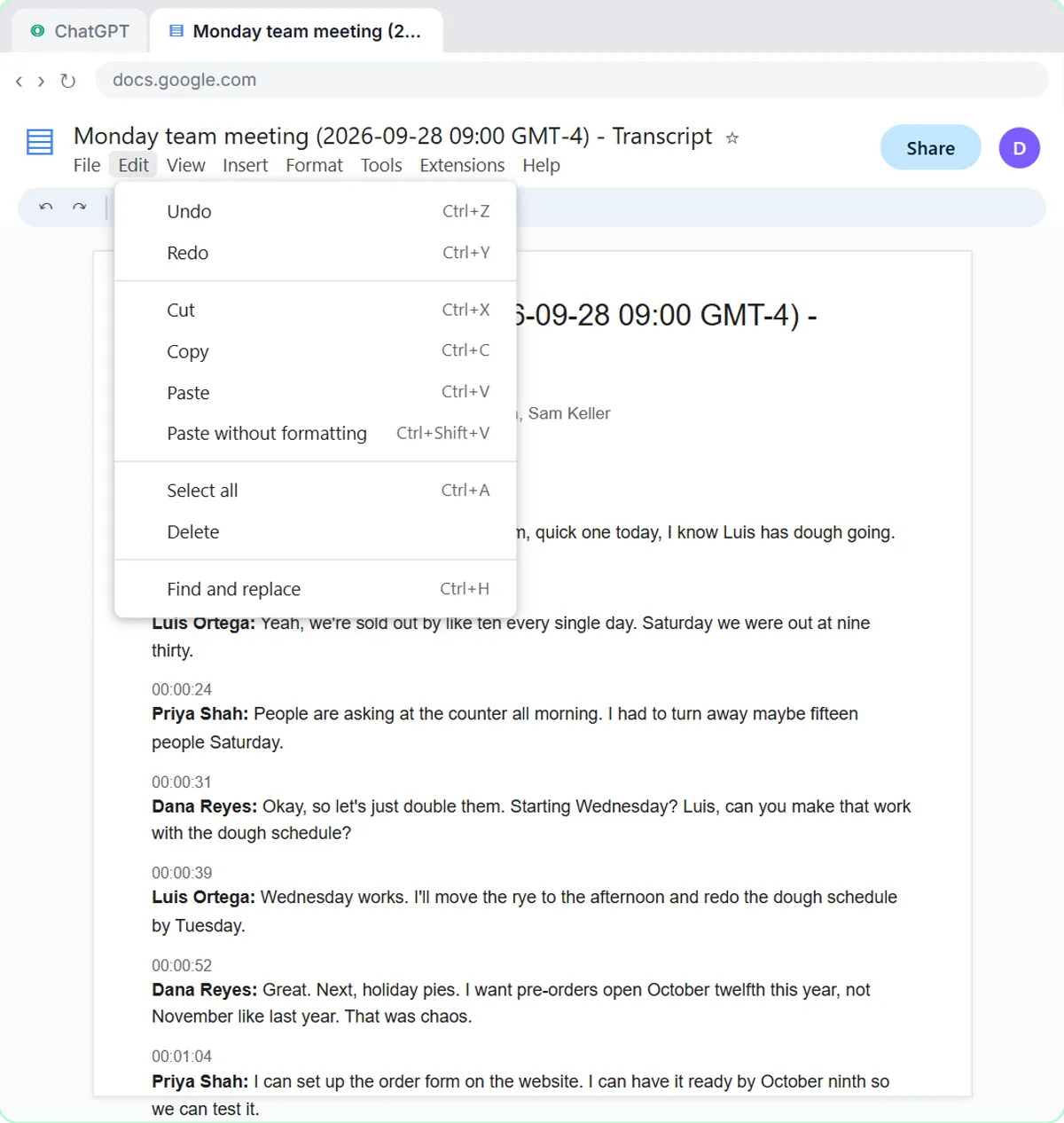
In the Summarize a Meeting Transcript lesson, you copy the transcript that Google Meet saved after a bakery's Monday team meeting. Every line starts with a timestamp and a speaker label, such as "Dana Reyes:", "Luis Ortega:" and "Priya Shah:".
Those labels are what make the action items table work. When you paste the transcript under the request, ChatGPT puts an owner and a due date on each task, and two dates come back as Not stated because nobody said them out loud. You fill them in and ask for a follow-up email, which only works because the table says who owns what.
Try this lesson free or read the step-by-step guide.
Common confusions
Speaker labels vs speaker names
A label can be a real name or a placeholder like "Speaker 1". Real names appear only when the meeting tool knows who joined with which account.
Speaker labels vs timestamps
Timestamps say when a line was said; labels say who said it. A meeting transcript usually has both.
Tips
- Ask everyone to join with their real name, so the labels come out right.
- When a transcript says "Speaker 2", replace it with the person's name before you paste it into AI.
- If a task has no clear owner in the labels, mark it "owner to be confirmed" instead of guessing.
Related terms
More Business terms
Where you use it: free lessons
- Summarize a Meeting Transcript with ChatGPT (ChatGPT, 9 min)
Prompt templates that use it
Frequently asked questions
- How do I add speaker labels to a transcript?
- Most meeting tools add them automatically when each person joins with their own name. For a transcript without them, type the names in by hand, or ask AI to label speakers from context and check its work.
- Why does my transcript say Speaker 1 and Speaker 2?
- The tool could tell voices apart but didn't know the names. Replace the placeholders with real names before you use the transcript.
- Are speaker labels always accurate?
- No. Similar voices get merged and crosstalk gets misassigned. Check the labels before you act on an action items table built from them.