What is a statement of work (SOW)?
Updated · By Robert Breen
A statement of work, or SOW, is a written document that spells out exactly what a provider will deliver for a client: the tasks, deliverables, timeline, price and what counts as done. It is the shared reference when anyone asks "was that included?"
Why it matters for a small business
Most client disagreements are not about quality. They are about what was promised. One side remembers a quick call, the other remembers an email, and the work expands or shrinks with each memory. A statement of work puts the promises in one place, so both sides can point at the same page.
A useful one is short and concrete. It lists deliverables as things you could hand over, gives dates, says what the client must provide and when, and names what is not included. Because it can become part of a contract, have a qualified professional review any version that carries legal weight rather than relying on a template or an AI draft.
In a real lesson: Turn a Client Meeting into Action Items and a Follow-Up Email (Accounting Firms)
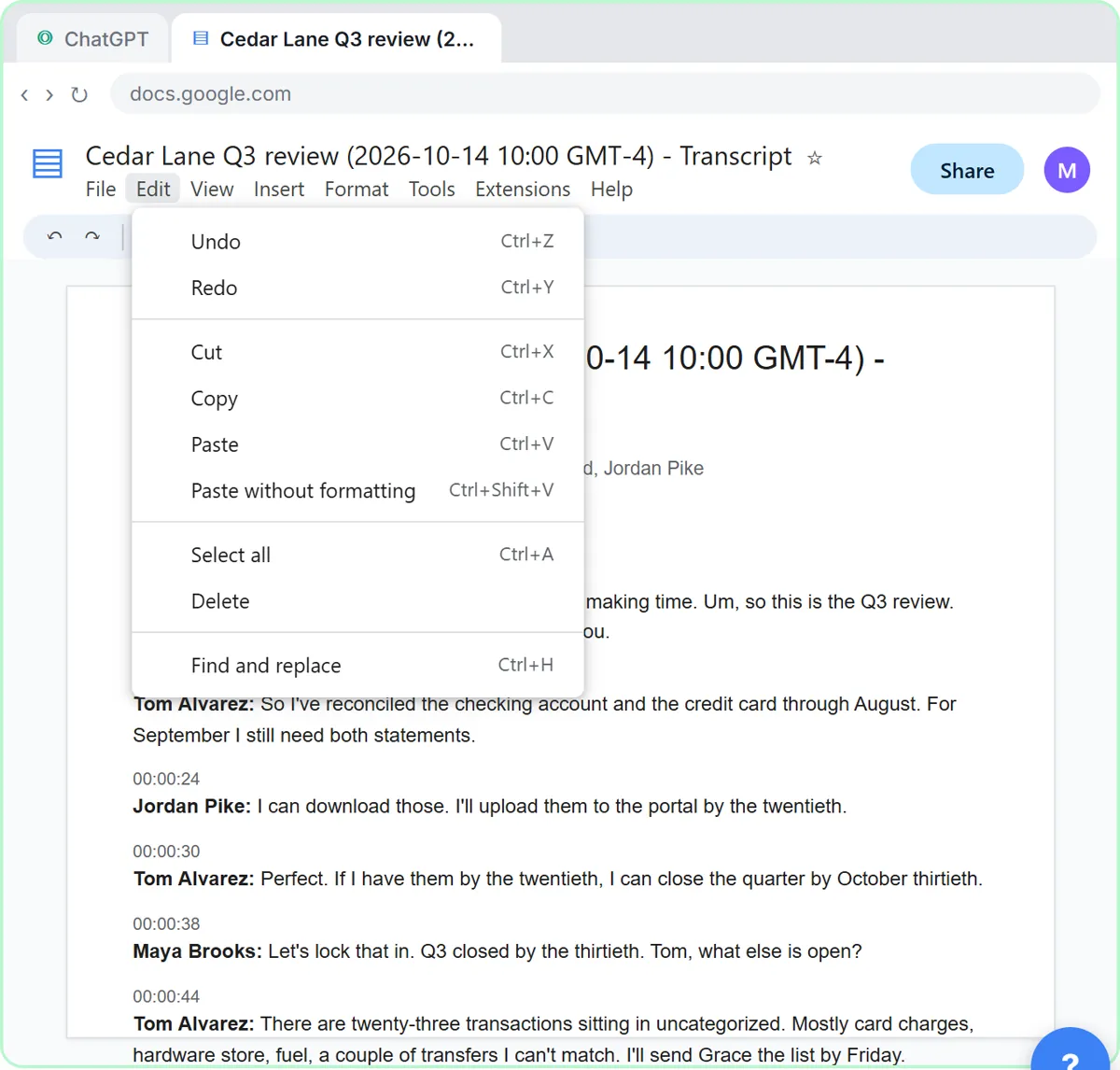
The Summarize a Client Meeting lesson is not a statement of work, but it shows the raw material one is built from. You take the transcript of a Q3 review between Millbrook Accounting, a made-up small accounting firm, and a made-up client, Cedar Lane Landscaping, and ask ChatGPT for a summary, decisions, an action items table and open questions.
In the transcript, the bookkeeper explains that if the client uploads the September statements to the portal by the twentieth, the quarter can close by October thirtieth. That is a deliverable with a date and a client dependency, the kind of line a statement of work captures. The request tells ChatGPT to write "Not stated" when an owner or date is missing, so gaps show up instead of being guessed.
You then fill in two dates nobody said aloud and ask for a follow-up email to the client. That email is a lightweight written record of who owes what. A formal scope document would go further, with price, exclusions and signatures, and would be written and reviewed by people, not summarized from a transcript.
Try this lesson free or read the step-by-step guide.
Common confusions
Statement of work vs contract
A contract sets the legal terms. A statement of work describes the work itself and is often attached to a contract. Do not treat one as a substitute for the other, and ask a lawyer when the stakes are real.
Statement of work vs proposal
A proposal is a sales document that argues why the client should hire you. The statement of work is what both sides agree to once the answer is yes. A proposal can be persuasive. A statement of work should be precise.
Tips
- Write deliverables as nouns you can check, like "monthly reconciled statements," not "support with accounting."
- List what the client must supply and by when. Late inputs are the biggest cause of late projects.
- Add an "out of scope" line. It is the cheapest way to prevent an argument six weeks later.
Related terms
Where you use it: free lessons
- Turn a Client Meeting into Action Items and a Follow-Up Email (Accounting Firms) (ChatGPT, 9 min)
- Summarize a Meeting Transcript with ChatGPT (ChatGPT, 9 min)
Frequently asked questions
- Can AI write a statement of work for me?
- It can draft a structure and plain-language wording from your notes. You still decide the scope and price, and a qualified person should review the final version before a client signs.
- How detailed should a statement of work be?
- Detailed enough that a stranger could tell whether a task was included, and short enough that people read it. Most small-business versions fit on one to three pages.