What is customer lifetime value (CLV)?
Quick answer
Customer lifetime value, or CLV, is an estimate of the total revenue or profit a business can expect from one customer over the whole time they keep buying. In plain words, it is the average order size, times how often they buy, times how long they stay.
Last updated
Updated · By Robert Breen
Why it matters for a small business
Looking only at the first sale undervalues customers who come back. A coffee subscriber who orders every month is worth far more than a one-time gift buyer, even if their first order was smaller. CLV puts that difference into a number, which changes decisions about how much to spend winning customers and how much effort to put into keeping them.
It also shifts attention to retention. If customers leave quickly, the lifetime is short and the value drops, no matter how good the first order looked. That is why CLV and customer churn are usually discussed together. Many teams compare CLV with customer acquisition cost: if winning a customer costs more than they are likely to be worth, growth loses money.
In a real lesson: Build an n8n AI Agent That Plans Your Content Calendar
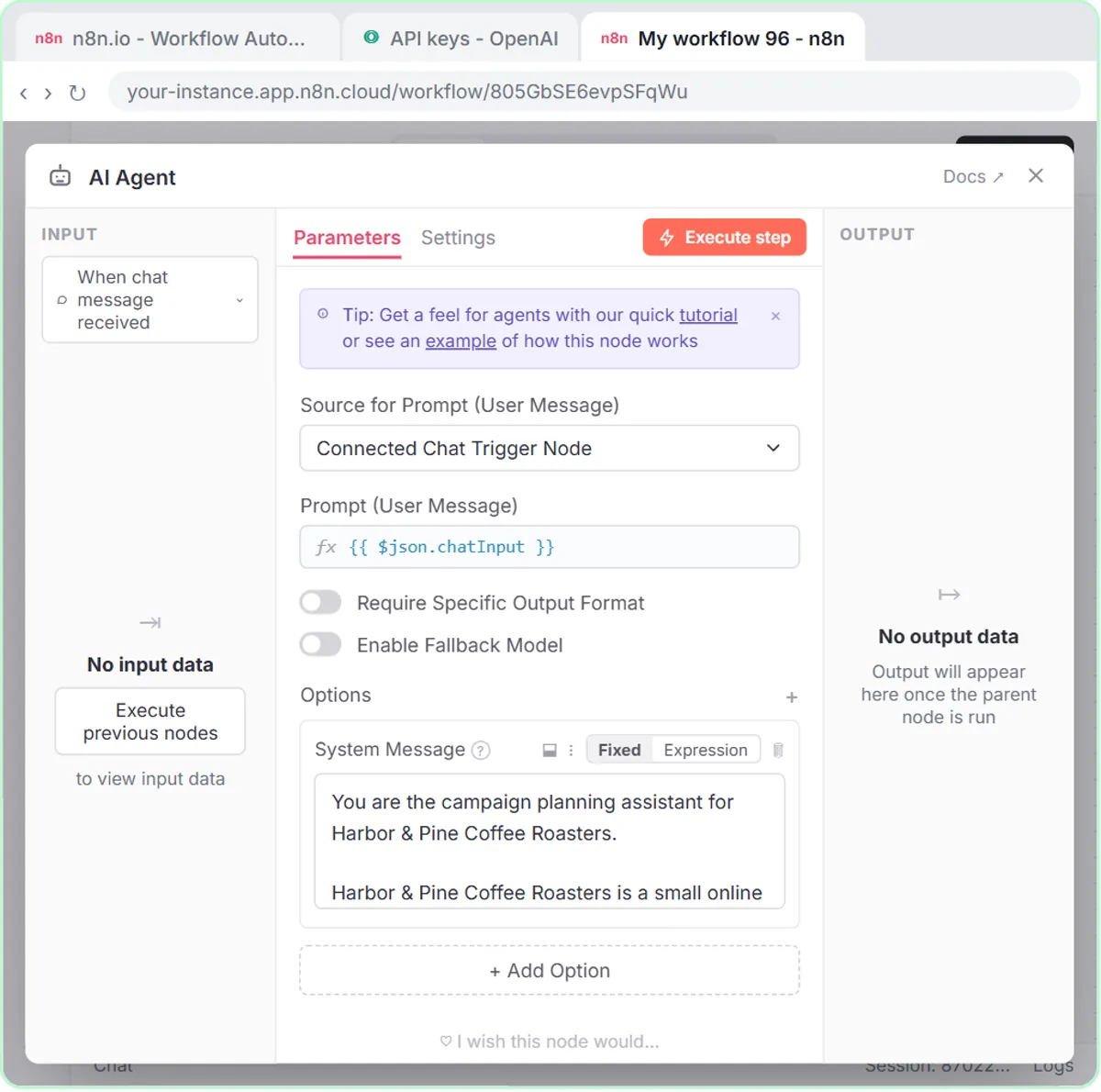
In the AI Campaign Calendar Agent lesson, the system prompt describes Harbor & Pine Coffee Roasters, a made-up small online coffee brand that sells "whole-bean and ground coffee, gift boxes, and a monthly subscription." Those three products have very different lifetime values, even though the lesson never calculates any of them.
Here is a made-up example to show the math. Suppose a subscriber pays 20 dollars an order, orders once a month and stays for 18 months. Their lifetime revenue is 20 times 12 per year times 1.5 years, or 360 dollars. A gift buyer who orders one 40 dollar box and never returns is worth 40 dollars. Those numbers are invented for illustration only.
The lesson's two-week Holiday Ember Blend calendar mixes a launch email, brewing tips, a customer question and a gift idea. Seen through CLV, the brewing posts help keep existing drinkers happy, while the gift email reaches new, possibly one-time buyers. Both matter, for different reasons.
Try this lesson free or read the step-by-step guide.
Common confusions
Lifetime revenue vs lifetime profit
Some teams calculate CLV from revenue, others subtract the cost of the goods and service first. Profit-based CLV is more honest when comparing it to marketing spend. Say which one you mean.
CLV vs average order value
Average order value is one purchase. CLV is all purchases over the relationship. A low order value with frequent repeat orders can beat a big one-time sale.
Tips
- Calculate CLV separately for groups that behave differently, like subscribers and one-time buyers.
- Use your own order history, not a guess. Even a rough number from real data beats an industry rule of thumb.
- Ask AI to help write the spreadsheet formula, then check it by hand on two or three customers.
Related terms
More Business terms
Where you use it: free lessons
- Build an n8n AI Agent That Plans Your Content Calendar (n8n, 12 min)
- Build a Lead Magnet Signup Form with an AI Welcome Email (Lovable and n8n, 15 min)
Prompt templates that use it
Frequently asked questions
- How do I estimate lifetime when customers are new?
- Use how long past customers stayed, or the inverse of your churn rate as a rough guide. Update the estimate as real history builds up, and label early numbers as estimates.
- Is CLV only for subscription businesses?
- No. Any business with repeat customers can use it, from accounting firms with yearly clients to shops with regular buyers. Subscriptions just make the math easier to see.