What is customer acquisition cost (CAC)?
Quick answer
Customer acquisition cost, or CAC, is the total you spend on sales and marketing in a period divided by the number of new customers you won in that period. It answers a simple question: on average, what did each new customer cost us to get?
Last updated
Updated · By Robert Breen
Why it matters for a small business
Marketing feels cheap when you look at one ad or one tool, and expensive when the bills arrive together. CAC adds it all up and ties it to results. If ad spend doubles but new customers only rise a little, CAC tells you the extra money bought less. If a new channel brings customers at a lower cost, CAC shows that too.
The number is most useful next to customer lifetime value. A customer who costs more to win than they will ever bring in is a loss, however exciting the growth looks. Be honest about what goes in: ad spend, tools, agency fees and the share of salaries spent on selling all count. Leaving out people's time makes CAC look better than it is.
In a real lesson: n8n AI Agent Tutorial: Save Social Media Ideas to Google Sheets
In the AI Social Media Idea Agent lesson, BrightPath Marketing, a made-up digital marketing agency, helps clients with "SEO, paid advertising, social media marketing, and website design." The agent writes post ideas that end with calls to action like "Send us a message." Every one of those channels has a cost, and CAC is how an agency or its client judges whether the spend paid off.
Here is a made-up example. Say a client spends 3,000 dollars in a month on ads, plus 1,000 dollars of agency fees and staff time, and wins 20 new customers that month. Their CAC is 4,000 dollars divided by 20, or 200 dollars per customer. These figures are invented for illustration only.
The lesson also shows a small, real cost. It notes that the AI model charges "per request, not per month," and that a run costs fractions of a cent. AI tools are part of the marketing budget too, so they belong in the CAC total, even when they are tiny next to ad spend.
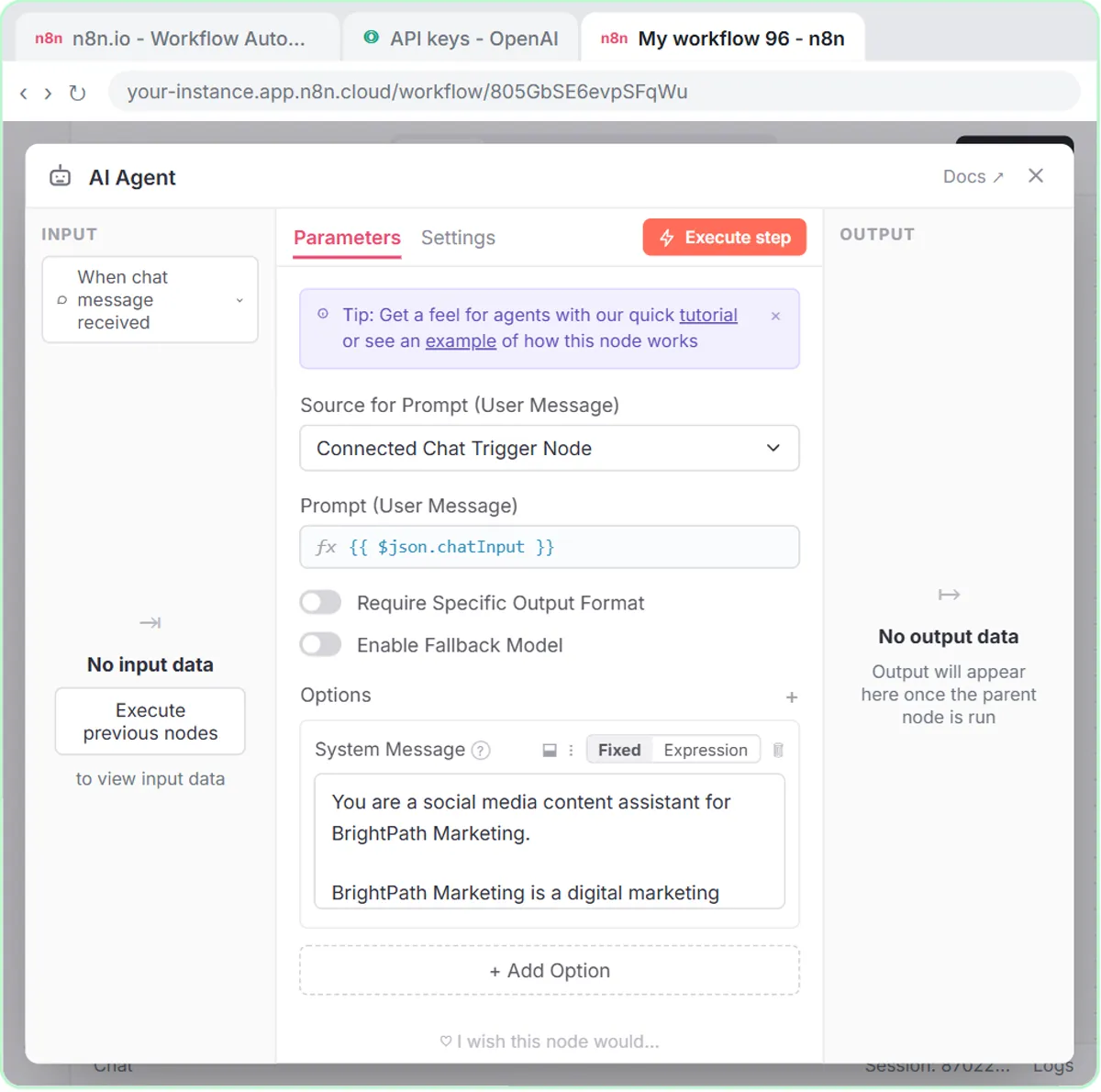
Try this lesson free or read the step-by-step guide.
Common confusions
CAC vs cost per lead
Cost per lead divides spend by the number of leads. CAC divides by paying customers. Cheap leads that never buy can hide a high CAC.
Blended CAC vs channel CAC
Blended CAC uses all spend and all new customers. Channel CAC looks at one source, like paid search. Blended is simpler. Channel CAC is what tells you where to move money.
Tips
- Pick a period, like a month or quarter, and count spend and new customers over the same dates.
- Track where each customer came from, for example with UTM parameters, so you can work out CAC per channel.
- Lower CAC by improving conversion, not only by cutting spend. A better form or follow-up can win more customers from the same budget.
Related terms
More Business terms
Where you use it: free lessons
- n8n AI Agent Tutorial: Save Social Media Ideas to Google Sheets (n8n, 12 min)
- Build an n8n AI Agent That Plans Your Content Calendar (n8n, 12 min)
Frequently asked questions
- Should salaries be part of CAC?
- Usually yes, at least the share of time spent on selling and marketing. Some teams report CAC with and without salaries. Just be consistent from one period to the next.
- What is a good CAC?
- There is no universal number. What matters is how CAC compares with what a customer is worth to you and how long it takes to earn the cost back.