Do AI detectors work?
Quick answer
An AI detector is a tool that estimates whether a piece of text, or sometimes an image, was made by AI. It gives a score or a label like "likely AI-written". The scores are guesses based on patterns, and they are often wrong in both directions: human writing flagged as AI, and AI text that passes as human.
Last updated
Take the free module →Module 5 of the free Better Prompts course, about 6 minutes. No account needed.
Updated · By Robert Breen
Why it matters for a small business
Detectors look for statistical patterns, such as very even sentence length and predictable word choices. Plain, clear human writing has those patterns too, and light editing removes them from AI text. OpenAI shut down its own AI text classifier in 2023, citing its low rate of accuracy.
That matters at work because a false flag can hurt someone. Using a detector score to reject a job applicant, discipline an employee or question a contractor is risky and unfair. If AI use matters, set a clear policy, ask people directly, and judge the work on its quality and accuracy.
For images, labels added when content is made, such as C2PA content credentials, are more reliable than after-the-fact detection, though they can also be stripped.
In a real lesson: Give Examples: Few-Shot Prompts That Copy Your Style
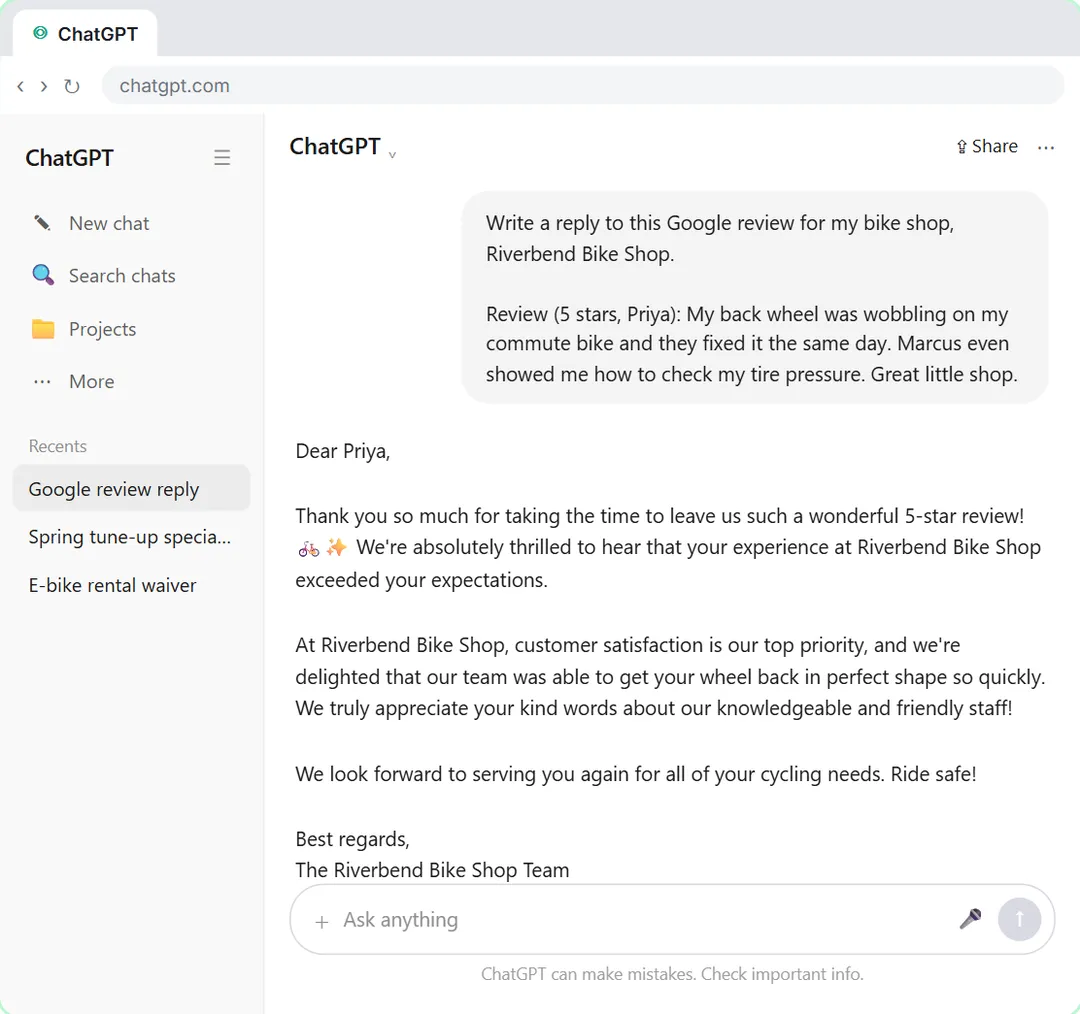
In Give Examples: Few-Shot Prompts That Copy Your Style, the bike shop owner pastes three of his real review replies, and ChatGPT's next reply sounds like him rather than the usual corporate thank-you.
That shows why detectors struggle. Once AI writes in a real person's style, there is little left to tell apart, and the owner's own short, friendly replies could be flagged too. The useful check isn't "was this AI?" but "is it accurate and does it sound like us?", which the owner answers by reading it.
Try this lesson free or read the step-by-step guide.
Common confusions
AI detector vs AI watermark
A watermark or content credential is added when content is made. A detector guesses afterward from the content itself and is much less reliable.
AI detector vs plagiarism checker
A plagiarism checker finds text copied from known sources. An AI detector guesses how the text was produced.
Tips
- Don't make decisions about people from a detector score alone.
- Write an AI use policy that says when AI is allowed and how to disclose it.
- Judge work on accuracy, sources and quality.
Related terms
More AI basics terms
Where you use it: free lessons
- Give Examples: Few-Shot Prompts That Copy Your Style (ChatGPT, 6 min)
- Roll Out a Team AI Policy in One Afternoon using Claude (Claude, 10 min)
- Make Images with ChatGPT for Your Business (ChatGPT, 7 min)
Frequently asked questions
- Are AI detectors accurate?
- Not reliably. They make mistakes both ways, and simple edits change their scores. Treat a score as a weak hint at most.
- Can my own writing be flagged as AI?
- Yes. Clear, plain, consistent writing is often flagged, which is why detector scores shouldn't be used as proof.
- Should a business use AI detectors on job applications?
- It is risky. A false flag can unfairly reject a good candidate. A clear policy and a conversation are fairer.